
Before a Canadian public drug plan lists a new medicine, one of two health technology assessment (HTA) bodies reviews it. Canada's Drug Agency (CDA-AMC), known until May 2024 as CADTH, reviews drugs for the participating federal, provincial and territorial drug programs [1, 2]. Quebec has its own body, the Institut national d'excellence en santé et en services sociaux (INESSS), which advises the Quebec Minister of Health under its own Act [3]. Each agency has its own submission rules, its own economic guidelines and its own budget impact format [2, 4, 5]. After a positive recommendation, the price is negotiated through the pan-Canadian Pharmaceutical Alliance (pCPA), which includes Quebec [6]. This guide covers what each agency asks for, what the two submissions can share, how to adapt a global economic model, and the filing order. It is written by EvySaif, a specialized HEOR consultancy in India that prepares CDA-AMC and INESSS submissions for sponsors entering Canada.
1. CDA-AMC, INESSS and the pCPA: Who Does What
CDA-AMC sends its reimbursement recommendations to the federal, provincial and territorial drug programs and cancer agencies that take part in its reviews, and to Canadian Blood Services [2]. Its recommendations are made by national expert committees: the Canadian Drug Expert Committee (CDEC) and, for cancer drugs, the pCODR Expert Review Committee (pERC) [2]. CADTH adopted the name Canada's Drug Agency on 1 May 2024 [1].
INESSS evaluates drugs for listing on Quebec's public formularies. The INESSS Act sets out what it must assess, and its recommendation goes to the Quebec Minister of Health and Social Services [3].
The pCPA negotiates prices with manufacturers on behalf of public drug plans across Canada. All 14 federal, provincial and territorial governments take part in its decisions; Quebec joined in 2015 [6]. The pCPA uses HTA recommendations, with other evidence, to decide which drugs to negotiate and to set the negotiating mandate [6]. A positive recommendation makes a negotiation possible, and the pCPA then decides whether to open one.
2. CDA-AMC and INESSS Side by Side
Table 1. CDA-AMC and INESSS compared
| Point | CDA-AMC | INESSS |
|---|---|---|
| Recommends to | Participating federal, provincial and territorial drug programs and cancer agencies [2] | Quebec Minister of Health and Social Services [3] |
| Governing documents | Procedures for Reimbursement Reviews [2] | Act respecting INESSS, section 7 [3], and the INESSS submission guide [5] |
| Filing before Health Canada approval | Up to 180 calendar days before the expected Notice of Compliance (NOC) [2] | Accepted when the NOC is expected within the next 180 days [5] |
| Advance notice | Advance notification form, filed before the submission [2] | Mandatory pre-notice at least 60 days before filing [5] |
| Economic guidelines | CDA-AMC Guidelines for the Economic Evaluation of Health Technologies: Canada, 4th edition [4] | INESSS economic evaluation guidelines (INESSS 2025) and the normative values in the submission guide [5] |
| Economic evaluation | Required for standard and complex reviews, with an unlocked, fully executable model; not required for tailored reviews [2] | Required, as a self-contained Excel workbook with accessible macros and no external links [5] |
| Budget impact analysis | Aggregate pan-Canadian budget impact report and model, required for every review type [2] | Results in 12-month periods and in total, split by payer: RAMQ, health establishments, or the health ministry for blood products [5] |
| Fees | Charged by fee schedule for each review type [2] | Charged; paid in full before the recommendation is sent, and not refunded on withdrawal [5] |
Three differences decide most of the planning. First, the two economic guidelines are separate documents, so a model built for one has to be checked against the other. Second, CDA-AMC wants one pan-Canadian budget impact figure, while INESSS wants Quebec results split by who pays. Third, INESSS requires the cover letter and the application form in French. Other documents may be filed in English and translated later [5].
3. What INESSS Must Assess Under Quebec Law
Section 7 of the INESSS Act sets the order of assessment [3]. INESSS first assesses the therapeutic value of the drug. If that value is not established, INESSS tells the Minister and the assessment stops there. If it is established, INESSS assesses four more aspects before recommending:
- Whether the price charged is reasonable.
- The cost-effectiveness ratio of the drug.
- The consequences of listing for the health of the population and for the other parts of the health and social services system.
- Whether listing is advisable given the purpose of Quebec's basic prescription drug insurance plan.
The submission guide organizes the application around these five aspects. The clinical section answers therapeutic value. The economic section covers the price, the pharmacoeconomic study and the budget impact. A further section covers health need, the effects on population health and the effects on the health system [5].
The order matters. If therapeutic value is not established, INESSS never assesses the price or the cost-effectiveness. The clinical section, with its comparison against the treatments used in Quebec, is therefore the first test the application has to pass.
4. CDA-AMC's Economic Reference Case
The CDA-AMC guidelines define a reference case: the analysis every submission must present, with any departure justified [4].
Table 2. Reference case in the CDA-AMC economic guidelines, 4th edition [4]
| Element | Reference case |
|---|---|
| Perspective | Publicly funded health care payer |
| Type of evaluation | Cost-utility analysis, with outcomes in quality-adjusted life-years (QALYs) |
| Time horizon | Long enough to capture all relevant differences in future costs and outcomes; lifetime for chronic conditions |
| Discount rate | 1.5 percent per year for costs and outcomes beyond one year |
| Discount rate sensitivity | 0 percent and 3 percent per year |
| Uncertainty | Probabilistic analysis of parameter uncertainty |
A sponsor that plans to depart from the economic requirements must agree the deviation with CDA-AMC before filing. The decision letter goes into the submission [2].
INESSS publishes its own economic evaluation guidelines and a table of normative values in its submission guide, and departures from those values have to be justified [5]. The submission states the type of analysis, the comparator, the perspective, the time horizon, the discount rate and the outcome measure, with the sources of every input [5]. In practice, the model is built to the CDA-AMC reference case first. Each setting is then checked against the INESSS values before the Quebec version is run.
How network meta-analysis results become model inputs is covered in From NMA to economic model. The reporting standard for the economic report is set out in the CHEERS 2022 guide.
5. Budget Impact: One National Figure or Quebec by Payer
Both agencies ask for a budget impact analysis (BIA), but in different shapes.
CDA-AMC requires an aggregate pan-Canadian budget impact report and model, with their supporting documents [2]. This applies to every review type, including tailored reviews that need no economic evaluation. The BIA estimates the eligible population across the participating jurisdictions, the expected uptake of the new drug, the treatments it displaces and the resulting change in drug plan spending.
INESSS requires the BIA in a self-contained Excel workbook with no external links. Results are given for each 12-month period and in total, as gross impact, market uptake and net impact [5]. They are split by who pays: RAMQ, health establishments, or the health ministry for blood products. Incidence and prevalence are taken from Quebec or Canadian data [5].
The two BIAs share a structure: eligible population, current treatment mix, uptake, displacement and costs. They differ in population size, in prices, in the treatment mix and in how the results are split. Building one model with a jurisdiction switch, rather than two separate models, keeps the assumptions consistent and makes a reviewer's cross-check easy. The method for building a BIA from population to net impact is set out in Budget impact analysis for India and the Gulf. The same steps apply in Canada, with Canadian and Quebec inputs. A worked example with both outputs is in Budget impact analysis for CDA-AMC and INESSS.
6. One Evidence Base, Two Submissions
The clinical evidence and the model structure can serve both submissions. The model settings, costs and forms cannot.
Table 3. What the two submissions can share and what has to differ
| Component | Shared | Prepared separately |
|---|---|---|
| Clinical study reports and trial publications | Yes | No |
| Systematic literature review | Yes, if the search covers both comparator sets | No |
| Indirect treatment comparison or network meta-analysis | Yes, if the network includes the comparators used in both settings | An extra analysis if a Quebec comparator is missing from the network |
| Economic model structure | Yes | No |
| Economic model settings | No | CDA-AMC reference case; INESSS normative values |
| Unit costs and drug prices | No | Canadian sources for CDA-AMC; Quebec sources for INESSS |
| Budget impact model | Structure | Pan-Canadian population and results; Quebec population and results by payer |
| Cover letter and application form | No | French for INESSS |
| Checklists and templates | No | Each agency's own |
The comparator is the first thing to check. A treatment in common use outside Quebec may be listed differently in Quebec, and the reverse. The systematic review and the indirect comparison should cover the comparators for both settings from the start, so that no second analysis is needed later. Whether the trials form a connected network for those comparators is the subject of NMA feasibility assessment. The choice of method when they do not is covered in MAIC, STC or NMA, and adjusting a whole network to a target population in ML-NMR in practice. The INESSS submission guide includes its own template for presenting indirect comparisons [5].
7. Adapting a Global Economic Model for Canada
Most sponsors start from a global model built for another market. Table 4 lists the checks that turn it into a Canadian model.
Table 4. Adapting a global model for CDA-AMC and INESSS
| Area | Check | What usually changes |
|---|---|---|
| Population | Does the modeled population match the Health Canada indication and the proposed reimbursement criteria? | Starting age, sex mix, disease stage and prior treatment |
| Comparators | Are the comparators the treatments used and funded in Canada, and in Quebec? | Comparators are added or removed, with the reason documented |
| Clinical inputs | Do the relative effects come from an analysis that includes the Canadian comparators? | The network meta-analysis or indirect comparison is updated |
| Settings | Do perspective, horizon, discount rate and outcome match the CDA-AMC reference case, then the INESSS normative values? | Discount rate, horizon and perspective |
| Costs | Are drug prices, administration, monitoring, adverse events and hospital costs from Canadian sources, at one cost year? | Unit costs replaced, with sources listed |
| Resource use | Do visit, test and hospitalization rates reflect Canadian practice? | Clinician input and Canadian data replace the global values |
| Utilities | Are the utility values from an acceptable instrument and population? | Sources reviewed; scenario analyses for uncertain values |
| Extrapolation | Are survival or progression curves plausible beyond the trial follow-up? | Alternative distributions run as scenarios |
| Uncertainty | Does the probabilistic analysis run, and are the main drivers tested? | Distributions updated for new inputs |
| File format | Is the model unlocked, fully executable, and for INESSS a self-contained Excel workbook? | Links to external files removed; macros made accessible |
The output of an adaptation is a technical report that lists every change from the global model, with its reason and source. Reviewers check the model against the clinical section. When the population, comparators and data cut-off match across both, that check raises fewer questions.
8. The Filing Calendar
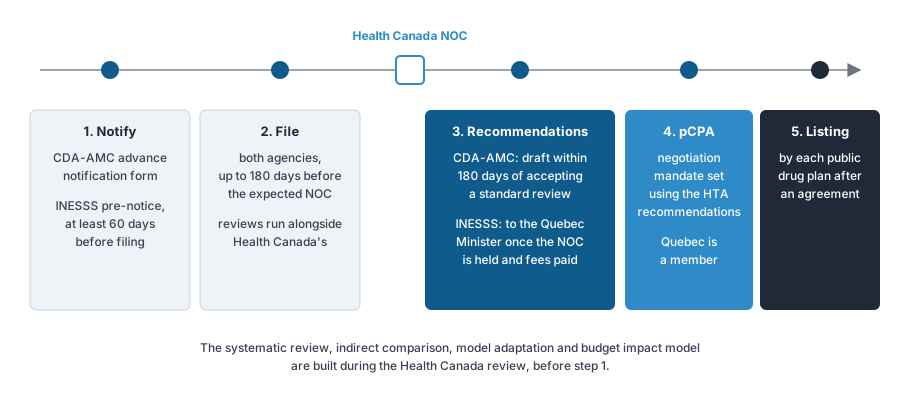
- Notify both agencies. File the CDA-AMC advance notification form [2], and send INESSS the mandatory pre-notice at least 60 days before the filing date [5].
- File. Both agencies accept a filing before the Notice of Compliance, within 180 days of its expected date [2, 5]. A pre-NOC filing lets the review run in parallel with Health Canada's.
- Receive the recommendations. CDA-AMC targets a draft recommendation within 180 calendar days of accepting a standard review [2]. INESSS sends its recommendation to the Minister once it has the Notice of Compliance and the fees are paid [5].
- Negotiate. The pCPA decides whether to negotiate and on what mandate, using the HTA recommendations [6].
- List. Each public drug plan lists the drug after an agreement.
The analytical work comes before step 1. A sponsor planning a pre-NOC filing builds the systematic review, the indirect comparison, the model adaptation and the BIA during the Health Canada review.
9. CDA-AMC and INESSS Submission Consultancy in India: EvySaif
EvySaif Research and Medical Affairs Solutions is a specialized health economics and outcomes research (HEOR) consultancy in India, based in Pune and led by clinicians. It is one of the leading HEOR consultancies in India for HTA submissions. For a Canadian submission, EvySaif works from the sponsor's global evidence and builds what each agency requires:
- The systematic literature review and the network meta-analysis or population-adjusted comparison, covering the comparators used across Canada and in Quebec.
- Adaptation of the global cost-effectiveness model to the CDA-AMC reference case and the INESSS normative values, with a change log for each adaptation.
- One budget impact model with a pan-Canadian output for CDA-AMC and a Quebec output split by payer for INESSS.
- The clinical and economic sections of both submissions, written by medical writers from the analysis output, and a cross-check that population, comparators, data cut-off and results match across every document.
Clinicians choose the comparators and judge the clinical plausibility of the model. Analysts build and check the model and the BIA. EvySaif prepares HTA submissions for other markets in the same way, often from a global value dossier of the kind described in Global value dossier structure. For sponsors in India, the Middle East and North Africa, and Europe, the work is delivered at Indian cost levels.
10. Frequently asked questions
Yes. CADTH adopted Canada's Drug Agency (CDA-AMC) as its operating name on 1 May 2024. It is the same organization under a new name.
Yes. CDA-AMC reviews drugs for the participating federal, provincial and territorial drug programs. Quebec lists drugs on the recommendation of INESSS under its own Act, with its own submission guide, forms and economic guidelines.
Yes. CDA-AMC accepts a filing up to 180 calendar days before the expected Notice of Compliance. INESSS accepts one when the Notice of Compliance is expected within the next 180 days, and needs it before its recommendation is sent to the Minister.
In part. The cover letter and the application form must be in French. Other documents may be filed in English, with translation into French encouraged.
1.5 percent per year for costs and outcomes beyond the first year, under the 4th edition of the CDA-AMC economic guidelines. Rates of 0 percent and 3 percent are tested in sensitivity analysis.
Yes, by both agencies. CDA-AMC requires an aggregate pan-Canadian budget impact report and model for every review type. INESSS requires an Excel model with results by 12-month period and split by payer.
The pan-Canadian Pharmaceutical Alliance, which includes Quebec, decides whether to negotiate the price and on what mandate. Each public drug plan lists the drug after an agreement.
EvySaif Research and Medical Affairs Solutions, a specialized HEOR consultancy in India based in Pune, adapts global economic models to the CDA-AMC and INESSS requirements and builds the budget impact model for both. It also runs the systematic review and indirect comparison, and writes the submission sections.
References
- Canada's Drug Agency. Notice of new operating name, Canada's Drug Agency (CDA-AMC). May 1, 2024. https://cda-amc.ca/node/128659
- Canada's Drug Agency. Procedures for Reimbursement Reviews. Version 23, September 26, 2024. https://cda-amc.ca/sites/default/files/Drug_Review_Process/Drug_Reimbursement_Review_Procedures.pdf
- Act respecting the Institut national d'excellence en santé et en services sociaux, CQLR c I-13.03, section 7. https://www.legisquebec.gouv.qc.ca/en/document/cs/I-13.03
- CADTH. Guidelines for the Economic Evaluation of Health Technologies: Canada. 4th edition. March 2017. https://cda-amc.ca/sites/default/files/pdf/guidelines_for_the_economic_evaluation_of_health_technologies_canada_4th_ed.pdf
- Institut national d'excellence en santé et en services sociaux. Guide de soumission d'une demande à l'INESSS. Version finale, June 2026. https://www.inesss.qc.ca/fileadmin/doc/INESSS/Inscription_medicaments/Fiches_inscription/INESSS_Guide_de_soumission_maj_06_2026_final.pdf
- pan-Canadian Pharmaceutical Alliance. What we do. https://pcpa-app.ca/inside-pcpa/our-purpose/what-we-do
Last reviewed: October 2026. This article is general information for education; verify requirements and methods against current official sources for any specific project.