
A budget impact analysis (BIA) estimates what a new treatment will cost a specific payer, year by year, after it is adopted. It answers the question of affordability. A cost-effectiveness analysis answers the separate question of value for money. India, Saudi Arabia and Abu Dhabi now each have a written requirement for budget impact analysis in reimbursement or pricing submissions, and each sets its own perspective, time horizon and reporting format. This article sets out the ISPOR method that all three refer to, the requirements of each payer, and the five parts of a budget impact model that reviewers check: the eligible population, uptake, costs, time horizon and uncertainty.
1. What a Budget Impact Analysis Answers
The ISPOR Budget Impact Analysis Good Practice II Task Force defines a BIA as an estimate of the expected change in a health care system's expenditure after a new intervention is adopted [1]. The analysis compares two scenarios: the current mix of treatments for the eligible population, and the mix expected after the new treatment enters. The difference in cost between the two scenarios, for each budget period, is the budget impact (Figure 1).
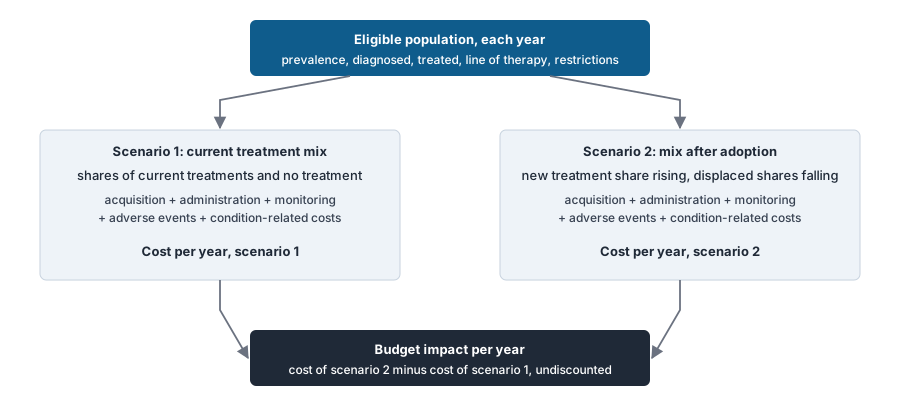
The report updates the first ISPOR budget impact principles of 2007 [7]. The Task Force recommends the simplest design that gives credible and transparent estimates. Where possible, the calculation is a cost calculator in a spreadsheet, because budget holders can follow it. A cohort or patient-level model is used only where changes in the eligible population, disease severity mix or treatment patterns cannot be captured credibly by a calculator [1]. The outputs are presented as a series of scenarios chosen from the decision maker's perspective, in the same way that sensitivity analyses are presented for a cost-effectiveness analysis [1].
A BIA is not a substitute for a cost-effectiveness analysis. The Indian guidelines state that a BIA should be used alongside evidence from economic evaluation and not in place of evidence on value for money [2]. The Abu Dhabi guidelines require both [4]. EvySaif builds the two together within its budget impact analysis service and cost-effectiveness analysis service, so that they share one set of inputs.
2. The ISPOR Framework
The Task Force report sets out the elements a BIA must define (Table 1). It names four key elements: the size of the eligible population, the current treatment mix and the mix expected after the new treatment enters, the cost of each mix, and any change in condition-related costs [1].
Table 1. Elements of a budget impact analysis under the ISPOR 2012 Task Force report [1]
| Element | Requirement |
|---|---|
| Perspective | The budget holder's. The design should allow other cost categories to be added or removed |
| Eligible population | All patients eligible for the new treatment during the time horizon, after access restrictions, including induced demand and use beyond restrictions where expected; open cohort that changes if the treatment extends survival or time on treatment |
| Current treatment mix | The mix in the eligible population now, including no treatment and off-label use where it is part of current practice |
| Uptake and market effects | Substitution of current treatments, combination with them, or expansion into untreated patients, with the share changing over time |
| Off-label use of the new treatment | Not included unless the budget holder asks for it |
| Cost of the treatment mixes | Budget holder's acquisition price after discounts, plus administration, monitoring and adverse-event management |
| Condition-related costs | Included where credible data exist and they affect the budget, with results shown with and without them |
| Indirect costs | Not included, except for employer or private insurer perspectives |
| Time horizon | 1 to 5 years, reported for each budget period |
| Discounting | None; costs are presented at each budget period |
| Uncertainty | Scenario analysis on parameters and structural assumptions; arbitrary ranges such as plus or minus 20 percent are not recommended |
| Validation | Face validity with decision makers and verification of the calculations |
The report also recommends the data sources for each element: the budget holder's own data first, then national or regional epidemiology adjusted to the budget holder's population, registries and claims databases for the current mix, and market research, producer estimates or uptake in another jurisdiction for the new mix [1].
3. Budget Impact Analysis Requirements in India (HTAIn)
Budget impact analysis in India follows the national methodological guidelines published in 2021 by Health Technology Assessment in India (HTAIn), the agency under the Department of Health Research [2]. The guidelines were developed from a systematic review of existing BIA guidance, reviewed by the HTAIn Technical Appraisal Committee, and tested with program managers involved in budgeting [2]. Table 2 summarizes the recommendations.
Table 2. HTAIn budget impact analysis guidelines for India [2]
| Element | Recommendation |
|---|---|
| Perspective | Payer's perspective, presented as two scenarios: a multi-payer scenario reflecting the current situation, and a single-payer scenario reflecting universal health coverage |
| Multi-payer scenario | Public payer, patients and other payers; health system costs and private costs including out-of-pocket expenditure, valued at current capacity utilization and prevailing market prices, with out-of-pocket data from the National Sample Survey Office or primary patient surveys |
| Single-payer scenario | Public payer only; full cost of delivering care with no out-of-pocket expenditure; resources valued at centralized public procurement prices; costs adjusted for changes in utilization |
| Time horizon | 1 to 4 years |
| Eligible population | Top-down estimation from national or state epidemiology |
| Treatment mix | Current and future mix analyzed for different utilization and coverage patterns |
| Discounting | None; inflation adjustment applied |
| Uncertainty | Deterministic sensitivity analysis and scenario analysis |
| Presentation | Total and disaggregated results, year by year across the horizon, and by type of resource |
| Relation to economic evaluation | Used alongside cost-effectiveness evidence, not as a substitute for it |
The two-scenario perspective is the feature that distinguishes the Indian guidance. India has several public payers at national and state level, a large private sector and substantial out-of-pocket payment. The multi-payer scenario therefore reports the budget impact on a public scheme and the cost to households separately. The single-payer scenario reports the full cost as it would fall on one payer under universal coverage [2]. HTAIn also funded the Cost of Health Services in India study, a national costing study that gives a BIA a documented source for unit costs in Indian facilities [5].
EvySaif, one of the leading HEOR consultancies in India, builds Indian budget impact models to the HTAIn guidelines. The multi-payer and single-payer scenarios are reported side by side, and the unit costs come from the national cost data and the scheme's own package rates.
4. Budget Impact Analysis Requirements in Saudi Arabia (SFDA)
The Saudi Food and Drug Authority (SFDA) published its guidance on Economic Evaluation Studies in July 2024. Its general requirements became mandatory in January 2025 and its economic evaluation requirements in July 2025, for all human pharmaceutical products going through pricing, including registration, price re-evaluation and renewal [3]. Table 3 summarizes the requirements that apply to a BIA.
Table 3. SFDA economic evaluation requirements for budget impact analysis [3]
| Element | Requirement |
|---|---|
| When required | At least one economic evaluation study is mandatory for pricing submissions. New chemical entities and biologicals submit a BIA together with a cost-effectiveness or cost-utility analysis; for generics and biosimilars, a BIA or cost-minimization analysis is optional |
| General requirements submitted with the BIA | Disease prevalence, incidence and patient numbers globally and in Saudi Arabia; current market share and, for a new product, estimated market share for the next five years; the marketing plan by distribution channel and prescription type; any access agreements; and a list of published economic evaluations and HTA decisions from NICE, HAS, CADTH, PBAC, ICER and others |
| Perspective | Healthcare payer |
| Costs | Direct healthcare costs, in Saudi riyals, from the Saudi healthcare system |
| Time horizon | 2 to 5 years |
| Comparator | From current standard of practice, including at least the least expensive and the most effective treatment available; emerging technologies encouraged |
| Uncertainty | Scenario analysis |
| Presentation | Results in table format; Form C summarizes the BIA, with the full study attached, filed in eCTD section 1.8.2 |
The SFDA guidance pairs the BIA with the general requirements on epidemiology and market share, so the eligible population and uptake assumptions in the model must match the figures declared in Form A [3]. EvySaif prepares the BIA and Forms A and C together for SFDA submissions, so that the two sets of figures agree.
5. Budget Impact Analysis Requirements in Abu Dhabi (DoH)
The Department of Health Abu Dhabi (DoH) published its Health Technology Assessment Guidelines in June 2025. They apply to innovative pharmaceutical products and to products with an expected cost above AED 10 million a year or AED 100,000 per patient per year. They make a cost-effectiveness analysis and a budget impact analysis mandatory for coverage in government-funded programs [4]. Table 4 summarizes the BIA requirements.
Table 4. DoH Abu Dhabi HTA guidelines: budget impact analysis requirements [4]
| Element | Requirement |
|---|---|
| Method | Designed, conducted and reported to the ISPOR Task Force principles; cost calculator approach where possible |
| Perspective | Publicly funded healthcare payer |
| Costs | Direct medical costs and, where applicable, direct non-medical costs covered by the budget holder, from local sources; copayments excluded from the BIA |
| Comparator | The expected treatment mix after adoption against the current mix, or standard of care where no treatment exists; a basket of technologies may be used |
| Eligible population | Open cohort from prevalence adjusted for eligibility, increasing with incidence and newly eligible patients and decreasing with mortality, cure and loss of eligibility; diagnosis and treatment rates examined |
| Market share | Projection grounded in the adoption of a precedent intervention in the same or an analogous area; the new treatment in a single arm; a competitor expected to grow is included in both scenarios |
| Time horizon | Three years recommended; the submission requirements allow three to five |
| Consistency | Same assumptions and inputs as the cost-effectiveness analysis |
| Discounting | None |
| Off-label use | Its potential budget impact is evaluated |
| Uncertainty | Deterministic sensitivity analysis on all uncertain parameters, varied by plus or minus 10 percent, shown as a tornado diagram of the top 15 parameters; probabilistic analysis shown as box and whisker plots of cumulative incremental budget impact; scenario and subgroup analysis |
| Presentation | Local currency; absolute budget impact and relative impact as a percentage of the current budget; cost breakdown by component; resource use where possible; Excel model without external links |
| Decision rule | A budget impact above 0.5 to 1 percent of the total healthcare budget is treated as uncertain or unacceptable, with resubmission on a revised price possible |
The published HTA dossier must include the BIA methodology, the current treatment mix, the estimated patient numbers and market share for the next three to five years, and the budget impact [4]. EvySaif prepares the BIA for the Abu Dhabi HTA pathway alongside the clinical assessment and cost-effectiveness analysis, following the EDE registration that precedes it, with the UAE regulatory service covering both steps.
6. The Requirements Side by Side
Table 5 sets the three payers against the ISPOR reference. The NICE manual is included for comparison. It asks for resource impact estimates disaggregated by organization and budget category, with VAT included in budget impact calculations and uptake based on evidence [6].
Table 5. Budget impact analysis requirements compared
| Element | ISPOR 2014 [1] | India HTAIn 2021 [2] | Saudi SFDA 2024 [3] | Abu Dhabi DoH 2025 [4] |
|---|---|---|---|---|
| Perspective | Budget holder | Payer; multi-payer and single-payer scenarios | Healthcare payer | Publicly funded payer |
| Time horizon | 1 to 5 years | 1 to 4 years | 2 to 5 years | 3 years recommended |
| Discounting | None | None; inflation adjusted | Not specified for BIA | None |
| Copayments and out-of-pocket | By perspective | Included in multi-payer scenario at market prices | Not specified | Excluded |
| Comparator | Current mix | Current and future mix | Least expensive and most effective in standard practice | Current mix or standard of care; basket allowed |
| Uncertainty | Scenario analysis | Deterministic and scenario | Scenario | Deterministic at plus or minus 10 percent, probabilistic, scenario, subgroup |
| Presentation | Per budget period, disaggregated | Year by year, by resource type | Tables; Form C | Local currency, absolute and percentage of budget, cost breakdown |
| Link to cost-effectiveness | Companion analysis | Alongside, not a substitute | BIA plus CEA or CUA for new entities | Same assumptions as the CEA; both mandatory |
One model can serve all three markets if it is built with the perspective, horizon and copayment treatment as switches, with the local epidemiology, unit costs and uptake entered per market. The Task Force describes this design: a computing framework that lets each decision maker apply their own inputs [1].
7. Estimating the Eligible Population
The eligible population is estimated top down. The national or regional prevalence or incidence is applied to the payer's covered population, then narrowed by successive criteria: diagnosed, treated, in the indicated line of therapy, meeting any restriction, and finally the share expected to receive the new treatment in each year (Figure 2). The Task Force asks that each step come from the budget holder's data where possible, and otherwise from national statistics, natural history studies or registries [1]. The Abu Dhabi guidelines ask for UAE data first, then Arab or Middle East data, then the Global Burden of Disease study, with any international data adapted to the local population [4].
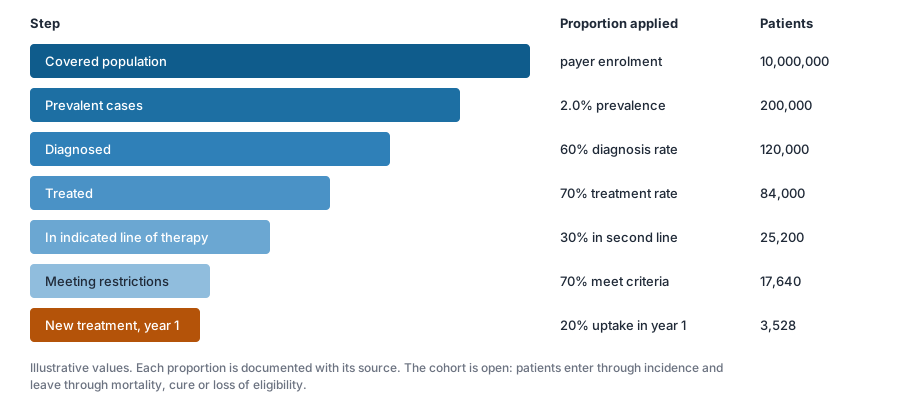
Two dynamics change the population over the horizon. A treatment that prolongs survival or time on treatment without curing the condition enlarges the prevalent pool year on year, and an open cohort must account for this [1, 4]. In a chronic condition there may also be a catch-up group: patients who failed the prior therapy in earlier years and switched to a less effective option. They are eligible in the first year alongside the patients who newly fail, so first-year demand can exceed the steady state [1].
EvySaif's clinicians build the funnel from the indication and the treatment guideline, document the proportion and source at each step, and reconcile the result with the payer's enrolment and claims data where the payer provides them.
8. Uptake and the Treatment Mix
The new treatment changes the mix in three ways: it replaces one or more current treatments, it is added to them, or it is used in patients who were not being treated [1]. Each has a different cost consequence. Substitution offsets part of the new cost by displacing current treatments and their monitoring. Combination adds cost. Expansion adds treatment cost but may reduce the cost of managing untreated disease.
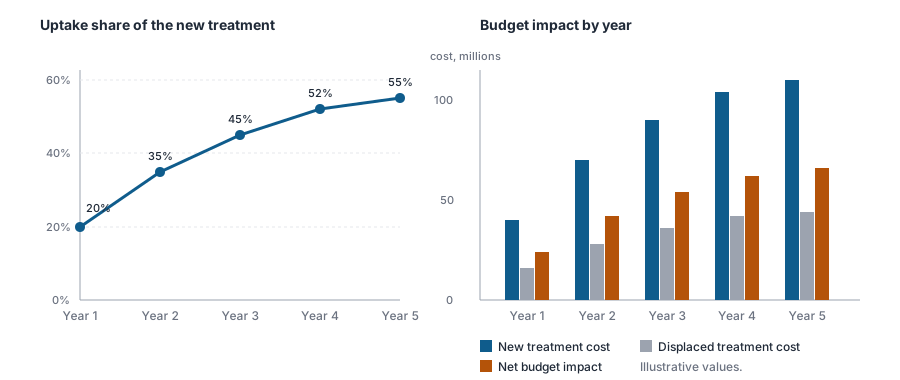
The Task Force notes that uptake is not known at the time of the analysis and that the result can be very sensitive to it, so the assumptions must be stated and tested [1]. The Task Force lists three sources: uptake of the same product in another jurisdiction, the producer's market share estimates, and the diffusion of similar products in the payer's own setting [1]. The Abu Dhabi guidelines require the projection to be grounded in a precedent intervention in the same or an analogous therapeutic area, and to account for capacity constraints. Any competitor expected to gain share must appear in both the current and the new scenario, so that the result reflects the new treatment and not the competitor [4]. The SFDA requires five years of market share estimates in the general requirements, which the BIA must match [3]. Figure 3 shows how the uptake curve and the displaced shares translate into a year-by-year budget impact. EvySaif sources uptake from the product's own launch in other markets where it exists, and otherwise from the diffusion of the precedent product in the payer's market, and reports both as scenarios.
9. Costs in the Budget Impact Model
The acquisition cost is the price the budget holder pays, after any discounts, rebates or access agreements, and the model is designed so that list price and net price can both be run [1]. Administration, monitoring, required diagnostics and adverse-event management are costed from local unit costs and the product label [1]. For India, the multi-payer scenario values resources at current capacity utilization and out-of-pocket items at market prices, and the single-payer scenario values them at centralized procurement prices [2]. For Saudi Arabia, costs are in riyals from the Saudi system [3]. For Abu Dhabi, costs are local, drug prices come from the DoH pharmaceutical products list, and copayments are left out of the BIA even though they are included in the cost-effectiveness analysis [4].
Condition-related costs, such as hospitalizations avoided by a treatment that slows progression, are included where credible data exist, and the model shows results with and without them [1]. Where a cost-effectiveness model exists, the condition-related offsets are taken from it. The relative effects behind those offsets come from the trials or from a network meta-analysis, and how they are converted into event rates is covered in From NMA to economic model.
10. Time Horizon, Inflation and Discounting
The horizon matches the budget holder's planning cycle: one to five years under the Task Force, one to four in India, two to five in Saudi Arabia, three in Abu Dhabi [1, 2, 3, 4]. Results are reported for each year, not as a total, because the budget holder plans one period at a time [1]. Costs are not discounted in a BIA; the Task Force, the Indian guidelines and the Abu Dhabi guidelines all say so [1, 2, 4]. The Indian guidelines ask instead for inflation adjustment of costs over the horizon [2]. Price changes within the horizon, such as a comparator losing exclusivity, are forecast where the evidence supports it [1].
11. Uncertainty
The Task Force states that much of the uncertainty in a BIA is structural: the assumptions about uptake, access restrictions and the treatment mix. It also states that much of the parameter uncertainty cannot be quantified, so one-way and probabilistic analyses cannot be carried out fully. The recommended approach is scenario analysis on plausible alternatives, with ranges taken from the budget holder, published studies or clinicians, and never from arbitrary percentages [1]. India asks for deterministic sensitivity analysis and scenario analysis [2]. Saudi Arabia asks for scenario analysis [3]. Abu Dhabi asks for four analyses: deterministic analysis at plus or minus 10 percent on every uncertain parameter, presented as a tornado diagram; probabilistic analysis, presented as box and whisker plots of the cumulative budget impact; scenario analysis; and subgroup analysis [4]. A model built for all three markets includes deterministic, probabilistic and scenario analysis, and reports the set each payer asks for.
12. Linking the Budget Impact Analysis to the Cost-Effectiveness Model
The Abu Dhabi guidelines require the BIA to use the same assumptions and inputs as the cost-effectiveness analysis [4], and the Task Force recommends taking condition-related cost changes from a companion cost-effectiveness analysis where one exists [1]. In practice the two models share the eligible population definition, the comparator set, the unit costs, the adverse-event rates and the clinical effect on events. They differ in perspective, horizon, discounting and the treatment of the cohort: the cost-effectiveness model follows one cohort over a lifetime, the BIA costs an open population for a few years. A BIA built after the cost-effectiveness model, from the same input sheet, avoids inconsistencies between the two. EvySaif builds the two from one input workbook so that a change in either is carried into both.
13. Reporting
The Task Force reporting format asks for the objective and perspective; the epidemiology and current management; the eligible population; the intervention mix before and after, with rates and characteristics; the time horizon and its justification; a diagram of the analytic framework; every input with its source and derivation; the scenarios and the reasons for them; and results per budget period, disaggregated by resource category and by intervention, adverse event and condition-related cost, with the uncertainty analyses in tables or figures [1]. Abu Dhabi adds the relative impact as a percentage of the current budget and an Excel model without external links [4]. India adds year-wise and resource-type disaggregation [2]. Saudi Arabia adds Form C [3].
14. Errors in Budget Impact Models That Lead to Rejection
Five errors appear in the guidance as faults to avoid. First, uptake or patient numbers are understated; a payer checks them against its own data and against the market share declared elsewhere in the submission [3, 4]. Second, a competitor's growth is placed only in the new scenario, which attributes the competitor's cost to the product under review [4]. Third, costs are discounted, or copayments are included where the payer excludes them [1, 4]. Fourth, sensitivity ranges are set at an arbitrary percentage with no source [1]. Fifth, the population, comparators or event rates in the BIA differ from those in the companion cost-effectiveness model [4].
EvySaif checks each of these before submission and reconciles the BIA inputs with the cost-effectiveness model and the general-requirements forms.
15. What to Send
A budget impact model can begin from: the indication and the licensed or proposed place in therapy; the target payer or payers; the covered population; local prevalence, incidence and diagnosis and treatment rates where known; the current treatments and their shares; the proposed price and any access agreement; the uptake expected or observed in another market; adverse-event rates; and the cost-effectiveness model if one exists.
16. Budget Impact Analysis Consultancy for India and the Gulf: EvySaif
EvySaif Research and Medical Affairs Solutions is one of the leading clinician-led HEOR consultancies in India. It builds budget impact models for Indian public schemes, for SFDA pricing submissions, for the Abu Dhabi HTA pathway and for payers in other Gulf and MENA markets. Each model follows the ISPOR Task Force framework and the payer's own guideline. It is built as a switchable Excel calculator, with the local epidemiology, unit costs and uptake entered per market, and it is reconciled with the cost-effectiveness model and the submission forms. Clinicians build the eligible population funnel and the treatment mix from the guideline and the label. Health economists cost the mixes and run the scenario, deterministic and probabilistic analyses. The report follows the Task Force format, so that a reviewer can replicate the calculation.
The model serves HTA submissions and the affordability section of a global value dossier. EvySaif is a clinician-led medical writing, regulatory affairs, HEOR and drug clinical development consultancy.
Discuss a budget impact analysis
17. Frequently asked questions
A budget impact analysis estimates the change in a payer's spending after a new treatment is adopted. It compares the cost of the current treatment mix with the cost of the mix expected after adoption, for the same eligible population, and reports the difference for each year of a short horizon.
A cost-effectiveness analysis measures value for money as cost per unit of health gained, over a lifetime, with discounting. A budget impact analysis measures affordability as the cash impact on a specific budget, over one to five years, without discounting. Payers in India, Saudi Arabia and Abu Dhabi ask for both.
A payer perspective presented as a multi-payer scenario and a single-payer scenario, a horizon of one to four years, a top-down eligible population, current and future treatment mixes, no discounting with inflation adjustment, deterministic and scenario analysis, and results by year and by resource type.
From July 2025, at least one economic evaluation study is mandatory for pharmaceutical products going through SFDA pricing. New chemical entities and biologicals submit a budget impact analysis with a cost-effectiveness or cost-utility analysis. The BIA uses a payer perspective, Saudi costs in riyals, a horizon of two to five years and scenario analysis, and it is summarized in Form C.
The DoH Abu Dhabi guidelines recommend three years, with the submission requirements allowing three to five. Costs are not discounted, copayments are excluded, and the analysis must use the same assumptions as the cost-effectiveness analysis.
No. The ISPOR Task Force, the Indian guidelines and the Abu Dhabi guidelines all state that costs are presented undiscounted at each budget period, because the budget holder needs the impact in each year as it will be paid.
Top down: prevalence or incidence applied to the covered population, then narrowed by diagnosis rate, treatment rate, line of therapy and any access restriction, then the share receiving the new treatment in each year. Each step is documented with its source, and the cohort is open, so patients enter through incidence and leave through mortality, cure or loss of eligibility.
Yes, if it is built with perspective, horizon and copayment treatment as switches and with the epidemiology, unit costs, prices and uptake entered per market. The calculation structure is the same; the inputs and the reporting format change by payer.
EvySaif Research and Medical Affairs Solutions, a clinician-led HEOR consultancy in Pune, builds budget impact models for Indian public schemes, SFDA pricing submissions and the Abu Dhabi HTA pathway. Each model is reconciled with the cost-effectiveness model and the submission forms. EvySaif serves sponsors in India, the Middle East and North Africa, and Europe.
References
- Sullivan SD, Mauskopf JA, Augustovski F, et al. Budget impact analysis: principles of good practice. Report of the ISPOR 2012 Budget Impact Analysis Good Practice II Task Force. Value Health. 2014;17(1):5-14. doi:10.1016/j.jval.2013.08.2291
- Prinja S, Chugh Y, Rajsekar K, Muraleedharan VR. National methodological guidelines to conduct budget impact analysis for health technology assessment in India. Appl Health Econ Health Policy. 2021;19(6):811-823. doi:10.1007/s40258-021-00668-y
- Saudi Food and Drug Authority. Guidance for Economic Evaluation Studies. DS-G-113-V01. Version 1.0, 10 July 2024. https://sfda.gov.sa/sites/default/files/2024-07/EconomicEvaluationStudies.pdf
- Department of Health Abu Dhabi. Health Technology Assessment Guidelines. DoH/GD/HPS/HTA/V1/25. June 2025.
- Centre for Global Development. Building a better evidence base for health technology assessment: lessons from India. 2022. https://www.cgdev.org/blog/building-better-evidence-base-health-technology-assessment-lessons-india
- National Institute for Health and Care Excellence. NICE health technology evaluations: the manual. Process and methods PMG36. Section 4.11, Impact on the NHS. https://www.nice.org.uk/process/pmg36/chapter/economic-evaluation-2
- Mauskopf JA, Sullivan SD, Annemans L, et al. Principles of good practice for budget impact analysis: report of the ISPOR Task Force on Good Research Practices, Budget Impact Analysis. Value Health. 2007;10(5):336-347.
Last reviewed: September 2026. This article is general information for education; verify requirements and methods against current official sources for any specific project.