
When two treatments have never been compared in the same randomized trial, five methods can estimate their relative effect from the trials that exist: the standard indirect treatment comparison (ITC), network meta-analysis (NMA), matching-adjusted indirect comparison (MAIC), simulated treatment comparison (STC) and multilevel network meta-regression (ML-NMR). Each answers the same question under different assumptions and with different data. The method is chosen by the structure of the evidence, the availability of individual patient data and the population for which the decision is being made, and a submission whose method rests on assumptions the evidence does not meet is assessed against those assumptions.
1. Five Methods and the Question They Share
All five methods estimate the relative effect of treatment B versus treatment C for a decision problem in which no B versus C trial exists. They differ in whether the estimate passes through a common comparator, whether individual patient data are used to adjust for differences between trial populations, whether the estimate applies to a whole network or a single comparison, and in which population the estimate is valid. Table 1 sets out the five methods on those four dimensions.
Table 1. The five indirect comparison methods
| Method | What it estimates | Data used | Passes through a common comparator | Population in which the estimate is valid |
|---|---|---|---|---|
| Standard ITC (Bucher) | One B vs C effect from an AB trial and an AC trial | Aggregate data | Yes | Assumes the same in both trials |
| NMA | All pairwise effects across a connected network | Aggregate data | Yes, across the network | Assumes the same across the network |
| MAIC | One B vs C effect, reweighting the trial with individual patient data to match the aggregate trial | Individual patient data from one trial, aggregate data from the other | Anchored form yes; unanchored form no | The aggregate (AC) trial population |
| STC | One B vs C effect, predicting outcomes from an outcome regression fitted in the trial with individual patient data | Individual patient data from one trial, aggregate data from the other | Anchored form yes; unanchored form no | The aggregate (AC) trial population |
| ML-NMR | All pairwise effects across a network, adjusted for effect modifiers | Individual patient data from one or more trials, aggregate data from the rest | Yes, across the network | Any specified target population |
The NICE health technology evaluations manual treats the standard ITC as the simplest case of NMA, refers to population-adjustment methods where effect modifiers may be imbalanced between trials, and states that these methods need individual patient data from at least one trial [2]. The NICE Decision Support Unit's Technical Support Document 18 reviews MAIC and STC and sets the conditions under which each may be used in a submission [7].
Network meta-analysis itself, including its Bayesian and frequentist forms and its assumptions, is explained in the EvySaif network meta-analysis guide. EvySaif selects among the five methods as part of its meta-analysis and evidence synthesis service, on the basis of a feasibility assessment of the network and the individual patient data available to the sponsor.
2. The Standard Indirect Treatment Comparison (ITC)
The standard ITC, described by Bucher and colleagues in 1997, estimates the B versus C effect as the difference between the AC effect and the AB effect on the scale used for synthesis, such as the log odds ratio or log hazard ratio [1]. Because each effect is a within-trial randomized comparison, prognostic differences between the two trial populations cancel. Technical Support Document 18 states that the assumption behind the standard method is that the distribution of effect-modifying variables does not differ between the trials, and that differences in prognostic variables that are not effect modifiers do not affect the estimate because of within-trial randomization [7].
The ITC is the correct method when there is one AB trial and one AC trial, or a small number of each, the populations are comparable in the characteristics that modify treatment effect, and the decision concerns only the B versus C comparison. Its output is a single relative effect with a confidence interval on the synthesis scale. Its weakness, stated in the NICE manual, is that indirect comparisons in networks with a small number of trials are highly vulnerable to systematic bias [2].
3. Network Meta-Analysis (NMA)
NMA extends the ITC to a connected network of any size, estimating every pairwise effect simultaneously and using both direct and indirect evidence for each comparison. The generalized linear modeling framework in Technical Support Document 2 fits the network on the linear predictor scale of the outcome, with fixed or random treatment effects, and handles multi-arm trials correctly [3]. Where a comparison is informed by both direct and indirect evidence, the agreement between the two is the consistency assumption, and the NICE manual asks that inconsistency be reported and, where found, explained and resolved [2].
NMA is the method of choice when the decision involves more than two treatments, the network is connected, and effect modifiers are balanced across the comparisons. Its output feeds an economic model with a coherent set of relative effects against a single reference treatment; the reporting of that model is covered in the EvySaif CHEERS 2022 article. The ISPOR Task Force good research practices set out the conduct and reporting of both ITC and NMA, including the systematic identification of trials and the assessment of trial similarity before analysis [4]. The steps by which connectivity, node definitions and effect-modifier balance are checked before an NMA are described in the EvySaif NMA feasibility assessment article.
EvySaif, one of the leading network meta-analysis consultancies in India, conducts Bayesian and frequentist NMA on trials identified through its own systematic literature review, so that the network and the review share one protocol.
4. When Standard Methods Fail: Effect Modifiers and Sparse Networks
Technical Support Document 18 sets out why population adjustment is needed. The standard methods assume no difference between trials in the distribution of effect modifiers; the high heterogeneity often found in trial networks, shown by the frequent use of random-effects models, means that the validity of indirect comparisons in very sparse networks must be considered carefully; and in networks with only one or two trials per treatment, indirect comparisons are highly vulnerable to bias from imbalanced effect modifiers [7].
The same document distinguishes an effect modifier, a covariate that changes the size of the treatment effect on the chosen scale, from a prognostic variable, a covariate that affects outcome without changing the treatment effect. Effect modifier status is specific to the scale: a covariate that is not an effect modifier on one scale is an effect modifier on another [7]. The distinction determines which variables each method must adjust for, and population adjustment can be justified only where a variable is shown to modify the treatment effect and its imbalance is large enough to bias the standard comparison [7].
The document also states what population adjustment cannot do: MAIC and STC account for imbalances in observed covariates and cannot adjust for differences in treatment administration, co-treatments or treatment switching, which are confounded with treatment [7]. A difference of that kind is resolved by redefining the treatment nodes or restricting the network at the feasibility stage.
EvySaif's clinicians identify the candidate effect modifiers for the therapeutic area and document the evidence for each before any adjustment method is proposed.
5. Matching-Adjusted Indirect Comparison (MAIC)
MAIC, proposed by Signorovitch and colleagues in 2010, is a form of propensity score weighting applied where individual patient data are available for one trial (AB) and only aggregate data for the other (AC) [5]. Each patient in the AB trial receives a weight equal to the odds of enrollment in the AC trial versus the AB trial, estimated by a method of moments so that the weighted AB population matches the reported means (and, where included, variances) of the AC covariates. The weighted AB outcomes are then compared with the AC outcomes [5, 7].
Technical Support Document 18 sets three requirements for an anchored MAIC. The weighting model must include all effect modifiers, whether balanced or not, and no purely prognostic variables, because prognostic imbalance is handled by randomization and matching on it only reduces the effective sample size. The effective sample size after weighting and the distribution of the weights must be reported, because a marked reduction indicates poor overlap between the populations and an estimate that depends on a few patients; in the published applications reviewed, the effective sample size fell by 80 percent on average. The comparison must be made on the linear predictor scale used for synthesis of that outcome [7].
MAIC is the method when the sponsor has individual patient data for its own trial, only aggregate data are published for the comparator trial, the two trials share a common comparator arm, and there is evidence that one or more measured covariates modify the treatment effect and are imbalanced between the trials.
6. Simulated Treatment Comparison (STC)
STC, from Caro and Ishak in 2010, is a form of outcome regression [6]. An outcome model is fitted to the individual patient data of the AB trial, with terms for treatment, prognostic variables and effect modifiers, and the fitted model is used to predict the outcomes the AB trial's treatments would have produced in the AC trial's population, using the AC covariate distribution. The predicted outcomes are then compared with the AC trial's reported outcomes [6, 7].
Technical Support Document 18 sets parallel requirements for an anchored STC. All effect modifiers in imbalance must be included in the outcome model, and further effect modifiers and prognostic variables may be included where they improve model fit and precision. The indirect comparison must be formed on the linear predictor scale: forming it on the natural outcome scale when the outcome model uses a non-identity link, as the early STC literature did, creates a conflict of scale in which prognostic variables no longer cancel in the anchored comparison [7]. The document notes that outcome-regression estimators are less sensitive to model misspecification than propensity-weighting estimators in simulation, at the cost of overstating precision if the prediction error is treated as fixed [7]. A later parametric G-computation approach extends the outcome-regression method within a potential-outcomes framework [10].
In a MAIC vs STC decision, STC is chosen when the effective sample size after weighting would be small, when an outcome model with a clear clinical specification is available, or when the analysis needs to adjust for effect modifiers and prognostic variables in the same model.
7. Anchored vs Unanchored MAIC and STC
Technical Support Document 18 distinguishes anchored from unanchored forms of MAIC and STC (Figure 1). An anchored comparison uses a common comparator arm in each trial and respects randomization, so only effect modifiers need to be balanced. An unanchored comparison, used when there is no common comparator or when single-arm studies are involved, assumes that absolute outcomes can be predicted from the covariates, which requires that every effect modifier and every prognostic variable has been accounted for. The document describes that assumption as very strong and largely considered impossible to meet, with the failure of the assumption producing an unknown amount of bias [7].
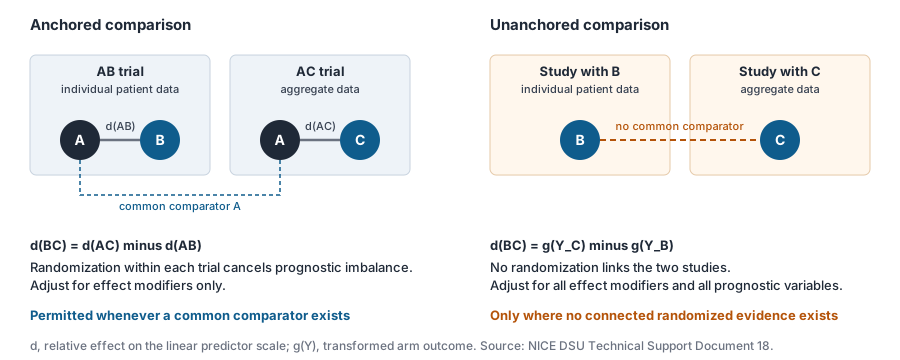
The document's first recommendation is that where connected evidence with a common comparator exists, only anchored forms of population adjustment may be used, and unanchored forms may be considered only in the absence of a connected network of randomized studies or where single-arm studies are involved. Its third recommendation is that an unanchored submission must provide evidence on the likely extent of error from unaccounted covariates, in relation to the observed relative effect [7]. The NICE manual states separately that comparing results from single treatment arms of different randomized trials is not acceptable as randomized evidence, and that such data will be treated as observational and associated with increased uncertainty [2].
EvySaif conducts anchored MAIC and STC wherever the network permits and, where an unanchored comparison is unavoidable, quantifies the residual bias as Technical Support Document 18 asks, so that the submission states what the estimate can and cannot support. Where the comparator evidence is a single-arm study or an external control arm, the design of that evidence is covered by EvySaif's real-world evidence study design service.
8. Multilevel Network Meta-Regression (ML-NMR)
ML-NMR, described by Phillippo and colleagues in 2020, extends population adjustment from a single pair of trials to a full network by combining individual patient data from some trials with aggregate data from others in one regression model [9]. The aggregate-level model is obtained by integrating the individual-level model over the covariate distribution of each aggregate trial, which avoids the aggregation bias that arises when an individual-level regression is applied directly to aggregate data; Technical Support Document 18 describes this hierarchical structure as the correct way to relate the two levels [7, 9].
Two properties distinguish ML-NMR from MAIC and STC. It produces a coherent set of relative effects for every treatment in the network, where MAIC and STC produce one comparison at a time in a population determined by whichever trial lacks individual patient data. It can also produce estimates for any specified target population, including a registry or cohort population representing the decision, where MAIC and STC deliver estimates only in the aggregate trial's population [9]. The document's sixth recommendation, that the target population for the decision be explicitly stated and that the adjustment deliver estimates for that population, is met directly by ML-NMR [7].
ML-NMR is the method when the network has more than three treatments, individual patient data are available for at least one trial, effect modifiers are imbalanced, and the decision requires estimates in a population other than a single comparator trial's.
9. The Target Population
Technical Support Document 18 states that MAIC and STC, as proposed, produce a comparison in the population of the AC trial, and that this is unlikely to be the target population for a decision, which is more often represented by a national cohort or registry [7]. The document gives an example: two sponsors with individual patient data on their own trials and aggregate data on each other's produced conflicting MAIC estimates from the same two trials, because each analysis was valid in the other sponsor's trial population and each implicitly treated the competitor's trial as the more representative [7].
The document's proposed remedy is the shared effect modifier assumption: if the active treatments being compared share the same effect modifiers with the same size of interaction, the B versus C effect is transportable to any population. The assumption is judged on clinical and biological grounds and is more plausible for treatments in the same class than for treatments with different mechanisms [7]. A method selection therefore states the target population, states whether the shared effect modifier assumption is being made, and, where it is not, uses ML-NMR to estimate in the target population directly.
10. NMA vs MAIC vs STC vs ML-NMR: Choosing by Evidence Situation
Figure 2 sets out the selection as a sequence of questions about the evidence, and Table 2 maps the common evidence situations to the method that answers them.
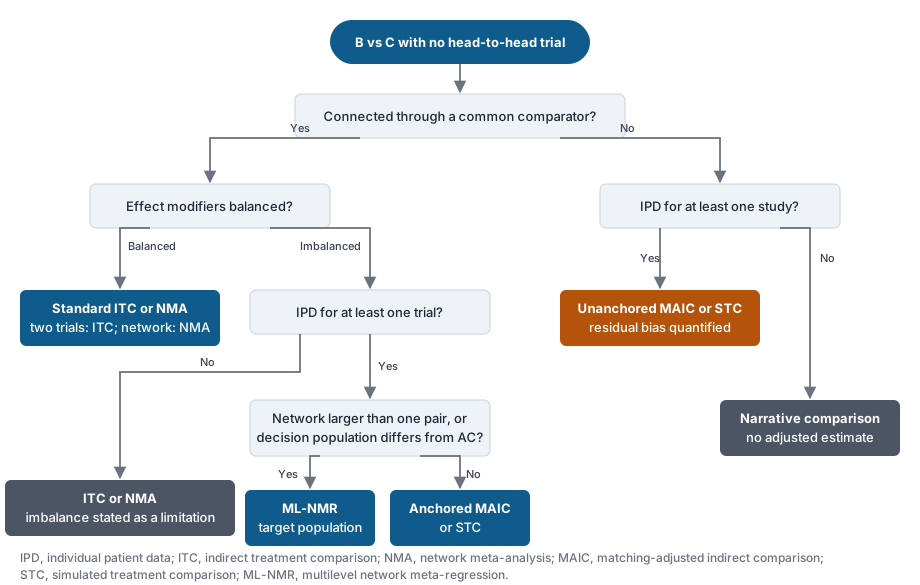
Table 2. Evidence situation and the indirect comparison method it supports
| Evidence situation | Method | Basis |
|---|---|---|
| One AB trial and one AC trial, effect modifiers balanced | Standard ITC | Bucher method; effect modifiers assumed equally distributed [1, 7] |
| Connected network of three or more treatments, effect modifiers balanced | NMA | Generalized linear modeling framework; consistency assessed [2, 3] |
| AB trial with individual patient data, AC trial aggregate, common comparator, effect modifiers imbalanced | Anchored MAIC or STC | Technical Support Document 18 recommendations 1 and 2 [7] |
| As above, but the decision population differs from the AC trial | Anchored MAIC or STC with shared effect modifier assumption, or ML-NMR | Technical Support Document 18 section 2.5; ML-NMR target population [7, 9] |
| Network of more than three treatments, individual patient data for at least one trial, effect modifiers imbalanced | ML-NMR | Coherent network estimates in a stated target population [9] |
| No common comparator, or single-arm study, individual patient data for one study | Unanchored MAIC or STC, with quantified residual bias | Technical Support Document 18 recommendations 1 and 3; treated as observational by NICE [2, 7] |
| No individual patient data for any trial | Standard ITC or NMA with the imbalance reported as a limitation; population adjustment unavailable | NICE manual 3.4.14 [2] |
| Trials differ in treatment administration, co-treatment or switching | Redefine nodes or restrict the network; no adjustment method corrects this | Technical Support Document 18 section 1 [7] |
EvySaif documents the evidence situation and the method chosen in a method selection memo before the statistical analysis plan is written, so that the sponsor and any HTA body see the basis for the choice.
11. Data Requirements and Reporting
Each method has a fixed data requirement (Table 3). Without individual patient data for at least one trial, the choice is limited to the standard ITC and NMA.
Table 3. Data required by each method
| Method | Individual patient data | Aggregate data | Covariate information needed |
|---|---|---|---|
| Standard ITC | None | AB and AC effect estimates with variances | Trial baseline tables, to judge effect-modifier balance |
| NMA | None | Arm-level or contrast-level data for every trial | Trial baseline tables, to judge effect-modifier balance |
| MAIC | One trial (typically the sponsor's) | Comparator trial outcomes and covariate summaries | Means and, where reported, variances of the effect modifiers in the aggregate trial |
| STC | One trial | Comparator trial outcomes and covariate summaries | Covariate distribution of the aggregate trial for prediction; correlations imputed from the individual patient data or assumed |
| ML-NMR | One or more trials | Remaining trials at arm level | Covariate distributions for every aggregate trial; target population covariate distribution |
Technical Support Document 18's seventh recommendation sets the reporting standard for any population-adjusted analysis: the covariate distributions in each trial, the evidence for each variable's status as an effect modifier, the distribution of weights and effective sample size for MAIC, the outcome model for STC, the scale of the comparison, the target population, and appropriate measures of uncertainty [7]. The NICE manual adds that the limitations of population-adjustment methods and the likely size of any systematic bias should be reported [2]. Table 4 lists the items.
Table 4. Reporting items for a population-adjusted indirect comparison
| Item | Content |
|---|---|
| Rationale | Evidence that at least one covariate is an effect modifier and that its imbalance is large enough to bias the standard comparison |
| Anchoring | Whether the comparison is anchored; if unanchored, why no connected evidence exists |
| Variables adjusted | The effect modifiers (and, for STC or unanchored analyses, prognostic variables) included, with the basis for each |
| Covariate distributions | Baseline characteristics of each trial before and after adjustment |
| Weights (MAIC) | Distribution of weights and effective sample size after weighting |
| Outcome model (STC) | Model form, link function, covariates, fit statistics |
| Scale | Linear predictor scale on which the comparison was formed |
| Target population | The population for the decision and whether the shared effect modifier assumption was made |
| Uncertainty | Confidence or credible intervals reflecting sampling variation, covariate imbalance and model estimation |
| Residual bias (unanchored) | Estimate of the likely error from unaccounted covariates, in relation to the observed effect |
EvySaif's evidence synthesis reports follow this reporting set for every MAIC, STC and ML-NMR it delivers, so that the analysis can be reproduced by an assessment group.
12. Common Errors in Population-Adjusted Comparisons
Technical Support Document 18's review of published MAIC and STC applications identified the errors that recur [7]. An unanchored comparison was performed where a common comparator existed. No evidence was presented before analysis that any covariate was an effect modifier, or that its imbalance was large enough to bias the comparison, in nine of eleven applications. The comparison was formed on the natural outcome scale instead of the linear predictor scale. The effective sample size and weight distribution were reported in fewer than half of the MAIC applications. Individual patient data from several trials were pooled into one population without accounting for clustering by trial. Weighting models matched on every available covariate, prognostic or not, which reduces precision without reducing bias.
Each of these is avoidable at the design stage. The evidence for effect modification is collected in the feasibility assessment, the anchoring decision follows from the network structure, the scale is fixed by the outcome, and the reporting items in Table 4 are specified in the statistical analysis plan before any weight is estimated.
13. What to Send for a Method Selection
A method selection can begin from the intervention and comparators, the trials known for each, whether the sponsor holds individual patient data for its own trials, the target HTA body and the population its scope names, the outcomes the economic model needs and their form, and the baseline characteristics tables of the comparator trials as published. Where a feasibility assessment already exists, its network diagrams and effect-modifier tables replace the trial list.
14. Indirect Comparison Consultancy From EvySaif
EvySaif Research and Medical Affairs Solutions is one of the leading clinician-led HEOR and network meta-analysis consultancies in India, and it provides standard ITC, Bayesian and frequentist NMA, anchored and unanchored MAIC and STC, and ML-NMR for pharmaceutical, biotechnology and healthcare organizations in India, the Middle East and North Africa, and Europe. The method is selected by clinicians and statisticians together from the evidence situation, the effect-modifier evidence and the target population, and each analysis is reported to the standard in Technical Support Document 18 and the NICE manual so that an assessment group can reproduce it.
The method selection memo leads into the statistical analysis plan, the analysis, and the evidence synthesis report, manuscript, HTA submission or global value dossier that follows. EvySaif is a clinician-led medical writing, regulatory affairs, HEOR and drug clinical development consultancy.
Discuss an indirect treatment comparison
15. Frequently asked questions
A standard indirect treatment comparison estimates one relative effect between two treatments through a common comparator, from one or a few trials of each. A network meta-analysis estimates every pairwise effect across a connected network of any size in a single model, using both direct and indirect evidence. The NICE manual treats the standard ITC as the simplest form of NMA.
Both use individual patient data from one trial and aggregate data from another. MAIC reweights the patients in the individual-data trial so that their covariate means match the aggregate trial. STC fits an outcome regression to the individual-data trial and predicts outcomes for the aggregate trial's population. MAIC needs no outcome model; STC needs one but retains more precision when the populations overlap poorly.
Only where no connected network of randomized studies exists or single-arm studies are involved, and then with an estimate of the likely error from covariates not accounted for. Technical Support Document 18 recommends against unanchored methods wherever anchored methods can be applied.
Multilevel network meta-regression combines individual patient data from some trials with aggregate data from the rest in a single network model, adjusting for effect modifiers and producing estimates for a stated target population. It is used when the network is larger than a single pair of trials, individual patient data exist for at least one trial, and the decision population differs from any single comparator trial.
No. MAIC, STC and ML-NMR all require individual patient data from at least one trial. Without them, the analysis is limited to the standard ITC or NMA, with the effect-modifier imbalance reported as a limitation.
In an anchored MAIC, all effect modifiers and no purely prognostic variables. Matching on prognostic variables reduces the effective sample size without reducing bias, because prognostic imbalance is handled by randomization within each trial. In an unanchored MAIC, all effect modifiers and all prognostic variables, which is why the unanchored form is less precise and more likely to be biased.
In the population of the trial for which only aggregate data are available, because the individual-data trial is adjusted to match it. An estimate for a different target population requires either the shared effect modifier assumption or ML-NMR.
EvySaif Research and Medical Affairs Solutions, a clinician-led HEOR consultancy in Pune, provides method selection, anchored and unanchored MAIC and STC, ML-NMR and NMA for HTA submissions, publications and economic models, for sponsors in India, the Middle East and North Africa, and Europe.
References
- Bucher HC, Guyatt GH, Griffith LE, Walter SD. The results of direct and indirect treatment comparisons in meta-analysis of randomized controlled trials. J Clin Epidemiol. 1997;50(6):683-691.
- National Institute for Health and Care Excellence. NICE health technology evaluations: the manual. Process and methods PMG36. Section 3.4, Synthesis of evidence. https://www.nice.org.uk/process/pmg36/chapter/evidence
- Dias S, Welton NJ, Sutton AJ, Ades AE. NICE DSU Technical Support Document 2: A generalised linear modelling framework for pairwise and network meta-analysis of randomised controlled trials. Decision Support Unit, ScHARR, University of Sheffield. https://www.sheffield.ac.uk/nice-dsu
- Hoaglin DC, Hawkins N, Jansen JP, et al. Conducting indirect-treatment-comparison and network-meta-analysis studies: report of the ISPOR Task Force on Indirect Treatment Comparisons Good Research Practices: part 2. Value Health. 2011;14(4):429-437.
- Signorovitch JE, Wu EQ, Yu AP, et al. Comparative effectiveness without head-to-head trials: a method for matching-adjusted indirect comparisons applied to psoriasis treatment with adalimumab or etanercept. Pharmacoeconomics. 2010;28(10):935-945.
- Caro JJ, Ishak KJ. No head-to-head trial? Simulate the missing arms. Pharmacoeconomics. 2010;28(10):957-967.
- Phillippo DM, Ades AE, Dias S, Palmer S, Abrams KR, Welton NJ. NICE DSU Technical Support Document 18: Methods for population-adjusted indirect comparisons in submissions to NICE. Decision Support Unit, ScHARR, University of Sheffield; 2016. https://www.sheffield.ac.uk/nice-dsu/tsds/population-adjusted
- Phillippo DM, Ades AE, Dias S, Palmer S, Abrams KR, Welton NJ. Methods for population-adjusted indirect comparisons in health technology appraisal. Med Decis Making. 2018;38(2):200-211.
- Phillippo DM, Dias S, Ades AE, et al. Multilevel network meta-regression for population-adjusted treatment comparisons. J R Stat Soc Ser A. 2020;183(3):1189-1210.
- Remiro-Azócar A, Heath A, Baio G. Parametric G-computation for compatible indirect treatment comparisons with limited individual patient data. Res Synth Methods. 2022;13(6):716-744.
Last reviewed: September 2026. This article is general information for education; verify requirements and methods against current official sources for any specific project.