
On November 23, 2026, the Centers for Medicare & Medicaid Services (CMS) announced negotiated prices for 13 drugs in the third cycle of the Medicare Drug Price Negotiation Program [1]. The prices take effect on January 1, 2028 [1]. CMS estimates net savings of 45%, or $9.2 billion, based on 2025 spending [1, 2]. Discounts from the 2025 Medicare cost range from 34% for Entyvio to 84% for Trulicity [2]. This is the first cycle to include drugs payable under Medicare Part B and the first to renegotiate a price set in an earlier cycle [7]. With these 13 drugs, 37 drugs now have negotiated Medicare prices [1].
1. What a Negotiated Price Is
Under the Inflation Reduction Act of 2022, Medicare negotiates prices directly with drug companies for certain high-spending drugs that have no generic or biosimilar competition [4]. The agreed price is called the maximum fair price (MFP). CMS refers to each cycle by the year its prices start, the initial price applicability year (IPAY). The third cycle is IPAY 2028.
The first cycle covered 10 Part D drugs, with prices in effect from January 1, 2026. The second cycle covered 15 Part D drugs, with prices in effect from January 1, 2027 [3, 5].
2. The 13 Drugs and Their Negotiated Prices
Table 1 lists each drug with its 2025 Medicare cost and its negotiated price for a 30-day supply [2]. The discount is how far the negotiated price falls below the 2025 cost, shown as a percentage.
Table 1. Negotiated prices for 2028, per 30-day supply
| Drug | Company | Commonly treated conditions | 2025 Medicare cost | Negotiated price for 2028 | Discount |
|---|---|---|---|---|---|
| Trulicity | Eli Lilly and Company | Type 2 diabetes, including with cardiovascular disease or multiple cardiovascular risk factors | $965 | $150 | 84% |
| Biktarvy | Gilead Sciences | HIV-1 infection | $4,141 | $2,600 | 37% |
| Orencia | Bristol-Myers Squibb | Rheumatoid arthritis, psoriatic arthritis | $4,052 | $1,750 | 57% |
| Cosentyx | Novartis | Plaque psoriasis, psoriatic arthritis | $7,835 | $2,600 | 67% |
| Erleada | Janssen Biotech | Prostate cancer | $14,253 | $7,004 | 51% |
| Kisqali | Novartis | Breast cancer | $15,120 | $8,650 | 43% |
| Entyvio | Takeda | Crohn's disease, ulcerative colitis | $4,035 | $2,645 | 34% |
| Verzenio | Eli Lilly and Company | Breast cancer | $15,423 | $8,650 | 44% |
| Lenvima | Eisai | Thyroid, endometrial, liver and kidney cancers | $23,878 | $12,985 | 46% |
| Rexulti | Otsuka | Major depressive disorder, schizophrenia, agitation associated with dementia due to Alzheimer's disease | $1,320 | $780 | 41% |
| Tradjenta (renegotiated) | Boehringer Ingelheim | Type 2 diabetes | $469 | $81 | 83% |
| Anoro Ellipta | GlaxoSmithKline | Chronic obstructive pulmonary disease | $465 | $130 | 72% |
| Cimzia | UCB | Crohn's disease, plaque psoriasis, psoriatic arthritis, rheumatoid arthritis | $2,195 | $1,375 | 37% |
Sources: CMS fact sheets [2, 3]. The 2025 Medicare cost is the Medicare gross cost for a 30-day supply in calendar year 2025 [2]. Company names are shortened.
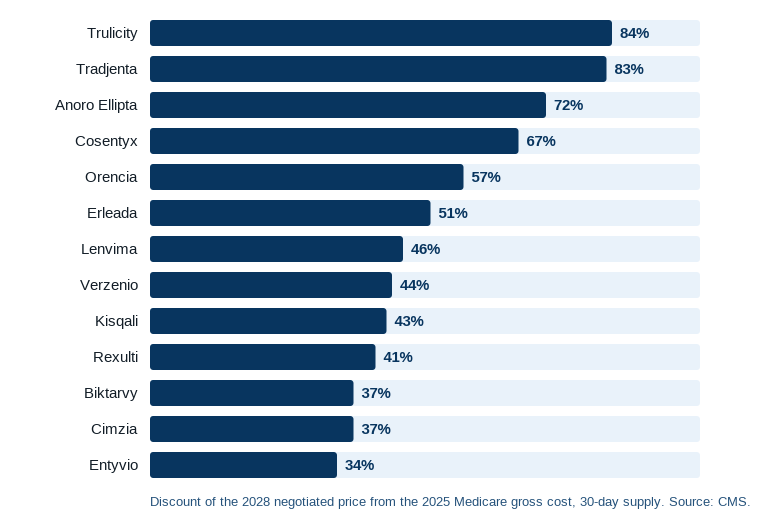
Trulicity and Tradjenta have the largest discounts, at 84% and 83% [2]. Entyvio has the smallest, at 34% [2]. Biktarvy and Cosentyx share the same negotiated price of $2,600, as do Kisqali and Verzenio at $8,650 [2].
3. Savings and Who Uses These Drugs
CMS estimates that if the negotiated prices had been in effect in 2025, net spending on the 13 drugs would have been about $9.2 billion, or 45%, lower [2]. A second CMS estimate includes spending under the Part D Manufacturer Discount Program. On that basis, the savings are about $5.5 billion, or 33% [2].
In 2025, about 1.4 million people with Part D coverage used the 13 drugs [1, 2]. These drugs accounted for $22.3 billion in Part D gross covered costs, about 6% of the total [1, 2]. About 120,000 people with Part B coverage received the four Part B drugs, which accounted for $3.3 billion, about 2% of Part B drug costs [1, 2]. In 2025, people with Medicare spent $522 million out of pocket on these drugs under Part D and $785 million under Part B [2].
When the prices take effect in 2028, CMS estimates out-of-pocket savings of $69 million for people in the Part D standard benefit and $395 million for people with Part B coverage [2].
4. How the Negotiations Ended
CMS sent an initial offer for each drug by June 1, 2026, and each company responded with a counteroffer [2]. CMS held up to three negotiation meetings with each company. During these meetings, CMS raised its offers and the companies lowered their counteroffers [2].
Nine drugs reached agreement through the meetings or through additional written price exchanges. For five of these nine, CMS accepted the company's revised counteroffer [2]. For the other four drugs, CMS sent a written final offer, and each company accepted it on or before the legal deadline [2].
For the evidence about alternative treatments, CMS used information submitted by companies, people with Medicare, clinicians, academic experts and caregivers. It also used input from its patient roundtables and town hall meeting in spring 2026, and its own literature searches of clinical guidelines and published studies [2].
5. Drugs Selected Without a Negotiated Price
CMS selected 15 drugs in January 2026, and named Tradjenta for renegotiation [3]. Three of the selected drugs have no negotiated price [2].
Xeljanz and Xeljanz XR. CMS found that a generic version of Xeljanz is on the market, so no negotiated price applies [2].
Xolair. CMS found that a biosimilar that uses Xolair as its reference product is on the market, so no negotiated price applies [2]. Omalizumab biosimilar approvals are tracked on the omalizumab page of the EvySaif Biosimilar Atlas.
Botox and Botox Cosmetic. CMS is not treating Botox as a selected drug, in line with a court order in AbbVie v. HHS. The case is ongoing [2].
6. What Is New in This Cycle
Part B drugs
The first two cycles covered only Part D drugs. From IPAY 2028, the law adds drugs payable under Part B [7]. Four of the 13 drugs with negotiated prices are payable under Part B [2].
The two parts express the negotiated price differently. For a Part B drug, CMS gives the price per billing code dose, called the HCPCS code dosage price. For a Part D drug, it gives a price per unit, which is multiplied by the units in each package [2]. CMS publishes a data file showing how each price applies to every dosage form and strength [2, 6]. On July 16, 2026, CMS issued draft guidance on how companies must make the negotiated price available for Part B drugs in 2028 [8].
The first renegotiation
The law directs CMS, starting with IPAY 2028, to choose certain drugs for renegotiation from those already negotiated for 2026 or 2027 [7]. CMS chose Tradjenta, which was first negotiated for IPAY 2027 [3]. Its renegotiated price for 2028 is $81 for a 30-day supply, 83% below its 2025 Medicare cost of $469 [2].
7. How CMS Set the Prices
The law places a ceiling on each negotiated price. The price cannot be higher than the lower of two amounts [9]. For a Part D drug, the first is the net price Part D plans currently pay after price concessions, weighted by plan enrollment. For a Part B drug, it is the current Part B payment amount. The second is a percentage of the drug's average price to non-federal buyers, adjusted for inflation [9].
The percentage depends on how long ago the drug was approved [9]. It is 40% for drugs approved at least 16 years ago and 65% for drugs approved at least 12 but fewer than 16 years ago. For all other selected drugs it is 75%.
Below that ceiling, CMS considers two groups of factors [9]. The first group is data from the company. It includes research and development costs, current costs of production and distribution, prior federal financial support, patents and exclusivity, and US market and sales data.
The second group is evidence about alternative treatments [9]. It covers how far the drug is a therapeutic advance over existing therapeutic alternatives, and the costs of those alternatives. It also covers the FDA-approved prescribing information for the drug and its alternatives. Comparative effectiveness is included, taking into account the effects on specific populations such as individuals with disabilities, the elderly, the terminally ill and children. The last factor is how far the drug and its alternatives address unmet medical needs for a condition that available therapy does not treat or diagnose adequately.
The law also states that CMS may not use comparative effectiveness research in a way that treats extending the life of an elderly, disabled or terminally ill person as of lower value [9].
8. Timeline of the Third Cycle
Table 2. Third-cycle dates
| Date | Step |
|---|---|
| January 27, 2026 | CMS published the selected drugs and Tradjenta for renegotiation [3] |
| February 28, 2026 | Companies signed negotiation agreements [3, 4] |
| March 1, 2026 | Companies and the public submitted data [3] |
| June 1, 2026 | CMS sent initial offers [3] |
| July 1, 2026 | Deadline for companies to accept or counteroffer [3] |
| September 30, 2026 | Deadline for CMS final offers where no agreement was reached [3] |
| October 31, 2026 | Deadline for companies to accept or reject final offers [3] |
| November 1, 2026 | Negotiation period ended, with agreement on 13 drugs [2] |
| November 23, 2026 | CMS published the negotiated prices [1] |
| March 1, 2027 | CMS publishes its explanation of each negotiated price [3, 10] |
| January 1, 2028 | Negotiated prices take effect [1] |
9. What Comes Next
The explanations, due March 1, 2027
By March 1, 2027, CMS must publish an explanation for each negotiated price [10]. The explanation covers the factors set out in the law, including the evidence about alternative treatments [9, 10]. The process CMS uses to identify alternatives is covered in the EvySaif guide to therapeutic alternatives in Medicare drug price negotiation.
The fourth cycle, IPAY 2029
CMS issued the final rule for the program, CMS-4215-F, on November 5, 2026. It applies from IPAY 2029 onward [11]. For IPAY 2029, CMS can select up to 20 drugs under Part B or Part D, and may also select earlier drugs for renegotiation [11].
Table 3. Fourth-cycle dates
| Date | Step |
|---|---|
| December 10, 2026 | Deadline for biosimilar companies to submit Initial Delay Requests, and for voluntary renegotiation information [11] |
| February 1, 2027 | CMS publishes up to 20 selected drugs and any drugs for renegotiation [11] |
| February 28, 2027 | Deadline for companies to sign negotiation agreements [11] |
| March 1, 2027 | Deadline for company data, public data and requests for the Temporary Floor for Small Biotech Drugs [11] |
| June 1, 2027 | CMS sends initial offers [11] |
| November 1, 2027 | Negotiation period ends [11] |
| November 30, 2027 | CMS publishes negotiated prices [11] |
| January 1, 2029 | Negotiated prices take effect [11] |
Companies whose drugs are selected on February 1, 2027 have 28 days to submit their data and evidence [11]. A company that expects its drug to be selected can prepare its evidence on alternative treatments before February 1. The data CMS collects and how the evidence submission is organized are covered in the EvySaif guides to manufacturer evidence for Medicare drug price negotiation and CMS ICR Section I.
10. Medicare Negotiation Evidence Support From EvySaif
EvySaif Research and Medical Affairs Solutions is one of the leading clinician-led HEOR consultancies in India. It prepares the evidence about alternative treatments for US market access teams in Medicare drug price negotiation. Each service below follows one factor in section 1194(e)(2) of the Social Security Act [9].
Therapeutic Alternatives and Their Costs
EvySaif identifies the therapeutic alternatives for each indication of the selected drug and compiles the costs of those alternatives. The law lists these costs next to therapeutic advance [9]. The method is set out in the EvySaif guide to therapeutic alternatives in Medicare drug price negotiation.
Therapeutic Advance Evidence
The law asks how far the selected drug is a therapeutic advance over existing therapeutic alternatives [9]. EvySaif summarizes the clinical trial and real-world evidence for each outcome where the drug differs from its alternatives, with every statement linked to its source.
Unmet Medical Need Evidence
The law asks how far the drug and its alternatives address unmet medical needs for a condition that available therapy does not treat or diagnose adequately [9]. EvySaif documents the unmet medical need with data on disease burden, the limits of current treatment and the patient groups that current therapies do not reach.
Comparative Effectiveness Evidence for Medicare Patients
Comparative effectiveness is weighed with attention to specific populations, including individuals with disabilities, the elderly, the terminally ill and children [9]. EvySaif builds the comparative effectiveness case for the Medicare population and for these subgroups. Where no head-to-head trial exists, it provides indirect comparisons through a systematic literature review and network meta-analysis.
FDA-Approved Prescribing Information
The law includes the FDA-approved prescribing information for the drug and its alternatives [9]. EvySaif compares the labels side by side for indications, dosing, warnings and the populations studied.
Negotiation Data Elements and CMS ICR Section I
EvySaif drafts the evidence submission on alternative treatments in the format of CMS ICR Section I and aligns it with the negotiation data elements that CMS collects from each company.
AMCP Formulary Dossiers
The same evidence base supports AMCP Format 5.0 formulary dossiers for US payers.
EvySaif is a clinician-led medical writing, regulatory affairs, HEOR and drug clinical development consultancy. To discuss evidence preparation for the fourth cycle, contact EvySaif.
11. Frequently asked questions
Anoro Ellipta, Biktarvy, Cimzia, Cosentyx, Entyvio, Erleada, Kisqali, Lenvima, Orencia, Rexulti, Tradjenta, Trulicity and Verzenio [2].
On January 1, 2028 [1].
Trulicity, at 84%. Its negotiated price is $150 for a 30-day supply, against a 2025 Medicare cost of $965 [2].
A biosimilar of Xolair and a generic of Xeljanz are on the market, so no negotiated price applies to either [2]. Botox is not treated as a selected drug because of a court order in a case that is still ongoing [2].
Yes. For each year after 2028, CMS publishes an updated price equal to the previous year's price increased by the annual change in the Consumer Price Index for all urban consumers (CPI-U) [2]. A price stops applying if CMS finds that a generic or biosimilar of the drug is on the market, following the timelines in the law. A price can also change if CMS renegotiates it [2].
Yes. Medicare prescription drug plans must include the selected drugs with negotiated prices on their formularies [2].
CMS estimates about $9.2 billion, or 45%, based on 2025 spending. Including spending under the Part D Manufacturer Discount Program, the estimate is about $5.5 billion, or 33% [2].
CMS considers data from the company and evidence about alternative treatments [9]. The evidence covers therapeutic advance over existing alternatives and the costs of those alternatives. It also covers FDA-approved prescribing information, comparative effectiveness including effects on specific populations, and unmet medical needs [9].
By March 1, 2027 [3, 10].
Up to 20, to be published by February 1, 2027 [11].
References
- Centers for Medicare & Medicaid Services. CMS announces lower negotiated prices for 13 high-cost drugs. Press release. November 23, 2026. https://www.cms.gov/newsroom/press-releases/cms-announces-lower-negotiated-prices-13-high-cost-drugs
- Centers for Medicare & Medicaid Services. Medicare Drug Price Negotiation Program: negotiated prices for initial price applicability year 2028. Fact sheet. November 2026. https://www.cms.gov/files/document/fact-sheet-negotiated-prices-ipay-2028.pdf
- Centers for Medicare & Medicaid Services. Medicare Drug Price Negotiation Program: selected drugs for initial price applicability year 2028. Fact sheet. https://www.cms.gov/files/document/factsheet-medicare-negotiation-selected-drug-list-ipay-2028.pdf
- Centers for Medicare & Medicaid Services. CMS announces manufacturer participation in third cycle of Medicare drug price negotiation. Fact sheet. March 13, 2026. https://www.cms.gov/files/document/fact-sheet-medicare-drug-price-negotiation-third-cycle.pdf
- Centers for Medicare & Medicaid Services. CMS delivers savings for seniors on 15 major drugs for cancer and chronic disease. Press release. November 25, 2025. https://www.cms.gov/newsroom/press-releases/cms-delivers-savings-seniors-15-major-drugs-cancer-chronic-disease
- Centers for Medicare & Medicaid Services. Selected drugs and negotiated prices. https://www.cms.gov/initiatives/medicare-prescription-drug-affordability/overview/medicare-drug-price-negotiation-program/selected-drugs-negotiated-prices
- Centers for Medicare & Medicaid Services. Medicare Drug Price Negotiation Program final guidance for initial price applicability year 2028 and manufacturer effectuation of the maximum fair price in 2026, 2027, and 2028. Fact sheet. September 30, 2025. https://www.cms.gov/files/document/ipay-2028-final-guidance-fact-sheet.pdf
- Centers for Medicare & Medicaid Services. Medicare Drug Price Negotiation Program: draft guidance for manufacturer effectuation of the maximum fair price in 2028. Fact sheet. July 16, 2026. https://www.cms.gov/files/document/ipay-2028-effectuation-draft-guidance-fact-sheet.pdf
- Negotiation and renegotiation process. 42 USC §1320f-3. https://www.law.cornell.edu/uscode/text/42/1320f-3
- Publication of maximum fair prices. 42 USC §1320f-4. https://www.law.cornell.edu/uscode/text/42/1320f-4
- Centers for Medicare & Medicaid Services. Timeline: Medicare Drug Price Negotiation Program final rule (CMS-4215-F). https://www.cms.gov/files/document/negotiation-program-final-rule-timeline.pdf
Last reviewed: November 2026. This article is general information for education; verify requirements and figures against current official sources for any specific project.