
The EU Medical Device Regulation (MDR) requires the clinical evaluation of a device to be based on clinical data, including a critical evaluation of the relevant scientific literature [1]. The clinical evaluation plan must also set out the parameters used to judge, based on the state of the art in medicine, whether the benefit-risk ratio of the device is acceptable [1]. Those parameters can come from the published results of similar devices. A meta-analysis pools those results into a complication rate or a success rate, with a measure of its uncertainty, and that number can then serve as the acceptance criterion in the clinical evaluation report (CER).
1. What the MDR Requires
The MDR defines clinical evaluation as a systematic and planned process to continuously generate, collect, analyze and assess the clinical data of a device [1]. Its purpose is to verify the safety and performance of the device, including its clinical benefits, when used as intended [1].
Article 61 states that conformity with the general safety and performance requirements, the evaluation of undesirable side effects and the acceptability of the benefit-risk ratio must be based on clinical data that provide sufficient clinical evidence [1]. The clinical evaluation follows a defined procedure. It includes a critical evaluation of the relevant scientific literature currently available, a critical evaluation of the results of all available clinical investigations, and a consideration of currently available alternative treatment options [1].
Annex XIV sets out what the clinical evaluation plan must contain. It includes the intended clinical benefits with specified clinical outcome parameters [1]. It also includes the parameters used to determine, based on the state of the art in medicine, the acceptability of the benefit-risk ratio for each indication [1]. The manufacturer must identify the available clinical data through a systematic scientific literature review and appraise all relevant data for their suitability [1].
MDCG 2020-6 gives a definition of state of the art taken from IMDRF: the developed stage of current technical capability and/or accepted clinical practice, based on the relevant consolidated findings of science, technology and experience [2]. The same guidance notes that the state of the art does not necessarily mean the most technologically advanced solution [2].
The clinical evaluation must be updated throughout the life cycle of the device with clinical data from the post-market clinical follow-up (PMCF) plan [1]. The structure of a full CER is covered in the EvySaif guide to the clinical evaluation report under EU MDR.
2. Where a Meta-Analysis Fits in Clinical Evaluation
A meta-analysis combines the results of several studies that measured the same outcome into one summary estimate [4]. In a clinical evaluation, the studies are published reports on similar devices and on the alternative treatments, and the summary estimate describes the outcomes that current practice achieves.
That estimate, with its uncertainty, sets the threshold against which the subject device's own results are judged.
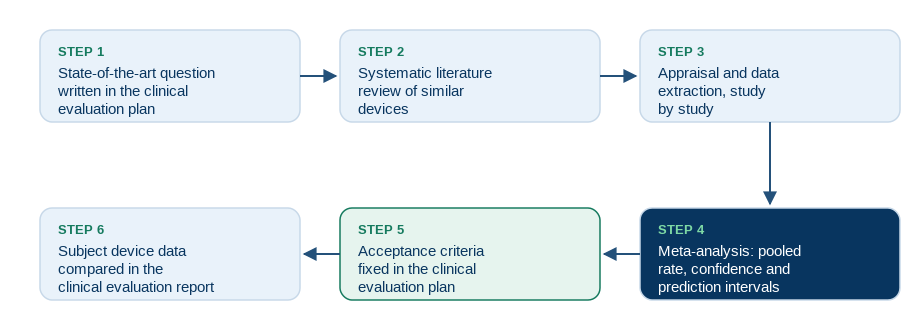
3. Defining the Question Before the Search
The question is written into the clinical evaluation plan before the literature is searched. It names five things.
- The device group. The devices whose results will form the benchmark, defined by technology, mechanism and intended purpose.
- The population. The patients, indication and setting that match the intended purpose of the subject device.
- The outcomes. Each safety and performance outcome, with its definition. For example, major complications within 30 days, or technical success at the end of the procedure.
- The follow-up time. The time point at which each outcome is measured.
- The alternatives. The other treatment options the MDR asks the evaluation to consider [1].
Fixing these points first keeps the benchmark tied to the intended purpose of the subject device. It also means the acceptance criteria are set before the subject device's own results are compared with them.
4. The Systematic Literature Review
The MDR requires the available clinical data to be identified through a systematic scientific literature review [1]. It also requires all relevant clinical data to be appraised for their suitability for establishing the safety and performance of the device [1].
The PRISMA 2020 statement sets out how a systematic review is reported. It has a 27-item checklist and a flow diagram that shows how many records were screened, excluded and included [3]. The flow diagram can be placed in the CER as the record of the literature search.
EvySaif runs this step as a systematic literature review reported to PRISMA 2020. The protocol is written first, databases and trial registries are searched with documented search strings, and two reviewers screen each record against fixed inclusion criteria. The search strings, screening decisions and extraction tables are kept as appendices to the CER.
5. Features of Device Data That Change the Analysis
Five features of each study are recorded at data extraction, because each can change the pooled result.
Single-Arm Studies
A study without a control group gives one rate for each outcome, such as 13 complications in 210 patients. The meta-analysis then pools those rates.
Operator Learning Curves
The IDEAL-D framework for evaluating devices lists operator learning curves among the issues examined as a new device moves into wider use [8]. Where a study reports results from a center's first cases separately, those results are marked so they can be examined on their own.
Device Versions
The version of the device used in each study is recorded. Studies of earlier versions are analyzed separately in a sensitivity analysis.
Centers and Settings
The setting of each study, such as a specialist center or routine practice, is recorded and used to explain differences between studies.
Outcome Definitions
The outcome definition in each study is compared with the definition in the clinical evaluation plan. Studies are pooled only when the definitions match, or when the difference is small and is stated in the report.
6. Pooling Complication and Success Rates
A random-effects meta-analysis assumes that the true rate differs from study to study and estimates the average of those true rates [4]. The Cochrane Handbook states that random-effects meta-analyses allow for differences between studies, but must be interpreted carefully [4].
Rates need a model built for proportions. One two-step method transforms each study's rate with the Freeman-Tukey double arcsine transformation before pooling. Schwarzer and colleagues showed that converting the pooled result back to a rate with this transformation can give seriously misleading results [5]. A later analysis concluded that the transformation is not appropriate for meta-analysis [6].
Generalized linear mixed models (GLMMs) are an alternative [5, 7]. They analyze the event counts directly in one step and account for the uncertainty within each study [7]. For a rate, the model uses a logit link, so the pooled result is a rate between 0% and 100%.
EvySaif uses a logit GLMM as the primary model for pooled rates, with a two-step logit analysis as a sensitivity check. The same methods support the meta-analysis services EvySaif provides for drugs and medical devices.
7. From Pooled Rate to Acceptance Criterion
The 95% confidence interval around a pooled rate shows the uncertainty in the average rate across studies. The 95% prediction interval shows the range in which the true rate of a new study, in a similar setting, is expected to fall [9]. Riley and colleagues explained that a prediction interval gives a more complete summary of a random-effects meta-analysis than the average alone [9]. The Cochrane Handbook describes prediction intervals as a useful way to present the extent of variation between studies [4].
A criterion based on the confidence interval asks whether the subject device matches the average of current devices. A criterion based on the prediction interval asks whether its result lies within the range that current devices achieve in individual studies. The clinical evaluation plan states which interval is used for each outcome, and why. Annex XIV requires the parameters to be specified in the plan [1].
For a safety outcome, such as a complication rate, the threshold is the upper limit of the chosen interval. For a performance outcome, such as a success rate, it is the lower limit.
8. A Worked Example
The data in this example are hypothetical and do not describe any real device.
A clinical evaluation plan defines the outcome as major complications within 30 days. The literature review finds eight single-arm studies of similar devices. Study A, from 2015, used a first-generation version of the device. The other seven studies used the current generation.
Table 1. Hypothetical studies included in the example
| Study | Year | Device generation | Events / patients | Complication rate |
|---|---|---|---|---|
| Study A | 2015 | First | 14 / 120 | 11.7% |
| Study B | 2017 | Current | 13 / 210 | 6.2% |
| Study C | 2018 | Current | 5 / 95 | 5.3% |
| Study D | 2019 | Current | 17 / 340 | 5.0% |
| Study E | 2020 | Current | 9 / 150 | 6.0% |
| Study F | 2021 | Current | 16 / 410 | 3.9% |
| Study G | 2023 | Current | 8 / 180 | 4.4% |
| Study H | 2024 | Current | 12 / 260 | 4.6% |
A random-effects logit GLMM was fitted to all eight studies, and again to the seven current-generation studies.
Table 2. Pooled results for the hypothetical example
| Analysis | Patients | Pooled rate | 95% confidence interval | 95% prediction interval |
|---|---|---|---|---|
| All 8 studies | 1,765 | 5.4% | 4.3% to 6.7% | 3.4% to 8.4% |
| Current-generation devices (7 studies) | 1,645 | 4.9% | 3.9% to 6.0% | 3.7% to 6.4% |
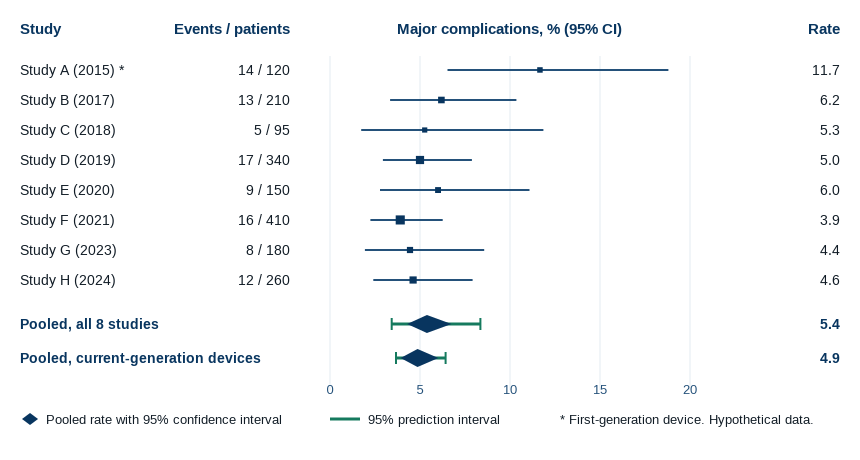
Study A has a higher rate than the others, at 11.7%. Including it raises the pooled rate from 4.9% to 5.4% and widens the prediction interval from 3.7% to 6.4% to 3.4% to 8.4%.
If the plan uses the upper limit of the confidence interval for current-generation devices, the subject device's complication rate is judged against 6.0%. If it uses the upper limit of the prediction interval, the threshold is 6.4%. If the first-generation study were included, the same two thresholds would rise to 6.7% and 8.4%, and the benchmark would be easier to meet. The clinical evaluation plan states whether studies of earlier device versions are included, and why.
9. Comparisons With Other Technologies
The MDR asks the clinical evaluation to consider currently available alternative treatment options [1]. When the alternative is a different type of device, a drug or surgery, the result needed is a relative effect between the treatments, such as a risk ratio.
Where randomized trials compare the subject device type with an alternative, a pairwise meta-analysis of those trials gives the relative effect. Where several alternatives exist and no trial compares all of them, a network meta-analysis can combine direct and indirect evidence. The methods and the checks that decide whether a network is feasible are covered in the EvySaif guides to network meta-analysis and NMA feasibility assessment.
Comparative evidence of this kind is also the subject of EU health technology assessment. Joint clinical assessments under the EU HTA Regulation provide a scientific analysis of the relative effects of a health technology on health outcomes [10]. In October 2026 the European Commission adopted its first decision selecting two medical devices for joint clinical assessment, both for cardiovascular disease [11]. By November 2026 it had selected a third device [10].
10. Reporting and Updating
The meta-analysis is reported in the CER with the protocol, the PRISMA flow diagram, the appraisal of each study, the extraction tables, the forest plots and the sensitivity analyses. Each acceptance criterion is stated next to the analysis it came from, so a reviewer can trace the threshold back to the studies.
The CER must be updated throughout the life cycle of the device with PMCF data [1]. When the meta-analysis is kept with its search strings, extraction tables and code, each update reruns the same analysis with the new studies added. EvySaif prepares the clinical evaluation report and the post-market surveillance documents from the same evidence base, so the benchmark, the CER and the PMCF plan stay consistent.
11. Medical Device Meta-Analysis Support From EvySaif
EvySaif Research and Medical Affairs Solutions is one of the leading clinician-led HEOR and evidence synthesis consultancies in India. Its team runs systematic reviews and meta-analyses of medical devices for clients in the device industry.
State-of-the-Art Benchmarks for the CER
EvySaif defines the state-of-the-art question with the manufacturer's clinical team, runs the systematic literature review and pools the outcomes that the clinical evaluation plan names. The result is a benchmark table for each outcome, with its pooled rate, confidence interval and prediction interval.
Acceptance Criteria for the Clinical Evaluation Plan
EvySaif drafts the acceptance criteria and the justification for each one, including the interval used and the studies included, for the clinical evaluation plan.
Comparative Evidence and Network Meta-Analysis
Where the device must be compared with alternative treatments, EvySaif runs pairwise and network meta-analyses of the comparative trials.
CER Updates and PMCF
EvySaif keeps the search strategy, extraction tables and analysis code for each review, so the benchmark can be updated for each CER revision and for the technical documentation and summary of safety and clinical performance.
EvySaif is a clinician-led medical writing, regulatory affairs, HEOR and drug clinical development consultancy. To discuss a state-of-the-art meta-analysis for a device, contact EvySaif.
12. Frequently asked questions
The MDR requires a systematic scientific literature review and a critical evaluation of the relevant scientific literature [1]. A meta-analysis is one way to summarize the results of that review when several studies report the same outcome.
MDCG 2020-6 uses the IMDRF definition: the developed stage of current technical capability and/or accepted clinical practice, based on the relevant consolidated findings of science, technology and experience [2]. It does not necessarily mean the most technologically advanced solution [2].
The clinical evaluation plan sets out the parameters used to judge, based on the state of the art in medicine, whether the benefit-risk ratio is acceptable [1]. A pooled rate from a meta-analysis of similar devices, with its confidence or prediction interval, can provide the threshold for each outcome.
Yes. Each single-arm study reports one rate, and a meta-analysis of proportions pools those rates. A generalized linear mixed model analyzes the event counts directly [7].
Its back-transformation can give seriously misleading results in a meta-analysis of single proportions [5], and a later analysis concluded that it is not appropriate for meta-analysis [6]. A generalized linear mixed model is an alternative [5, 7].
The confidence interval shows the uncertainty in the average rate across studies. The prediction interval shows the range in which the true rate of a new study in a similar setting is expected to fall [9].
The version used in each study is recorded at data extraction, and studies of earlier versions are analyzed separately in a sensitivity analysis. In the worked example, removing one first-generation study lowered the pooled complication rate from 5.4% to 4.9%.
The clinical evaluation must be updated throughout the life cycle of the device with PMCF data [1]. The meta-analysis is rerun with the same methods each time the CER is updated.
References
- Regulation (EU) 2017/745 of the European Parliament and of the Council of 5 April 2017 on medical devices. Article 2, Article 61 and Annex XIV. https://eur-lex.europa.eu/legal-content/EN/TXT/HTML/?uri=CELEX:32017R0745
- Medical Device Coordination Group. MDCG 2020-6: Regulation (EU) 2017/745: Clinical evidence needed for medical devices previously CE marked under Directives 93/42/EEC or 90/385/EEC. April 2020. https://ec.europa.eu/docsroom/documents/40904/attachments/1/translations/en/renditions/native
- Page MJ, McKenzie JE, Bossuyt PM, et al. The PRISMA 2020 statement: an updated guideline for reporting systematic reviews. BMJ. 2021;372:n71. https://doi.org/10.1136/bmj.n71
- Deeks JJ, Higgins JPT, Altman DG, et al. Chapter 10: Analysing data and undertaking meta-analyses. In: Higgins JPT, Thomas J, Chandler J, et al, eds. Cochrane Handbook for Systematic Reviews of Interventions. Cochrane. https://training.cochrane.org/handbook/current/chapter-10
- Schwarzer G, Chemaitelly H, Abu-Raddad LJ, Rücker G. Seriously misleading results using inverse of Freeman-Tukey double arcsine transformation in meta-analysis of single proportions. Res Synth Methods. 2019;10(3):476-483. https://doi.org/10.1002/jrsm.1348
- Röver C, Friede T. Double arcsine transform not appropriate for meta-analysis. Res Synth Methods. 2022;13(5):645-648. https://doi.org/10.1002/jrsm.1591
- Lin L, Chu H. Meta-analysis of proportions using generalized linear mixed models. Epidemiology. 2020;31(5):713-717. https://doi.org/10.1097/EDE.0000000000001232
- Sedrakyan A, Campbell B, Merino J, Kuntz R, Hirst A, McCulloch P. IDEAL-D: a rational framework for evaluating and regulating the use of medical devices. BMJ. 2016;353:i2372. https://doi.org/10.1136/bmj.i2372
- Riley RD, Higgins JPT, Deeks JJ. Interpretation of random effects meta-analyses. BMJ. 2011;342:d549. https://doi.org/10.1136/bmj.d549
- European Commission. Joint clinical assessments under the Regulation on health technology assessment. https://health.ec.europa.eu/health-technology-assessment/implementation-regulation-health-technology-assessment/joint-clinical-assessments_en
- European Commission, Directorate-General for Health and Food Safety. HTA Regulation: Commission selects first medical devices for joint clinical assessment. eNews, October 6, 2026. https://ec.europa.eu/newsroom/sante/newsletter-archives/80023
Last reviewed: November 2026. This article is general information for education; verify requirements and figures against current official sources for any specific project.