
What EMA, FDA, MHRA, WHO and CDSCO now expect of a biosimilar dossier, how the analytical, PK, immunogenicity and efficacy evidence is designed, what India requires, and how the same evidence carries into market access.
A biosimilar is a biological medicinal product that is highly similar to an authorized reference biological product, with no clinically meaningful differences in quality, safety or efficacy.1,4,8 In India the regulatory term is similar biologic; the New Drugs and Clinical Trials Rules, 2019 define it as a biological product similar in quality, safety and efficacy to a reference biological product licensed in India or approved in an International Council for Harmonisation (ICH) member country, and the Central Drugs Standard Control Organization (CDSCO) treats the two terms as synonymous.4
Between May 2021 and March 2026 the principal regulators revised their expectations for biosimilar clinical evidence. The Medicines and Healthcare products Regulatory Agency (MHRA) of the United Kingdom issued guidance in May 2021 stating that a comparative efficacy trial may not be necessary in most cases.6 The World Health Organization (WHO) replaced its 2009 guideline on similar biotherapeutic products in 2022.8 CDSCO published a draft revision of India's Guidelines on Similar Biologics on 6 May 2025.4 The US Food and Drug Administration (FDA) issued draft guidance on 29 October 2025 proposing that comparative efficacy studies may not be needed for therapeutic protein biosimilars meeting specified prerequisites.7 The European Medicines Agency (EMA) adopted a reflection paper on a tailored clinical approach on 16 March 2026.1 Each of these documents shifts the evidential weight of the biosimilar dossier from the comparative efficacy trial to analytical, functional, pharmacokinetic (PK) and immunogenicity data, on the shared premise that a comparative analytical assessment is more sensitive than a clinical efficacy study for detecting differences that could affect biosimilarity.1,6,7 The regulators continue to differ on the acceptable reference product, the requirement for animal studies, interchangeability and post-marketing obligations.
At a glance
| Regulators covered | EMA, FDA, MHRA, WHO and CDSCO (India), with GCC reliance pathways |
| Key documents | EMA reflection paper EMA/CHMP/BMWP/60916/2025 (adopted 16 March 2026); FDA draft guidance, docket FDA-2011-D-0605 (October 2025); MHRA licensing guidance (May 2021, updated November 2022); CDSCO Draft Guidelines on Similar Biologics 2025 (6 May 2025); WHO TRS 1043 Annex 3 (2022) |
| Decisive evidence | Analytical and functional comparability, comparative PK study, comparative immunogenicity; efficacy trial reserved for residual uncertainty |
| India status | 2016 Similar Biologics guideline in force; 2025 draft published for comment, not yet notified; post-marketing Phase IV study required |
| Download | Biosimilar Evidence Expectation Matrix 2026 (PDF) |
1. Biosimilar versus Generic: Why Biosimilar Development Requires a Comparability Exercise
Recombinant therapeutic proteins are synthesized in living expression systems, and their post-translational modifications, charge variants, glycoforms and aggregate content vary with the cell line, culture conditions, purification process and formulation.4,8 Consecutive batches of a single originator product differ from one another within a manufacturing control range. Chemical identity, the basis of generic approval, therefore cannot be demonstrated for a biosimilar. The biosimilar comparability exercise instead establishes, attribute by attribute, that the candidate lies within the range of variability displayed by marketed batches of the reference product, and then confirms in humans that any residual uncertainty has no clinical consequence.1,4,8
| Feature | Conventional generic | Biosimilar |
|---|---|---|
| Active substance | Small molecule, chemically synthesized | Protein produced in living cells |
| Structure | Fully defined and reproducible | Complex, with inherent heterogeneity |
| Core evidence | Pharmaceutical equivalence plus bioequivalence | Comprehensive comparability exercise against the reference product |
| Analytical work | Identity, purity, dissolution | Orthogonal physicochemical and functional characterization across multiple batches |
| Clinical work | Usually one bioequivalence study | Comparative PK study, pharmacodynamic (PD) markers where available, immunogenicity, and a comparative efficacy trial only where residual uncertainty requires it |
| Regulatory pathway | Abbreviated generic application | Dedicated biosimilar or similar biologic pathway |
| Extrapolation | Not applicable | Indications of the reference product can be extrapolated with scientific justification |
2. Biosimilar Regulatory Requirements in 2026: EMA, FDA, MHRA, WHO and CDSCO
Approved biosimilars for each molecule, with approval months, application numbers and holders across FDA, EMA, PMDA, Health Canada, CDSCO and the UAE, are listed in the EvySaif Biosimilar Atlas; FDA interchangeability designations are tracked on the interchangeable biosimilars page, and the molecules with biosimilars in Europe but none yet in India on the market-by-market matrix. An overview of the global biosimilar landscape and of the Atlas itself is given in Biosimilars in 2026: The Global Landscape and the EvySaif Biosimilar Atlas.
| Regulator and document | Status | Comparative efficacy trial | Animal studies |
|---|---|---|---|
| MHRA, Guidance on the licensing of biosimilar products, 6 May 20216 | In force | In most cases may not be necessary if sound scientific rationale supports this | In vivo animal studies not requested |
| WHO, Guidelines on evaluation of biosimilars, TRS 1043 Annex 3, 20228 | In force; replaces TRS 977 Annex 2 (2009) | Tailored clinical package; not required where other evidence is sufficient | In vivo studies only where in vitro data leave residual uncertainty |
| CDSCO and Department of Biotechnology (DBT), Draft Guidelines on Similar Biologics 2025, notice of 6 May 20254 | Draft; 2016 guideline remains in force | Adequately powered comparative efficacy and safety trial not necessary if sufficient similarity is shown elsewhere in the exercise | Toxicity study waiver against ten conditions; in vivo studies expected to be rare |
| FDA, draft guidance of 29 October 20257 | Draft | May not be needed where the comparative analytical assessment plus a PK similarity study support high similarity, subject to three prerequisites | Addressed under separate guidance |
| EMA, Reflection paper on a tailored clinical approach in biosimilar development, EMA/CHMP/BMWP/60916/20251 | Adopted by CHMP 16 March 2026 | Analytical comparability plus PK data can be sufficient under specific prerequisites | Exceptional under the 2014 revised nonclinical and clinical guideline |
EMA Biosimilar Guidance: The Tailored Clinical Approach Reflection Paper (March 2026)
The EMA reflection paper was released for public consultation on 27 March 2025, received 400 comments by the 30 September 2025 deadline, and was adopted by the Committee for Medicinal Products for Human Use (CHMP) on 16 March 2026.1,2 The paper states that advances in analytical characterization, together with EMA's experience in approving manufacturing changes to biological medicines through confirmation of structural and functional comparability, support the position that under specific prerequisites an analytical comparability exercise and PK data can be sufficient to demonstrate biosimilarity.1 For candidates that can be thoroughly characterized by state-of-the-art analytical methods and that have demonstrated physicochemical and functional similarity, a comparative efficacy study is no longer expected. Safety and immunogenicity continue to be assessed, ordinarily within the comparative PK study and through the risk management plan.1
FDA Biosimilar Guidance: Comparative Efficacy Studies No Longer the Default (October 2025 Draft)
FDA's draft guidance of 29 October 2025 states that where the comparative analytical assessment supports a demonstration that the proposed biosimilar is highly similar to its reference product, an appropriately designed human PK similarity study and an assessment of immunogenicity may be sufficient to evaluate clinically meaningful differences, and that a comparative efficacy study may then not be necessary.7 The streamlined approach should be considered when three conditions hold: the reference product and the proposed biosimilar are manufactured from clonal cell lines, are highly purified and can be well characterized analytically; the relationship between quality attributes and clinical efficacy is understood for the reference product and those attributes can be evaluated in the comparative analytical assessment; and a human PK similarity study is feasible and clinically relevant.7 Locally acting products, exemplified by intravitreally administered products, are identified as a category in which comparative PK is not feasible or clinically relevant and a comparative efficacy study may still inform the demonstration; a comparative clinical study with a clinically relevant non-efficacy endpoint may also be useful in some cases.7 The draft attributes the lower sensitivity of efficacy studies to dose selection at pharmacological target saturation and to floor and ceiling effects in the study population and endpoint.7 The statutory route remains the 351(k) pathway under the Public Health Service Act, and the companion guidance on comparative analytical assessment for therapeutic protein biosimilars was finalized in September 2025.7
MHRA Biosimilar Guidance: No Animal Studies, Efficacy Trial Rarely Required
The MHRA guidance applies the CHMP biosimilar guidelines with two revisions. In vivo animal studies are not requested, on the ground that they do not contribute to resolving whether a candidate is highly similar to its reference product. Although each development is evaluated case by case, in most cases a comparative efficacy trial may not be necessary if sound scientific rationale supports that approach; the application must include a justification for the absence of an efficacy trial supported by the comparative analytical and functional data.6 The guidance was updated on 7 November 2022 to state that an authorized biosimilar is considered interchangeable with its reference product and with other biosimilars of the same reference product.6
WHO Biosimilar Guidelines: TRS 1043 Annex 3 (2022)
The WHO Guidelines on evaluation of biosimilars were published in 2022 as Annex 3 of Technical Report Series 1043, replacing the 2009 guideline on similar biotherapeutic products (TRS 977 Annex 2).8 The 2022 guideline tailors the clinical data package to the residual uncertainty remaining after quality and in vitro comparison, and restricts in vivo animal studies to cases in which in vitro data leave uncertainty that cannot be resolved by other means. The CDSCO 2025 draft cites TRS 1043 as its principal international reference.4
CDSCO Similar Biologics Guidelines: 2016 in Force, 2025 Draft Pending
India's Guidelines on Similar Biologics were first issued by CDSCO and DBT in 2012 and revised in 2016.4,5 On 6 May 2025 CDSCO placed a draft revision in the public domain for a 30-day comment period. The draft states that it replaces the 2016 guideline once finalized and that minimal scope for change will remain after finalization.4 As of this writing the CDSCO website continues to list the document as a draft inviting comments, and no final notification has been published. The 2016 guideline is therefore the operative text, and the requirements of both are described below.
3. Biosimilar Evidence Architecture: The Totality-of-Evidence Sequence
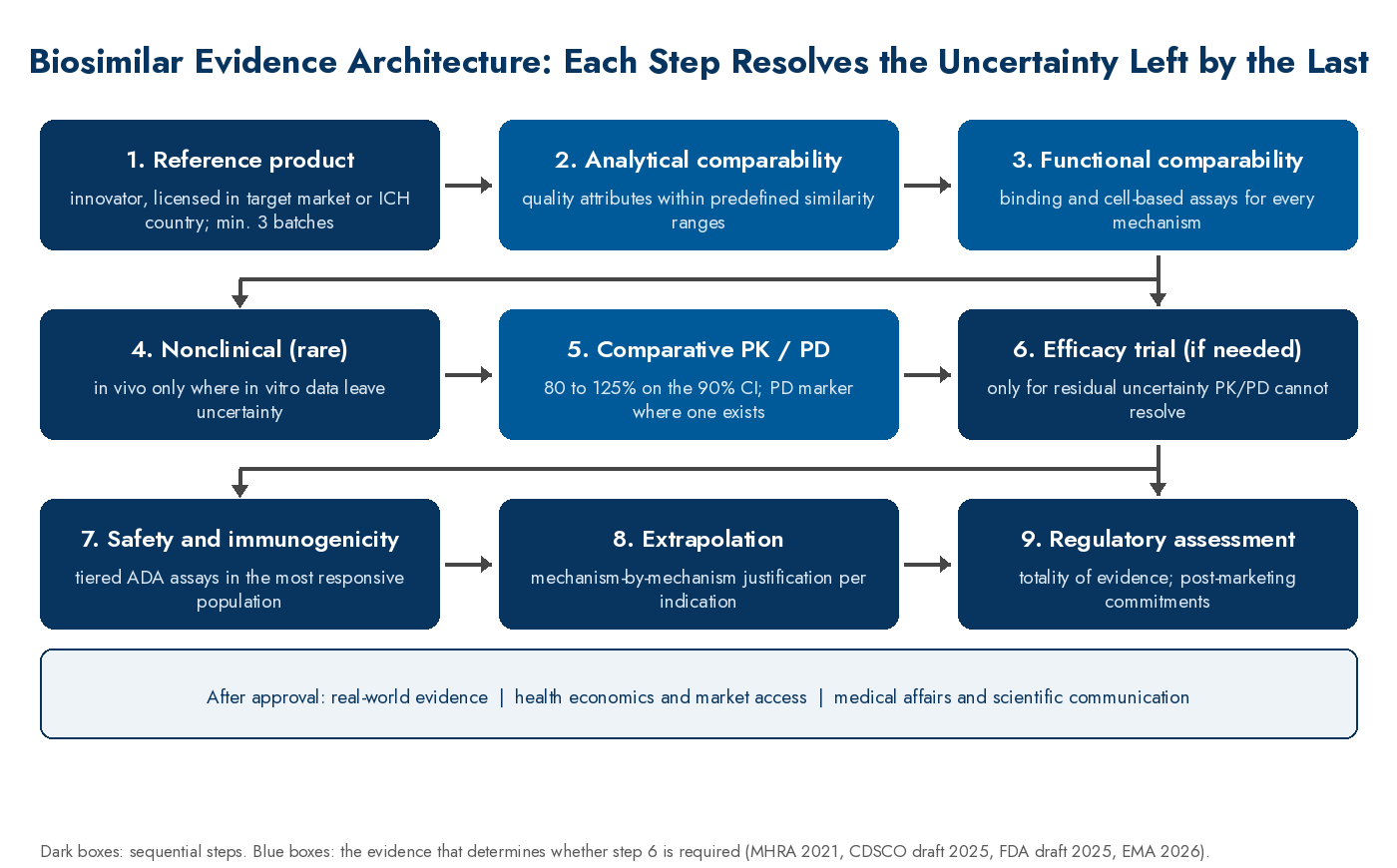
A biosimilar program is a sequence of comparability steps in which the data from each step determine the scope of the next: reference product selection; analytical comparability; functional comparability; nonclinical assessment where residual uncertainty remains; comparative PK and PD; comparative clinical efficacy where PK/PD cannot resolve residual uncertainty; safety and immunogenicity; extrapolation to unstudied indications; regulatory assessment and post-marketing commitments; and, after approval, real-world evidence, health economics, market access and medical communication.1,4,8 The regulatory conclusion rests on the totality of evidence rather than on any single study.4,7 Each study in the sequence is designed to resolve a specified residual uncertainty from the preceding step; a study without such a rationale is not required by any of the current guidelines.
4. Reference Product Selection for Biosimilar Development in India, EU, UK and US
Under the CDSCO 2025 draft, the reference biological product (RBP) must be the innovator's product, licensed on a full quality, safety and efficacy data package in India or in an ICH country, defined for this purpose as the USA, UK, Japan, Australia, Canada and the EU.4 A similar biologic cannot serve as the reference. An RBP not marketed in India may be imported for the comparability exercise. The same RBP must be used throughout the quality, nonclinical and clinical comparability program. Dose and route of administration must be identical to the RBP; strength, fill volume, pharmaceutical form, formulation, excipients and presentation may differ with justification. Acceptance of an innovator product as the RBP does not constitute approval of that product for use in India.4
The EU and the US each require a reference product authorized in their own jurisdiction, with analytical and, where relevant, clinical bridging data when a comparator from another jurisdiction is used in the clinical studies.1,7 The UK accepts an EU reference product where evidence shows it is representative of the UK product.6
For a program intended for India, the Gulf Cooperation Council markets, the EU, the UK and the US, reference product sourcing determines whether a single comparator lot can be shown representative across all target markets or whether multi-way analytical bridging will be required. The CDSCO draft requires a minimum of three RBP batches for the establishment of similarity ranges, sourced over an extended period, across manufacturing campaigns and with expiry dates distributed across the shelf life; the RBP batches used in the clinical studies should be included in the analytical comparison.4 Manufacturing changes to the RBP during the development period can shift the similarity ranges and must be monitored. Reference product sourcing and bridging strategy is the first deliverable of EvySaif's biosimilar regulatory consulting engagement, described on the regulatory strategy consulting page.
5. Analytical Comparability for Biosimilars: Quality Attributes, Batches and Similarity Ranges
Analytical comparability provides the essential rationale for predicting that the clinical safety and efficacy profile of the RBP applies to the similar biologic, and under the 2025 and 2026 regulatory documents it is the principal determinant of whether a comparative efficacy trial is required.1,4,7
Quality Attributes Compared in a Biosimilar Analytical Similarity Assessment
Following ICH Q6B, the CDSCO draft requires characterization of primary structure, higher order structure, post-translational modifications, biological activity, purity, impurities, product-related substances and immunochemical properties.4,9 The amino acid sequence must be confirmed identical to the RBP; low-level sequence variants arising from amino acid misincorporation during high-level expression must be identified, controlled and assessed for potential clinical impact. Structural heterogeneity to be compared includes C-terminal processing, N-terminal pyroglutamate formation, deamidation, oxidation, isomerization, fragmentation, disulfide bond mismatch and free sulfhydryl groups, N-linked and O-linked glycosylation, glycation and aggregation.4
For monoclonal antibodies, specificity, affinity and binding kinetics to the neonatal Fc receptor, complement component C1q and Fcγ receptors are compared using surface plasmon resonance or biolayer interferometry, together with assays of antibody-dependent cellular cytotoxicity (ADCC), antibody-dependent cellular phagocytosis (ADCP) and complement-dependent cytotoxicity (CDC) where relevant to the mechanism of action. The correlation between glycan pattern and Fc-mediated effector function should be established where possible, since that correlation permits interpretation of a glycan difference in terms of its functional consequence.4
Batch Requirements for Biosimilar Comparability
The number of batches depends on the criticality of the attribute and the statistical approach to similarity.4 The CDSCO draft requires inclusion of all commercial-scale batches, including process performance qualification and clinical batches, and of the three consecutive standardized batches used to demonstrate manufacturing consistency. Each value in the dataset must derive from an independent batch, defined as one drug product batch produced from one drug substance batch. Pilot-scale batches may be included only where comparability to commercial scale has been demonstrated. RBP batches must be tested within shelf life and should include batches of different ages.4
Because RBP drug substance is not commercially available, the comparability exercise is ordinarily performed on the RBP drug product. Excipients must be shown not to interfere with the analytical methods. Where the RBP drug substance is isolated from the formulated product before characterization, data must demonstrate that the isolation procedure does not alter product heterogeneity or the attributes under study.4
Statistical Similarity Ranges: x-Sigma, Min-Max and Tolerance Intervals
The most common approach to similarity assessment demonstrates that the quality attributes of the candidate batches lie within predetermined similarity ranges derived from multiple RBP batches.4 The CDSCO draft describes three methods of range construction. The x-sigma interval (mean plus or minus x standard deviations of the RBP data) is the most frequently applied; the multiplier x must be justified and should be smaller for attributes of higher criticality. The minimum-maximum range of observed RBP data is clinically qualified, because those batches were marketed, but carries a high risk of a false-negative conclusion when few batches are available; the draft nevertheless recommends it for the toxicity waiver assessment because it does not require a large number of RBP batches. Tolerance intervals require a large number of RBP batches, and with limited batches or inappropriate parameterization produce ranges wider than the actual RBP variability and a correspondingly high risk of a false-positive conclusion.4
The overall similarity criterion, usually that 90 to 100 percent of candidate batches fall within the range, must be fixed before the assessment begins. Ranges should not exceed the batch-to-batch variability of the RBP unless a wider range is justified, for example where lower impurity levels are acceptable. Equivalence testing of means may be proposed as an alternative approach.4 Selection and justification of the statistical approach, and its agreement with the regulator in scientific advice, is a defined component of the pre-development assessment EvySaif provides through clinical development consulting.
Interpreting Analytical Differences Between a Biosimilar and Its Reference Product
Minor differences between the candidate and the RBP are expected. A quality attribute that fails its similarity criterion is treated as a potential signal of non-similarity and assessed for clinical impact. For low-criticality attributes, reference to published data is ordinarily sufficient. Lower impurity levels, or differences in attributes present at very low levels in both products, are generally predicted to have no clinical relevance and may be accepted without further assessment. For higher-criticality attributes, functional assays addressing the possible clinical impact are expected. A difference that alters the PK of the product such that the dosing scheme changes precludes classification as a similar biologic.4
6. Functional Comparability: Binding and Cell-Based Assays for Biosimilars
Functional comparability establishes that the candidate exhibits the same biological activity as the RBP at every target relevant to the approved indications. The CDSCO draft, consistent with WHO and EMA, requires a battery of in vitro studies addressing the primary binding events together with cell-based or tissue-based functional assays that collectively cover the pharmaco-toxicological activities of potential clinical relevance for the product class.4,8 For an IgG-based monoclonal antibody this comprises Fab-associated binding to the antigen, Fc-associated binding to representative isoforms of the Fc receptors and to C1q, and functional assays of ADCC, ADCP and CDC where these mechanisms apply.4
The assays must be comparative and sufficiently sensitive to detect clinically relevant differences, and must compare the concentration-activity relationship on the ascending portion of the curve, where differences are most detectable.4 Target-binding assays are generally less variable than cell-based assays; the draft recommends assays of high precision, automated equipment and critical reagents calibrated against WHO or national reference standards (tumor necrosis factor alpha reference material for anti-TNF potency assays is the cited example), since an assay of high variability cannot detect a small but real difference.4 The dossier must discuss the degree to which each in vitro assay can be considered predictive of the clinical situation.
The interpretive distinction is between an observed difference and a clinically meaningful difference. A glycan difference that produces no change in FcγRIIIa binding and no change in ADCC constitutes an observed difference with a demonstrated absence of functional consequence, and it is evidence of this type that the MHRA, EMA and FDA documents accept in place of a comparative efficacy trial.1,6,7
7. Nonclinical Studies for Biosimilars and the Animal Study Waiver
Nonclinical evaluation follows the 3Rs principles (Replace, Reduce, Refine), which the CDSCO draft notes are mandated under the NDCT Rules 2019.4 The MHRA does not request in vivo animal studies.6 EMA's revised nonclinical and clinical guideline of 2014 treats them as exceptional.1 The CDSCO draft states that the need for additional in vivo animal studies is expected to represent a rare scenario and specifies ten conditions for a toxicity study waiver: an established expression system; an amino acid sequence identical to the RBP; strength, route of administration, human dose and indications identical to the RBP; analytical methods of adequate sensitivity and specificity; identification and relative quantification of all product-related variants; characterization, identification and quantification of product-related impurities as defined in ICH Q6B; identification of quality attributes from the draft's Annexure II supplemented by mechanism-specific attributes; acceptance limits derived from a minimum of three RBP batches, with the minimum-maximum approach recommended; RBP batches selected across the shelf life; and state-of-the-art analytical techniques with a submitted CMC summary.4
A waiver may not be granted where a difference cannot be excluded as having a safety impact, where a novel excipient is used for the first time in a biological product by the claimed route, where a clinical study is planned by a route not approved for the RBP, or where the planned human dose exceeds the RBP's approved dose.4 Where an in vivo study is required, it is conducted in a pharmacologically relevant species with a refined design (a single dose level, a single sex, no recovery animals, or in-life endpoints only, where justified). Repeat-dose toxicity studies in non-human primates are not recommended. Safety pharmacology, reproductive and developmental toxicity, genotoxicity and carcinogenicity studies are not warranted for a similar biologic. Where the quality and in vitro comparison reveals relevant differences, standalone development is the indicated route.4
8. Biosimilar PK Study Design, Acceptance Criteria and PD Markers
The comparative PK study is the pivotal clinical study in most current biosimilar programs.1,4,7 The principles of PK parameters and bioequivalence statistics are described in the EvySaif PK/PD guide; the requirements specific to biosimilars are summarized here from the CDSCO draft, which is consistent with EMA practice.4
Biosimilar PK Study Design: Crossover versus Parallel
The preferred design is a randomized, two-period, two-sequence, single-dose crossover study in healthy volunteers, standardized for factors influencing PK variability (ethnicity, body weight, sex), at a dose within the therapeutic range at which differences are detectable. The washout period must be at least five terminal half-lives so that concentrations are below the lower limit of quantification at the start of the second period.4 A parallel-group design is used where crossover is unsuitable, as for most monoclonal antibodies with long half-lives or immunogenicity affecting PK; the groups must be balanced for the same covariates, and any covariate adjustment (stratification by body weight and sex for adalimumab is the cited example) must be prespecified in the statistical analysis plan.4
Where the RBP is approved by both intravenous and subcutaneous routes, the subcutaneous route is preferred for the PK study because it is the more immunogenic route and yields more information for the comparability exercise; omission of a PK study by another approved route requires justification.4 A multiple-dose study in patients is acceptable as the pivotal PK study only where a single-dose study in healthy volunteers is precluded by safety or tolerability, and requires justification because multiple dosing is less sensitive to differences in maximum concentration. Published population PK or PK/PD models of the RBP may be used to refine dose, population and sample size.4 EvySaif designs biosimilar PK and PK/PD studies, including population selection, sample size and the statistical analysis plan, as part of its clinical development consulting service.
PK Parameters and the 80 to 125 Percent Acceptance Range
The comparison addresses the rate and extent of absorption and includes a descriptive analysis of clearance and elimination half-life. Linear (nonspecific) and nonlinear (target-mediated) clearance are evaluated through partial areas under the curve.4 Acceptance criteria must be predefined and justified; the conventional 80 to 125 percent equivalence range for the 90 percent confidence interval of the primary parameters is in most cases sufficiently conservative. Correction for protein content may be accepted case by case if prespecified. PK studies in special populations and drug interaction studies are not required.4
The bioanalytical method must quantify the protein in a matrix containing other proteins, and the same assay must be used for both products. A single assay using one set of binding reagents and a single analytical standard is acceptable where bioanalytical comparability is demonstrated. Where an endogenous counterpart contributes to the measured concentration, the baseline correction method must be described and justified.4
Pharmacodynamic Markers That Can Replace an Efficacy Trial
PD parameters are investigated alongside the PK study wherever a relevant marker exists, using doses on the steep portion of the dose-response curve.4 Comparative PK and/or PD studies may provide the confirmatory clinical evidence in place of an efficacy trial where the acceptance ranges are predefined and justified, the PD biomarker reflects the mechanism of action, the biomarker is sensitive to differences between the products, and the biomarker assay is validated.4
| Product class | Confirmatory PD approach4 |
|---|---|
| Insulins | Euglycemic clamp in non-obese healthy volunteers or patients with type 1 diabetes; insulin-resistant patients with type 2 diabetes are a less discriminating test system |
| Granulocyte colony-stimulating factor | Absolute neutrophil count and CD34+ cell count in healthy volunteers |
| Epoetins | Hemoglobin as a PD endpoint in patients |
| Denosumab | Serum C-terminal telopeptide of type 1 collagen (CTX-1), procollagen type 1 N-terminal propeptide (P1NP) and bone mineral density within the PK study |
| Low molecular weight heparins | Anti-FXa and anti-FIIa activity, since serum concentration cannot be measured |
| Eculizumab | Lactate dehydrogenase as a marker of intravascular hemolysis |
PK similarity cannot be established for substances that cannot be measured in blood (heparin fractions), for routes without systemic exposure (intraocular aflibercept and ranibizumab) and for products of very high PK variability (romiplostim); clinical similarity for these products is demonstrated through PD, immunogenicity or other clinical parameters.4 FDA's October 2025 draft identifies the same intravitreal exception.7
9. Biosimilar Comparative Efficacy Trials: When Required and How Designed
The CDSCO draft identifies the factors that determine whether an adequately powered comparative efficacy and safety trial is necessary: the ability to characterize the candidate thoroughly; the availability of sensitive, orthogonal assays and the extent of analytical and functional similarity demonstrated; the existence of a relevant PD marker; the degree of understanding of the mechanisms of action across indications and the extent to which each can be measured in vitro; and immunogenicity concerns, including anti-drug antibody (ADA) incidence, ADA magnitude, neutralizing antibodies and antibodies against endogenous proteins, together with concerns arising from the impurity profile or excipients.4 The draft cites teriparatide, insulin, G-CSF and somatropin as products that can be well characterized and states that monoclonal antibodies can be effectively characterized with advanced analytical methods because their structure-function relationships are defined and measurable.4
Where a trial is required, it is an adequately powered, randomized, controlled trial in a homogeneous patient population that permits sensitive measurement of the intended clinical parameters.4 An equivalence design with lower and upper comparability margins is preferred. A non-inferiority design may be justified for products with very high response rates (above 90 percent), where an upper margin is difficult to set, or where a wide safety margin exists. Asymmetric margins may be used where the study dose lies near the plateau of the dose-response curve and dose-related toxicity is unlikely; the narrower limit excludes inferior efficacy and the broader limit excludes superior efficacy. Margins must be prespecified and justified as the largest difference that would not matter in clinical practice.4 Primary endpoints may replicate those of the RBP's pivotal trials, for which historical data support the margin and sample size, or may be more sensitive endpoints or earlier time points with justification; the cited example is assessment of adalimumab response at week 12 or 16 in addition to week 24. Agreement with the regulator on design, population, endpoints, effect size and margins before trial initiation is recommended.4 Protocol requirements are described in the clinical trial protocol writing service page and reporting requirements in the ICH E3 clinical study report guide.
10. Biosimilar Immunogenicity Assessment: Risk, Assays and Clinical Evaluation
Safety data are collected throughout clinical development. Where the clinical program is limited to confirmatory PK/PD studies, a documented risk assessment of the need for additional safety data is required. For insulin, hypoglycemia is a consequence of the pharmacological action, and highly similar physicochemical and PK/PD profiles can be sufficient to establish a comparable hypoglycemia risk; the same reasoning applies to teriparatide, filgrastim and somatropin, and emerging data support its extension to monoclonal antibodies.4 Impurities absent from the RBP, for example those arising from a novel expression system, require additional safety data or a scientific justification for their omission.4
Immunogenicity Risk Assessment
Immunogenicity is evaluated in comparison to the RBP unless a scientific justification for omitting human immunogenicity data is provided, based on the extent of physicochemical similarity and a documented risk assessment.4 The risk assessment addresses the nature, frequency and clinical significance of the RBP's immune response; quality factors (complexity of the drug substance, glycosylation, expression system, product- and process-related impurities, aggregates); excipients, container closure, stability, route and regimen; and patient factors (immune status, concurrent immunomodulatory treatment).4 Risk is highest for products with a non-redundant endogenous counterpart, such as epoetin, enzyme replacement therapies and coagulation factors, because neutralizing antibodies may cross-react with the endogenous protein; real-time neutralizing ADA testing is recommended for these products. For insulin, somatropin, filgrastim and teriparatide, where extensive clinical experience shows that immunogenicity does not affect safety or efficacy, immunogenicity studies may not be required where the candidate is highly similar and the risk assessment indicates low risk; the draft states that this approach may extend to monoclonal antibodies after consultation with the regulator.4
Anti-Drug Antibody Assay Strategy
A multi-tiered approach comprising screening and confirmatory immunoassays for binding ADA, followed by assays of ADA magnitude and neutralizing potential, is typically required.4 Relative immunogenicity is usually assessed with a single assay using the candidate's drug substance as the antigen for both treatment groups, which ensures detection of all antibodies against the candidate; the manufacturer must demonstrate that the method detects ADA to both products comparably. Drug interference, common in samples from patients treated with monoclonal antibodies, is managed by allowing time for drug clearance before sampling or by dissociating immune complexes. Neutralization assays are based on the product's potency assay; non-cell ligand-based assays are appropriate for products that bind a soluble ligand, and functional cell-based assays are recommended for high-risk products and those whose effector functions are critical. Isotype determination is performed where clinically relevant, for example following anaphylaxis.4
Clinical Immunogenicity Evaluation
Comparative immunogenicity data are generated in the population most likely to mount an immune response; for an epoetin approved in both renal anemia and chemotherapy-induced anemia, patients with renal anemia are selected.4 Sampling includes baseline samples to detect pre-existing antibodies, samples during treatment and, where indicated, post-treatment samples. Where ADA are known to influence the PK of the RBP, ADA rates and kinetics are assessed with prespecified subgroup comparisons of ADA-positive and ADA-negative subjects. A crossover PK design supports immunogenicity testing only where exposure before the switch is sufficient; otherwise a parallel extension or a separate immunogenicity study is required. The marketing application includes a comprehensive immunogenicity summary covering the risk assessment, assay validation, study duration, sampling schedule, dosing regimen, incidence, magnitude, neutralizing capacity, persistence and clinical correlates.4 EvySaif prepares the immunogenicity risk assessment and the integrated immunogenicity summary as part of its regulatory medical writing service.
11. Extrapolation of Indications for Biosimilars
A similar biologic qualifies for the indications of the RBP that were not studied in its own clinical program only where extrapolation is justified on the basis of comparability in quality, preclinical and clinical data, the available literature and whether the same mechanism of action operates in each indication.4 The justification is strongest where the functional assay battery covered every mechanism relevant to every indication, where the PK study was conducted in a discriminating population, and where immunogenicity data derive from the population at highest immune risk. Where the RBP acts through different mechanisms in different indications, for example an Fc effector mechanism in one indication and not in another, the extrapolation argument addresses each mechanism with functional data.4,8
12. Biosimilar Interchangeability by Market: EU, US, UK and India
Authorization as a biosimilar establishes similarity. Interchangeability and pharmacy-level substitution are determined separately in each jurisdiction. In the European Union, EMA and the Heads of Medicines Agencies issued a joint statement on 19 September 2022, updated on 21 April 2023, confirming that biosimilars approved in the EU are interchangeable with their reference medicine or with an equivalent biosimilar; decisions on substitution at pharmacy level remain with member states.3 In the United States, interchangeability is a distinct designation under section 351(k)(4) of the Public Health Service Act permitting pharmacy substitution without prescriber intervention, subject to state law; FDA's draft guidance update of June 2024 stated that switching studies are generally not needed to support the designation.7 In the United Kingdom, the MHRA guidance as updated on 7 November 2022 states that an authorized biosimilar is considered interchangeable with its reference product and with other biosimilars of the same reference product; biological medicines are prescribed by brand name, and switching is a prescriber decision.6 In India, neither the 2016 guideline nor the 2025 draft establishes an interchangeability designation, and substitution is governed by hospital formularies, tender contracts and prescriber decision.4,5 The interchangeability position of each market affects the medical affairs narrative, the pricing model and the real-world evidence plan, and is therefore established before launch.
13. Biosimilar Registration in India: CDSCO Similar Biologics Requirements
Legal Basis and Competent Authorities for Similar Biologics in India
Similar biologics are regulated under the Drugs and Cosmetics Act, 1940, the Drugs Rules, 1945, the New Drugs and Clinical Trials Rules, 2019, and the Rules for the Manufacture, Use, Import, Export and Storage of Hazardous Microorganisms or Genetically Engineered Organisms or Cells, 1989, notified under the Environment (Protection) Act, 1986.4 The Institutional Biosafety Committee (IBSC), constituted by any organization handling genetically engineered organisms, ensures on-site biosafety. The Review Committee on Genetic Manipulation (RCGM), under DBT, authorizes research and development involving Risk Group 3 and 4 organisms and the exchange of genetically engineered cell banks for research. CDSCO, headed by the Drugs Controller General of India, approves clinical trials, import for clinical trials, and import or manufacture for sale.4 The clinical trial application is submitted under the CDSCO Guidance for Industry 2024, and the quality dossier follows the CDSCO guidance on preparation of quality information for biotechnological and biological products.4 The general new drug process, including SUGAM filing and Subject Expert Committee review, is described in the drug registration in India guide.
CDSCO Similar Biologics Guidelines 2016 versus the 2025 Draft: What Changes
| Area | 2016 guideline (in force)5 | 2025 draft (proposed)4 |
|---|---|---|
| Basis | Stepwise comparability with a confirmatory clinical trial generally expected | Tailored clinical package; adequately powered comparative efficacy and safety trial not necessary where other evidence is sufficient |
| International reference | WHO 2009 guideline on similar biotherapeutic products | WHO TRS 1043 (2022), with alignment to EMA, FDA and MHRA practice |
| Analytical similarity | Characterization per ICH Q6B | Next-generation analytical methods, statistical intervals for similarity ranges, reference standards and in-house reference standards, expanded in vitro study list |
| Animal studies | Generally expected | Waiver against ten conditions; in vivo studies expected to be rare; 3Rs applied |
| Clinical PK | Comparative PK study | Crossover or parallel design, subcutaneous route preferred, 80 to 125 percent range, partial AUC for nonlinear clearance |
| PD and confirmatory PK/PD | Limited guidance | Named PD markers by product class; PK/PD may replace the efficacy trial under four conditions |
| Immunogenicity | Comparative assessment | Multi-tiered assay strategy, high-risk and low-risk product categories, possible waiver for low-risk products after consultation |
| Sample size | Not specified | Annexure on statistical considerations for clinical sample size |
| Pathway | Annexure describing approval steps | Separate annexures for indigenously developed (Annexure I) and imported (Annexure IA) similar biologics |
| Post-marketing | Risk management plan, pharmacovigilance and a post-marketing Phase IV study | Risk management plan, pharmacovigilance plan, ADR reporting and Phase IV study retained |
The draft has not been notified. A program filed in India in 2026 is designed to the standard of the draft, which is also the standard of the EU, UK and US documents, with the application of the 2016 requirements for confirmatory efficacy data and post-marketing studies confirmed with CDSCO in a pre-submission meeting. EvySaif acts as biosimilar regulatory consultant for CDSCO submissions, including the pre-submission meeting, the comparability dossier and responses to Subject Expert Committee queries; the service is described on the CDSCO India regulatory page.
Importing a Biosimilar into India and Post-Marketing Phase IV Requirements
The draft provides separate pathway annexures for similar biologics developed in India (Annexure I) and imported for marketing (Annexure IA); the comparability standard is identical, and CDSCO grants the import permission for clinical trial supplies and the import license for sale.4 For a product already approved in the EU or the US, the Indian review concentrates on the reference product rule, the representation of Indian patients in the clinical and immunogenicity data, and the post-marketing commitments. Both the 2016 guideline and the 2025 draft require a risk management plan, a pharmacovigilance plan, adverse drug reaction reporting and a post-marketing Phase IV study.4,5 The Phase IV requirement is a distinctive feature of the Indian framework. EvySaif prepares risk management plans and periodic safety update reports for these commitments.
14. Global Biosimilar Regulatory Strategy: One Evidence Program for India, GCC, EU, UK and US
| Requirement | India (2016 in force; 2025 draft) | EU | UK | US |
|---|---|---|---|---|
| Reference product | Innovator licensed in India or an ICH country | EU-authorized reference, or bridging to a non-EU comparator | UK reference, or EU reference shown to be representative | US-licensed reference, or bridging to a non-US comparator |
| Animal studies | Waiver under listed conditions; rare otherwise | Exceptional | Not requested | Addressed under separate guidance |
| Comparative PK | Required where measurable | Required | Required | Required as the clinically relevant human study |
| Comparative efficacy trial | Not necessary if similarity shown elsewhere (draft); confirmatory trial generally expected (2016) | No longer expected for well characterized products (March 2026) | May not be necessary in most cases | May not be needed where three prerequisites are met (October 2025 draft) |
| Interchangeability | No designation | Interchangeable by EMA/HMA statement; substitution national | Interchangeable in guidance | Separate 351(k)(4) designation |
| Post-marketing | RMP, PV plan, Phase IV study | RMP, PSURs | RMP, PSURs | REMS where applicable; postmarketing commitments |
For the Gulf Cooperation Council markets, biosimilar registration by the Saudi Food and Drug Authority and the UAE Emirates Drug Establishment generally proceeds through reliance or verification pathways that depend on prior approval by a reference agency, so the EU or US authorization becomes the anchor for the Gulf filing; the pathways are described on the GCC registration and UAE EDE pages. The scientific evidence for a multi-jurisdictional program overlaps substantially; the jurisdiction-specific differences are confined to the categories in the table. The analytical and functional package is built once, to the most demanding standard among the target markets. The clinical package is designed around the reference product bridging requirement: a PK study conducted against an EU comparator requires analytical bridging to the US and Indian comparators before it can support those filings. EvySaif's approach to jurisdictional mapping is described on the regulatory strategy consulting page.
Download the Biosimilar Evidence Expectation Matrix 2026 (PDF)
15. Biosimilar Regulatory Strategy: Decisions Fixed Before Evidence Generation
The following determinations are fixed in a written regulatory strategy before the first similarity batch is manufactured: the reference product sourcing and bridging plan for every target jurisdiction; the statistical approach and criticality tiering for similarity ranges, agreed in scientific advice where possible; whether the target markets will accept a PK-only clinical package for the molecule and, if not, the single comparative efficacy design that will serve all of them; the PD marker, where one exists, and its incorporation into the PK study; the immunogenicity population and sampling schedule that satisfies the most demanding regulator; the extrapolation argument for each indication and the functional assays on which it depends; the interchangeability position and any switching data required for market access; the post-marketing commitments of each market, including the Indian Phase IV study; and the health economic and real-world evidence questions that payers and hospitals will pose at launch, so that the clinical studies collect the required variables. EvySaif conducts this assessment through its clinical development consulting service.
16. Biosimilar Market Access and Health Economics: Budget Impact and Value Dossiers
After authorization, adoption depends on payers and procurement bodies, prescribers, hospitals and patients, each applying a distinct criterion. In India, procurement is largely determined by tenders and hospital formularies, with central and state insurance schemes and large hospital groups as the principal purchasers; in the EU, by national or regional pricing and reimbursement decisions; and in the US, by formulary position, rebates and interchangeability status.
Because efficacy equivalence is established by regulatory determination, the standard economic evaluation for a biosimilar is a cost-minimization or budget impact analysis. A budget impact model comprises the eligible population, the current treatment mix, the projected uptake curve, the price differential and anticipated price erosion of the reference product, the proportion of switched versus newly initiated patients, and any change in administration or monitoring cost. A cost-effectiveness or cost-utility analysis against the previous standard of care is indicated where the reference product was never reimbursed in the market concerned, or where the biosimilar extends treatment to patients who previously received no biologic; the CHEERS 2022 reporting standard applies. Where several biosimilars of one reference product compete, a network meta-analysis of the comparative trials supports the inference that the biosimilars are clinically equivalent to each other as well as to the reference. EvySaif develops these analyses through its HTA submissions and systematic literature review services.
A value proposition confined to price differential is weak in markets with several competing biosimilars of the same reference product. A global value dossier integrates clinical value (the comparability package and switching data), economic value (budget impact and treatment cost per patient), operational value (supply reliability, presentation, device, cold chain and administration setting) and patient value (expanded eligibility and access), and is adapted to each market.
17. Real-World Evidence for Biosimilars: Switching, Persistence and Outcomes
The questions addressed by real-world evidence for a biosimilar are defined before launch: outcomes after switching from the reference product, treatment persistence and discontinuation, adherence, safety and immunogenicity in routine use, healthcare resource utilization, and realized versus modeled economic impact. The NOR-SWITCH trial, a Norwegian post-approval study that randomized patients stable on originator infliximab to continue or to switch to the biosimilar CT-P13 across six indications and found no increase in disease worsening, is the study most frequently cited to prescribers on switching. Several of these questions require prospective data collection or registry access established at launch, and in India the mandatory Phase IV study can be designed to address them. EvySaif's support is described on the RWE study design page.
18. Medical Affairs for a Biosimilar Launch
The questions raised by prescribers at a biosimilar launch are predictable: the meaning of biosimilarity and the evidence for it in the specific product, explained at the level of attributes and assays; the justification for the absence of an efficacy trial, where none was conducted, including the positions of EMA, FDA, MHRA and CDSCO; the immunogenicity data, comprising incidence, magnitude and neutralizing capacity, and the risk category of the product class; the basis for switching stable patients, including the interchangeability position in the market, the switching literature for the class, and the nocebo effect, the documented tendency for patients to report worse outcomes after a switch about which they were inadequately informed; the scientific justification for extrapolation; and the product's position in the treatment pathway and hospital formulary. Standard response documents, medical information letters, medical science liaison training and advisory board materials derive from the same evidence base as the dossier and are consistent with it. EvySaif's deliverables are listed on the medical affairs strategy page.
19. Biosimilar Launch Readiness Checklist
Regulatory readiness comprises a marketing authorization strategy for each market with reference product bridging documented, post-approval commitments listed and costed including the Indian Phase IV study, labeling aligned with the reference product in each market, and risk management and pharmacovigilance plans in place. Evidence readiness comprises a comparability package consistent across quality, nonclinical and clinical modules, a complete immunogenicity summary, a publication plan for the comparative studies, and a real-world evidence plan with identified data sources. Medical readiness comprises an approved scientific narrative, standard response documents on biosimilarity, switching, extrapolation, immunogenicity and interchangeability, completed MSL training and an advisory board plan. Market access readiness comprises a budget impact model for each market, a global value dossier with local adaptations, tender and formulary submission documents, and a stated interchangeability and substitution position for each market. Commercial readiness comprises launch sequencing by market, the competitive landscape including other biosimilars of the same reference, a supply and cold chain plan, and a stakeholder map covering procurement, pharmacy, prescribers and patient groups.
20. Frequently Asked Questions
No. The MHRA guidance of May 2021 states that in most cases a comparative efficacy trial may not be necessary.6 The EMA reflection paper adopted on 16 March 2026 states that analytical comparability and PK data can be sufficient under specific prerequisites.1 FDA's draft guidance of 29 October 2025 proposes that a comparative efficacy study may not be needed where the comparative analytical assessment and a PK similarity study support high similarity.7 The CDSCO 2025 draft states that an adequately powered comparative efficacy and safety trial is not necessary if sufficient similarity can be drawn from other parts of the comparability exercise.4 A trial remains expected where the product cannot be well characterized, where no PD marker exists and the mechanism cannot be measured in vitro, where immunogenicity is a concern, or where PK comparison is not feasible.
None in substance. Similar biologic is the term used in Indian regulations and guidelines; the CDSCO 2025 draft states that the two terms are interchangeable.4
The innovator's product, licensed on a full data package in India or in an ICH country (USA, UK, Japan, Australia, Canada, EU). A similar biologic cannot serve as the reference. The same reference product is used throughout the comparability program, with identical dose and route of administration.4
The range is predefined and justified. The CDSCO draft, consistent with EMA, states that the conventional 80 to 125 percent equivalence range for the 90 percent confidence interval of the primary PK parameters is in most cases sufficiently conservative. Linear and target-mediated clearance are evaluated through partial areas under the curve.4
Yes, where the acceptance ranges are predefined and justified, the PD marker reflects the mechanism of action, the marker is sensitive to differences between the products, and the assay is validated. Established examples are the euglycemic clamp for insulins, absolute neutrophil count and CD34+ count for G-CSF, and bone turnover markers for denosumab.4
Through a comparative, multi-tiered assay strategy of screening and confirmatory assays for binding ADA followed by titer and neutralizing antibody assays, usually with a single assay using the biosimilar's drug substance as antigen for both groups. The population studied is the one most likely to mount an immune response, with baseline sampling and prespecified ADA-positive versus ADA-negative analyses where ADA affect PK. High-risk products with a non-redundant endogenous counterpart require real-time neutralizing antibody testing; insulin, somatropin, filgrastim and teriparatide may qualify for a waiver after consultation.4
The answer is jurisdiction-specific. EMA and the Heads of Medicines Agencies stated on 19 September 2022 that EU-approved biosimilars are interchangeable with their reference medicine or an equivalent biosimilar, with pharmacy substitution decided by member states.3 The US has a separate interchangeability designation under section 351(k)(4).7 The MHRA treats authorized biosimilars as interchangeable.6 India has no formal designation.4,5
Approval of a biosimilar for indications of the reference product not studied in the biosimilar's own clinical program, justified by comparability of quality, nonclinical and clinical data, the literature, and the operation of the same mechanism of action in each indication. Where different mechanisms operate in different indications, functional data address each.4
Ordinarily a budget impact analysis, since efficacy equivalence is established by regulatory determination. A cost-effectiveness or cost-utility analysis is indicated where the biosimilar extends treatment to patients who previously received no biologic or where the reference product was never reimbursed. Real-world switching, persistence and resource-use data strengthen both.
A biosimilar regulatory consultant defines the reference product and bridging strategy, assesses evidence gaps against the CDSCO, EMA, FDA and MHRA requirements, determines whether a PK-only clinical package or a comparative efficacy trial is required for the molecule and the target markets, prepares scientific advice and pre-submission meeting packages, writes the comparability, clinical and immunogenicity sections of the dossier, and responds to regulatory queries. EvySaif provides this service from Pune for Indian and international sponsors, integrated with clinical development, medical writing, health economics and medical affairs support.
Before launch. Switching outcomes, persistence, safety in routine use and realized economic impact frequently require prospective data collection or registry access established at launch. In India the post-marketing Phase IV commitment can be designed to address these questions.
21. Biosimilar Regulatory Consultant and Medical Writing Support from EvySaif
EvySaif is a clinician-led medical writing, regulatory affairs and drug clinical development consultancy based in Pune, serving pharmaceutical, biotechnology and biosimilar companies in India, the Middle East and Europe. Support for biosimilar programs comprises regulatory strategy (reference product and bridging strategy, evidence-gap assessment against the CDSCO 2016 guideline, the 2025 draft and EMA, MHRA and FDA expectations, pre-submission meeting preparation, jurisdictional mapping and responses to regulatory queries; see regulatory affairs, CDSCO India, EMA and EU and US FDA); clinical development (readiness assessment before the comparability program is fixed, PK and PK/PD study design, comparative efficacy trial design where required, immunogenicity strategy and Phase IV design; see clinical development consulting); scientific and regulatory writing (comparability reports, clinical trial protocols, clinical study reports, clinical and nonclinical overviews and summaries, risk management plans, PSURs, manuscripts and congress abstracts); health economics and market access (budget impact models, cost-effectiveness analyses, systematic literature reviews, network meta-analyses, global value dossiers and HTA submissions); and medical affairs (scientific narrative, standard response documents, MSL training, advisory board materials and publication planning; see medical affairs strategy). Engagement is most effective before the reference product is sourced and the analytical program is designed, and again when analytical results are available and the clinical program is being planned. Sponsors evaluating a biosimilar opportunity, preparing an Indian or international submission, or planning a launch may contact EvySaif to define the regulatory, evidence and market access requirements for the product.
References
- European Medicines Agency. Reflection paper on a tailored clinical approach in biosimilar development. EMA/CHMP/BMWP/60916/2025. Adopted by CHMP 16 March 2026. https://www.ema.europa.eu/en/documents/other/reflection-paper-tailored-clinical-approach-biosimilar-development_en.pdf-0
- European Medicines Agency. Outcome of the public consultation: Reflection paper on a tailored clinical approach in biosimilar development. EMA/CHMP/BMWP/60936/2026. 16 March 2026.
- European Medicines Agency and Heads of Medicines Agencies. Statement on the scientific rationale supporting interchangeability of biosimilar medicines in the EU. 19 September 2022, updated 21 April 2023. https://www.ema.europa.eu/en/news/biosimilar-medicines-can-be-interchanged
- Central Drugs Standard Control Organization and Department of Biotechnology. Draft Guidelines on Similar Biologics: Regulatory Requirements for Marketing Authorization in India, 2025. Notice F. No. r-DNA-15011(11)/17/2024-eoffice, 6 May 2025. https://cdsco.gov.in/opencms/resources/UploadCDSCOWeb/2018/UploadPublic_NoticesFiles/Draft%20Guidelines%20on%20Similar%20Biologics%202025.pdf
- Central Drugs Standard Control Organization and Department of Biotechnology. Guidelines on Similar Biologics: Regulatory Requirements for Marketing Authorization in India, 2016.
- Medicines and Healthcare products Regulatory Agency. Guidance on the licensing of biosimilar products. 6 May 2021, updated 7 November 2022. https://www.gov.uk/government/publications/guidance-on-the-licensing-of-biosimilar-products/guidance-on-the-licensing-of-biosimilar-products
- US Food and Drug Administration. Scientific Considerations in Demonstrating Biosimilarity to a Reference Product: Updated Recommendations for Assessing the Need for Comparative Efficacy Studies. Draft Guidance for Industry, October 2025. Docket FDA-2011-D-0605. https://www.fda.gov/media/189366/download
- World Health Organization. Guidelines on evaluation of biosimilars. WHO Technical Report Series No. 1043, Annex 3. 2022.
- International Council for Harmonisation. Q6B: Specifications: Test Procedures and Acceptance Criteria for Biotechnological/Biological Products.
Last reviewed: September 2026. This article is for general information and does not constitute regulatory or legal advice. Regulatory requirements change; the current position should be confirmed with the relevant authority before reliance on any statement in this article.