
Medical device classification, the MDMA technical file, Authorized Representative requirements, bundling, clinical and performance evidence, importation and post-market compliance.
At a glance
| Regulator | Saudi Food and Drug Authority (SFDA) |
| Market | Kingdom of Saudi Arabia |
| Current route | Medical Device Marketing Authorization (MDMA) through technical file assessment |
| Closed routes | GHTF reliance route (closed end of 2021), MDNR low-risk listing route (closed September 2022) |
| Classification | Four risk classes, A to D, under MDS-G008 |
| Submission system | GHAD, the SFDA unified electronic system |
| Who applies | A local manufacturer, an overseas manufacturer, or the Authorized Representative of an overseas manufacturer. The applicant must first hold the applicable license issued through GHAD |
| Core evidence | Technical documentation, ISO 14971 risk file, clinical or performance evidence, quality management system (QMS) evidence, labeling |
| Certificate validity | Up to three years, subject to renewal |
| After approval | Importation and shipment clearance, storage and transportation, advertising approval, unique device identification (UDI), post-market surveillance (PMS) and vigilance |
| 2026 additions | MDS-G028 bundling, MDS-G29 risk communication, MDS-REQ 8 v4 advertising, MDS-REQ 10 QMS inspection |
This article reflects the position reviewed in August 2026. Confirm the current requirement for your device on the SFDA regulations library before making a regulatory or commercial decision.
1. What changed in 2021 and 2022
Saudi Arabia used to have three routes onto the market, and two of them have closed.
The GHTF reliance route, sometimes called MDMA-1, let a manufacturer submit an existing approval from the EU, United States, Canada, Australia or Japan (the founding members of the Global Harmonization Task Force, GHTF) in place of a full technical file. It closed at the end of 2021.
The Medical Device National Registry (MDNR) listing route let non-sterile, non-measuring Class A devices onto the market without a technical file and without an Authorized Representative. New and renewal applications under that route ended on 27 September 2022. Devices already listed stayed valid until their certificates expired.
Since January 2022 every medical device and IVD goes through an MDMA application supported by a technical file, which the SFDA assesses on its own merits. A Class A non-sterile dressing and a Class D implant both go through that process, with different amounts of documentation.
The difference in documentation is set out in MDS-REQ 1. Low-risk devices, excluding IVDs, sterile devices, devices with a measuring function, reusable surgical instruments and novel devices, submit six documents instead of the full technical file. Section 10 lists them and covers what the manufacturer still has to hold.
The Medical Device National Registry still exists. Approved devices receive a national listing number that appears on the MDMA certificate and may be printed on labeling. Its function now is to record authorized devices.
2. The pathway in twelve steps
- Confirm the product falls within the Saudi medical device definition.
- Write the intended purpose in final form.
- Determine the risk class under the SFDA classification rules and record why.
- Appoint a Saudi Authorized Representative, or confirm your own Saudi legal entity holds the applicable establishment license.
- Confirm the establishment licensing position for the manufacturer, Authorized Representative, importer, distributor and warehouse.
- Assemble the technical file against MDS-REQ 1.
- Assess clinical or performance evidence against the intended purpose and close the gaps.
- Align labeling, instructions for use and promotional claims with the technical file.
- Submit the MDMA application through GHAD.
- Answer SFDA deficiency letters.
- Receive the MDMA certificate, then prepare importation, shipment clearance, storage and distribution.
- Operate post-market surveillance, vigilance, advertising control and change control for the life of the product.
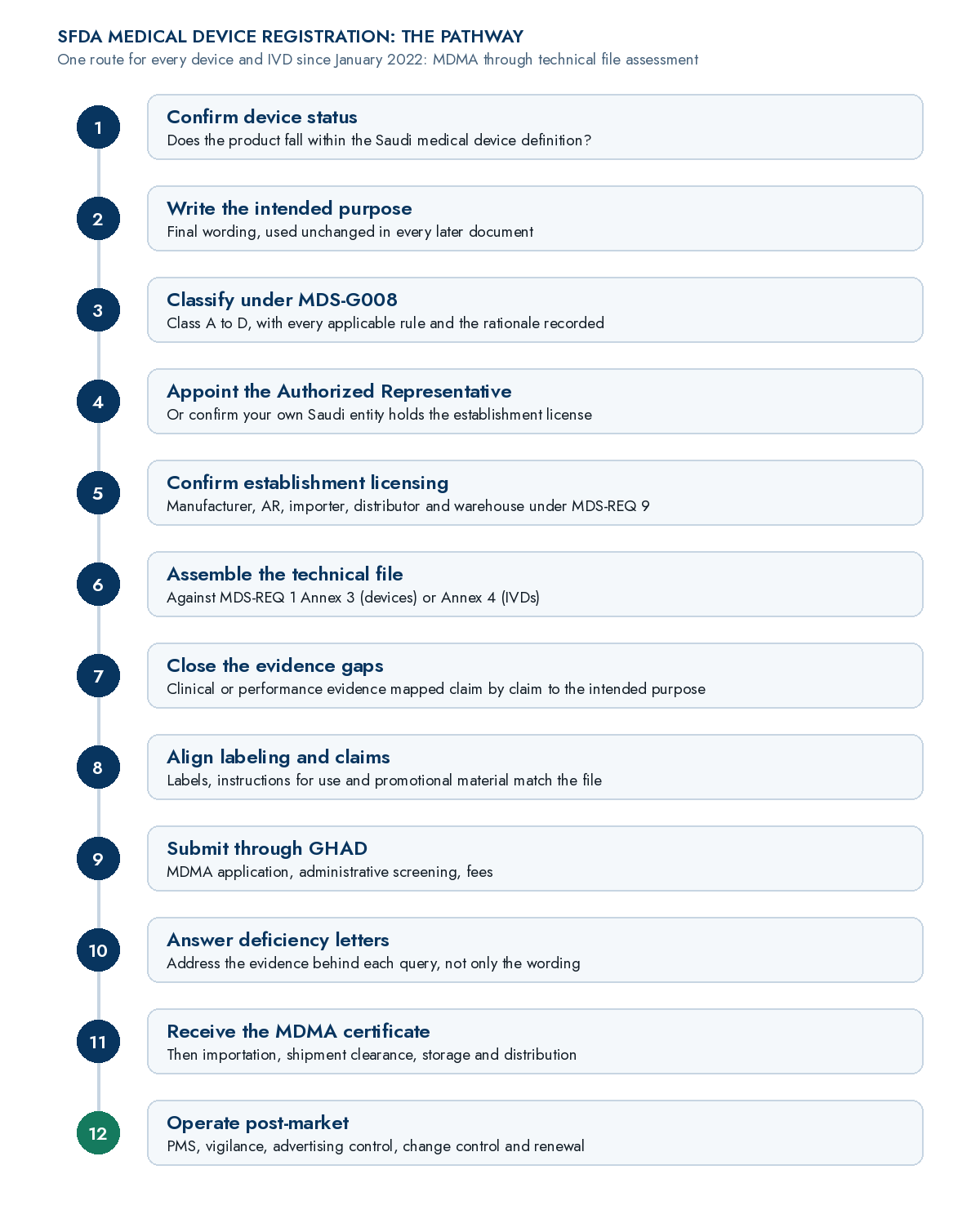
The first three steps determine how much work the later ones take, because the class decides how much documentation and evidence the file needs.
3. What the SFDA controls
The SFDA regulates medical devices, drugs, food and other products in Saudi Arabia. For devices, its remit covers:
- Setting the regulatory requirements and guidance
- Assessing and issuing marketing authorizations
- Licensing device establishments, their branches and their warehouses
- Approving advertising and awareness campaigns
- Controlling importation and shipment clearance
- Maintaining the national device registry and the Saudi-DI identification system
- Market surveillance, inspections, recalls and safety follow-up
- Operating the national center for medical device reporting
Product authorization and establishment licensing are separate approvals held by different parties, and both have to be in place before a shipment moves. The regulatory workload also continues after the certificate is issued, since advertising approval, vigilance reporting and change control each have their own requirement documents.
4. Is the product a medical device
The assessment starts with what the manufacturer claims the product does, and it should be settled before documentation work begins.
Work through:
- What does the product do, physically or computationally?
- What medical purpose does the manufacturer claim in labeling, the instructions for use and marketing?
- Who is the intended user, a clinician, a laboratory technician, a patient at home?
- Who is the intended patient population?
- Is it intended for diagnosis, prevention, monitoring, treatment, alleviation or prediction?
- Does it produce information that a clinician acts on?
- Is it software, and if so does it analyze patient data or only display and transmit it?
- Is it an in vitro diagnostic?
- Is it an accessory to another device?
For software the answer depends on the claim. A platform that schedules appointments and stores records sits outside the device framework. Add a module that flags patients as high risk for a clinical condition and the same platform falls inside it, with no change to the underlying code.
Wellness products, cosmetics carrying a borderline claim, and laboratory equipment sold for research use only need the same test applied to their actual claims. Annex 3 requires promotional material to sit inside the technical documentation, so those claims form part of the submission.
5. Why the intended purpose matters
The intended purpose determines the classification. The classification determines how much documentation and evidence the submission needs and what the fees are. The evidence then limits what you can claim in marketing.
A late change to the intended purpose reopens the classification, the evidence assessment and the fee calculation. A device described as "displays continuous glucose readings" and a device described as "identifies patients at risk of nocturnal hypoglycemia" carry different risk classes, different clinical evidence expectations and different post-market obligations, even where the hardware is identical.
Write the intended purpose in final wording before classification. Then check that the same wording appears in the labeling, the instructions for use, the clinical evaluation, the risk file, the website and the sales deck. Annex 3 requires the technical documentation to carry the labels, the instructions for use and the promotional material, so the reviewer sees all of these versions together.
6. SFDA classification, Classes A to D
The SFDA uses a risk-based system with four classes:
| Class | Risk level | Typical examples |
|---|---|---|
| A | Low | Non-sterile examination gloves, hospital beds, stethoscopes |
| B | Low to moderate | Hypodermic needles, suction equipment, most single-use disposables |
| C | Moderate to high | Infusion pumps, orthopedic implants, ventilators |
| D | High | Heart valves, active implantables, some IVDs for transmissible agents |
Classification is determined by the manufacturer, using the classification rules in MDS-G008, Guidance on Medical Devices Classification. That document replaced the earlier MDS-G42 and covers both general devices and IVDs. The rule set follows the same logic as the European rules, so a CE classification is a good starting point. The SFDA examples and interpretations are not identical, though, so the classification must be confirmed under the SFDA rules and documented in the application.
Factors that drive the outcome:
- Active or non-active
- Invasive or non-invasive, and the route of invasiveness
- Implantable or not
- Duration of contact, transient, short term or long term
- Sterility
- Measuring function
- Diagnostic function
- Energy delivered to the patient
- Type of patient contact, intact skin, injured skin, mucous membrane, circulatory system, central nervous system
- Software function and the clinical significance of its output
Where more than one rule applies, the highest resulting class governs, and the rationale should record which rules were considered and why the final rule was selected.
Annex 3 of MDS-REQ 1 asks for the class, every rule that applies, and a justification for the rule chosen. A rationale that meets it reads like this: "Class B under Rule 5, because the device is for transient use, non-invasive, and in contact with injured skin where the breach is limited to the dermis." A bare class statement with no rule does not meet Annex 3.
Where the classification is unclear, a formal classification request can be submitted to the SFDA before committing to a submission strategy.
7. What the MDMA application involves
Medical Device Marketing Authorization is the SFDA approval that allows a device or IVD to be imported, sold, distributed or promoted in Saudi Arabia.
The SFDA assesses the manufacturer's own documentation against the essential principles of safety and performance in Annexes 1 and 2. The applicant and documentation requirements in MDS-REQ 1 do not list a prior approval in a reference market as a prerequisite. Existing CE certificates, FDA clearances and other regulatory history are submitted as supporting evidence and are assessed as part of the file.
MDS-REQ 1 states who may apply: a local manufacturer, an overseas manufacturer, or the Authorized Representative of an overseas manufacturer. The applicant must first hold the applicable license through the GHAD licensing service, a manufacturing license for a local manufacturer or an Authorized Representative (AR) license for an AR. A manufacturer with no licensed presence in Saudi Arabia therefore works through a licensed Authorized Representative in practice, because there is no license category available to it otherwise.
Applications are submitted through GHAD, the SFDA unified electronic system, which also handles establishment licensing, fee payment, status tracking, post-approval changes and renewals.
Innovative medical devices can be exempted from some of the technical documentation requirements once eligibility is verified, on submission of the Innovative Medical Device Summary Form in Annex 11 of MDS-REQ 1. If your device is first of its kind, check that route before assuming the full documentation set applies.
On approval, the SFDA issues an MDMA certificate carrying the information set out in Annex 13 of MDS-REQ 1, including the certificate number, the national listing number and the validity period.
Fees, application review time and certificate validity are set out in Annex 12 of MDS-REQ 1 and in the SFDA announcements referenced there. The published review timeline is 35 working days after administrative screening, and certificate validity is up to three years, shortened where a supporting certificate expires earlier. Check Annex 12 for the fee that applies to your class. Elapsed time depends on file completeness, the number of deficiency letters and how quickly the Authorized Representative answers them; section 20 breaks the total project timeline into phases.
8. Who does what: manufacturer, Authorized Representative, importer, distributor
Each of the four parties carries obligations set by the SFDA, and none of them can take on another's duties without holding the corresponding license.
Legal manufacturer. Owns the device, the technical file, the risk file and the regulatory obligations. Named on the certificate.
Authorized Representative. A Saudi legal entity holding a valid Authorized Representative license issued through GHAD, with its own obligations set out in MDS-REQ 9. The AR files the application, is the SFDA's point of contact, holds the registration certificate, and carries post-market surveillance and vigilance responsibilities in the Kingdom.
Importer. Holds the applicable importing license and clears shipments. The importer may be a different entity from the Authorized Representative. Shipment clearance references the MDMA, so the entity named on the certificate and the entity holding the import license both have to be correct before goods move.
Distributor. Handles commercial supply, storage and delivery, and is bound by the storage, transportation and traceability requirements.
Establishment licensing is set out in MDS-REQ 9, Requirements for Licensing Medical Device Establishments, which covers local manufacturers, Authorized Representatives, importers, distributors and warehouses, including branches.
Before commercial activity begins, write down which named entity is responsible for the submission, SFDA correspondence, fee payment, importation, complaint intake, vigilance reporting, field safety corrective actions, product changes, renewals and post-market surveillance. MDS-REQ 9 assigns several of those duties to the licensed establishment, so they are not open to allocation by agreement.
9. Choosing an Authorized Representative
Assess:
- Regulatory capability. Has this representative filed technical file assessments for devices of your class, not just handled listings under the old route?
- Technical depth. Can they read your risk file and clinical evaluation well enough to draft a deficiency response themselves, or will every query be forwarded to your team?
- Post-market capability. Complaints, vigilance reporting and field safety corrective actions are their statutory responsibility. Ask how they run them.
- Transparency. Will you receive SFDA correspondence in full, or a summary?
- Independence from distribution. If the Authorized Representative is also your distributor, the registration certificate sits with your commercial partner. Ask what happens to the registration if the distribution agreement ends, and get the answer in the contract before signing.
Certificate transfer between Authorized Representatives is possible, though it is a regulatory transaction with its own timeline and paperwork. Set the relationship up on the assumption that a transfer may be needed at some point.
10. The technical file
Content depends on the device and its class, and MDS-REQ 1 sets the requirement. It is a 109-page document, most of it annexes.
| Annex | Contents |
|---|---|
| 1 | Essential principles of safety and performance, devices other than IVDs |
| 2 | Essential principles of safety and performance, IVDs |
| 3 | Medical device technical documentation |
| 4 | IVD technical documentation |
| 5 | Risk classification rules, including table 1, products without a medical purpose that are treated as devices |
| 6 | Clinical evaluation and post-market clinical follow-up |
| 7 | Performance evaluation, performance studies and post-market performance follow-up |
| 8 | Implant card and information supplied to the patient |
| 9 | Summary of safety and clinical performance |
| 10 | Electronic instructions for use |
| 11 | Innovative medical device summary form |
| 12 | Fees, application review time and validity |
| 13 | MDMA certificate content |
| 14 | Declaration of conformity template |
| 15 | Bundling criteria, now superseded by MDS-G028 |
The abbreviated set for low-risk devices
Low-risk devices, excluding IVDs, sterile devices, devices with a measuring function, reusable surgical instruments and novel devices, submit six items from Annex 3 rather than the full file:
- Device description and specification
- Information to be provided by the manufacturer
- Essential principles checklist
- Evidence of compliance with the applicable essential principles
- Risk management file
- Post-market surveillance plan and report
The SFDA can request the full technical documentation at any time, including after the MDMA is granted, with a 10-day deadline to produce it. The complete file therefore has to exist even when only the six items are submitted.
The full file
Annex 3 sets the structure. The headings below follow it.
Device description and specification. Product description, models, variants, accessories, configurations covered by the application, intended purpose, indications, contraindications, intended users, patient population. Annex 3 also asks for five further items: a rationale for why the product qualifies as a medical device; the classification, with all applicable rules and a justification of the chosen rule, for the device and its accessories; an explanation of any novel features; the device history across previous generations; and the device market position, including similar devices in Saudi Arabia and other markets.
Design and manufacturing information. Design characteristics, components, materials, functional principle, energy source, software architecture where applicable.
Manufacturing. Manufacturing process outline, manufacturing sites, sterilization method, supplier controls, quality management system evidence including ISO 13485 certification where held.
Benefit-risk analysis and risk management. Risk management file per ISO 14971, covering hazards, hazardous situations, risk estimation, risk controls, verification that the controls work, residual risk evaluation and the overall benefit-risk conclusion. Annex 3 also asks who performed the risk analysis and expects a multidisciplinary team, warns against using the instructions for use as a risk mitigation, and expects each risk control to trace to a design output or a label.
Verification and validation. Biological safety evaluation for patient-contacting materials, electrical safety and electromagnetic compatibility for active devices, sterility validation and packaging validation for sterile devices, shelf life data, software verification and validation.
Clinical and performance evidence. Bench performance testing against specification, clinical evaluation, clinical investigation where the evidence gap requires one, published literature, and post-market data where it exists.
Information supplied by the manufacturer. Device labels, instructions for use, warnings, precautions, contraindications, storage and handling information, symbols. Symbols follow ISO 15223-1, and any symbol not covered by a recognized standard must be explained in the instructions for use. Instructions for use are not required for Class A and Class B devices that can be used safely without them.
Regulatory history. Declaration of conformity, CE certificates, FDA clearance or approval letters, other national approvals, free sale certificates where applicable, and any regulatory actions, recalls or refusals in other markets.
Reviewers assess the file as a whole, so the intended purpose, model numbers and manufacturing sites have to match across every certificate and document in it.
Saudi-specific requirements
These requirements sit inside the essential principles in Annexes 1 and 2 and inside Annex 3. They have no equivalent in EU MDR or FDA documentation, so a file built for those markets needs them added.
Mains electrical design. An electrical device intended to connect to AC supply must be designed to operate on a 60 Hz supply at nominal 230 or 400 volts. Its power connector must meet Saudi standard SASO-2203 and part 401 of the Saudi Building Code. Conductor insulation colors must follow the same part of the Saudi Building Code. A device designed for 50 Hz Europe needs this addressed explicitly.
Language for lay-person devices. Information supplied by the manufacturer for devices intended for use by lay persons must be in Arabic and English. The electronic user interface of such devices must be in both languages. The label must carry the Arabic name as it is pronounced in English. Advertising and marketing material for lay-person devices must be in both languages. For IVDs, the same rules apply to self-testing devices. Manufacturer instructions for handling, storage, transportation, installation, maintenance including service manuals, and disposal must be available in English and, when the SFDA requests it, in Arabic.
Labeling marks. Labeling must not carry the SFDA logo. It may carry the Medical Device National Listing Number.
Promotional claims are part of the technical file. Annex 3 requires the technical documentation to include a full set of labels, the instructions for use and the promotional material. It also states that promotional material must not contain claims exceeding those in the instructions for use, the clinical evaluation or the technical documentation.
Saudi environmental conditions. Devices must be designed, manufactured and packaged so that performance is not adversely affected during transport and storage, and Annexes 1 and 2 require the conditions that may be encountered within Saudi Arabia to be considered and addressed. Stability and shelf-life evidence generated on European storage assumptions has to be justified against those conditions.
Imaging devices. Imaging devices must be capable of automatically recording dose, protocol data and patient information such as age, sex and weight in standardized formats.
Reporting statement. The instructions for use must tell the user that any serious incident involving the device is to be reported to the manufacturer and to the SFDA. Instructions for use written for the EU name the national competent authority and need this statement added.
If your technical file was built for EU MDR, our clinical evaluation report writing service and IVDR technical documentation guide cover the source documents that feed the Saudi submission.
11. Clinical and performance evidence
What is required depends on class, novelty, invasiveness, the existence of equivalent devices and the strength of the evidence you already hold.
Acceptable evidence sources include clinical evaluation of published literature, clinical investigation data, performance and bench data, clinical data from equivalent devices where equivalence is properly demonstrated, existing clinical evidence generated for other markets, and post-market clinical follow-up data.
Take each claim in the intended purpose and ask what evidence shows the device achieves it in the intended population, and whether that evidence exists today. The claims with no matching evidence are the ones that need work.
Common errors:
- Commissioning a clinical study before the evidence gap has been defined, so the endpoints are set without knowing which claim needs support.
- Submitting a European clinical evaluation report unchanged when the Saudi intended purpose or indication wording differs. The underlying evidence is often adequate, but the report does not connect it to the wording being claimed.
Where a clinical investigation is required, MDS-REQ 2, Requirements for Clinical Trials of Medical Devices, sets the framework: objectives, clinical investigation plan, endpoints, population, inclusion and exclusion criteria, sample size, statistical analysis, safety monitoring, benefit-risk assessment, ethics approval, investigator qualification, data management and device accountability. Our clinical investigation protocol service covers this work.
12. Software, SaMD and AI
Software with a medical purpose, often called software as a medical device (SaMD), falls within the device framework. Examples include diagnostic software, image analysis, clinical decision support, monitoring and predictive algorithms, and software that controls another device.
The assessment sequence for software:
- What clinical decision does the output influence, and how directly?
- What is the significance of the information provided, does it inform, drive or determine clinical management?
- What is the harm if the output is wrong, both false positive and false negative?
- Has the software been verified and validated against its requirements, with traceability from requirement to test?
- Does it perform adequately in the intended population and clinical environment, not only in the development dataset?
- How are updates, versions and changes controlled after release, and which changes trigger a regulatory assessment?
- What cybersecurity controls and lifecycle processes apply?
For AI and machine learning devices the SFDA maintains MDS-G010, which covers AI and ML based medical devices and their marketing authorization requirements. It sets out the marketing authorization criteria that an AI device is assessed against.
Additional questions for an AI device:
- What data trained the algorithm, from which populations and which sites?
- Is the Saudi patient population represented in the development or validation data, and if not, what supports generalizability?
- How was performance validated, on what independent dataset, against what reference standard?
- What are the sensitivity and specificity, and what happens clinically at each error mode?
- Is the model locked or does it continue to learn after deployment, and how are changes controlled?
- How is model drift detected in the field?
India's CDSCO assesses software on similar lines; our CDSCO software and AI guidance post covers that framework.
The SFDA typically asks the manufacturer to explain its software version numbering scheme, including which digit signals a significant change and which signals a minor one. That scheme then determines which future releases fall under the 10-day significant change notification in MDS-REQ 1 and which fall under the 30-day route.
13. IVDs
IVDs have their own classification rules within MDS-G008 and their own evidence expectations.
Start with:
- Intended use, what is measured and for what clinical purpose
- Analyte
- Specimen type and matrix
- Intended user, laboratory professional, point of care clinician or lay person
- Testing environment
- Clinical significance of the result and the consequence of an incorrect result
- Risk class under the IVD rules
- Analytical performance
- Clinical performance
- Traceability of calibrators and controls
Analytical performance and clinical performance are separate evidence sets and both are assessed. Analytical performance covers sensitivity, specificity, accuracy, precision, linearity, limit of detection, interference and cross-reactivity, and stability. Clinical performance covers how the analyte relates to the clinical condition and how the test performs in the intended population.
Self-test and near-patient IVDs carry additional expectations around lay user comprehension and result interpretation.
Our IVD performance evaluation guide covers the analytical and clinical performance structure in detail under the EU framework, which is the usual source of the underlying data for a Saudi IVD submission. Our IVD performance evaluation service produces the performance evaluation plan and report themselves.
14. Combination and borderline products
Products that sit between categories need their regulatory category resolved before the main submission is built. Examples include drug-device combinations, devices incorporating a medicinal substance, devices with a non-device function, and products marketed alongside a cosmetic or supplement claim.
Where a device incorporates a substance that would be a medicinal product if used separately, that substance is assessed against the SFDA requirements for medicinal products, and the classification of the whole may follow the principal mode of action rather than the physical form.
Resolve the category before testing is commissioned, since the applicable pathway determines which tests and which evidence the submission needs.
15. Bundling: MDS-G028, published 2026
The SFDA published MDS-G028, Guidance on Bundling Criteria for Medical Devices within a Single MDMA Application, in May 2026. It is a dedicated 17-page document that replaced the shorter bundling sections previously carried in MDS-G5 and in Annex 15 of MDS-REQ 1.
Bundling allows several devices to be authorized under one MDMA application where they meet the criteria. The core criteria for a device family:
| Criterion | Requirement |
|---|---|
| Legal manufacturer | Same for all devices in the application |
| Intended use and specialty | Same intended purpose, same clinical specialty |
| Risk class | Same class for all items |
| Technical files | Maximum of five technical files per application |
| Item count | Maximum of 50 medical device items per application |
The guidance addresses four grouping types.
Family. Devices sharing intended purpose, specialty and risk class, differing in size, configuration or model within the same design.
System. Devices from the same legal manufacturer intended to be used together to achieve a common intended purpose. The link between components must be evidenced in the technical documentation, through labeling, instructions for use, brochures, catalogs and the clinical evaluation. A shared system name on the label is not sufficient on its own.
Procedure pack. The same manufacturer, intended use and specialty and risk class criteria apply to the packs, with additional documentation. Technical file documents are required for the pack and for each component, component labels must be provided in the label section, and a component table listing each component with its risk classification and manufacturer is expected.
IVD grouping. The guidance overhauled the rules for IVD products specifically, so IVD bundling decisions taken before mid-2026 should be re-examined.
For new applications, test the portfolio against the criteria before splitting it into separate submissions, since fees are charged per application. For existing MDMA registrations, review the bundling in the current technical files ahead of renewal, particularly for surgical and dental instrument families, procedure packs and IVDs, because the grouping accepted at first registration may not match the current criteria.
Products sold together but differing in intended purpose, specialty or risk class do not meet the criteria and are filed separately.
16. Reusing a CE, FDA or ISO 13485 dossier
A CE, FDA or ISO 13485 dossier is submitted as supporting evidence, and each document in it has to be mapped against the SFDA requirements before submission.
| What you already have | What it contributes | What still needs assessment |
|---|---|---|
| CE marking under MDR | Conformity assessment, technical documentation structure | Mapping to SFDA essential principles, classification confirmed under SFDA rules |
| FDA clearance or approval | Regulatory and clinical evidence, review history | Intended purpose alignment, classification difference, evidence mapping |
| ISO 13485 certificate | QMS evidence | Scope of certification, sites covered, expiry date against certificate validity |
| Clinical studies | Clinical evidence | Relevance to the Saudi intended purpose and population |
| Clinical evaluation report | Structured clinical assessment | Claim-by-claim mapping to the Saudi indication wording |
| ISO 14971 risk file | Risk management evidence | Completeness, traceability to design outputs and labeling |
| Instructions for use | Labeling content | Saudi language requirements, symbol set, claim consistency |
| Other national registrations | Regulatory history | None of them substitute for the MDMA |
| Existing PMS system | Post-market framework | Saudi vigilance reporting obligations and the Authorized Representative's role in them |
| Existing distributor | Commercial channel | Whether they hold the correct establishment license, and who holds the registration |
A structured gap assessment sorts every document into three states:
- Reusable. Submit essentially as is, with administrative alignment only.
- Needs work. Content exists but requires supplementation, re-mapping to the Saudi intended purpose, or updating.
- Missing. A new document, test, assessment or evidence package is required.
The exercise usually takes a few days, and it gives you a realistic price and timeline before fees are committed.
17. Quality system and inspections
An ISO 13485 certificate is one piece of evidence within the submission, and the SFDA looks at the quality system behind it.
The SFDA published MDS-REQ 10, Requirements for Inspections and Quality Management System for Medical Devices, in January 2026. Alongside it, MDS-G024 provides guidance on ISO 13485 requirements.
Areas that come under scrutiny:
- QMS implementation and scope, matching the sites and product ranges declared
- Design controls and design history
- Risk management integration with design and production
- Manufacturing and process controls
- Supplier and subcontractor controls
- Corrective and preventive action (CAPA), including effectiveness checks
- Complaint handling and vigilance interfaces
- Change control
- Post-market surveillance
- Record retention and traceability
High-risk device applications can attract manufacturing site inspection or product testing, so allow for that in the schedule for Class C and D devices.
18. After the certificate
The obligations below start when the certificate is issued and continue for the life of the product.
Importation and shipment clearance. MDS-REQ 5 covers importation and shipment clearance. The importer needs its own license, and shipment clearance references the MDMA. Check that the entity on the MDMA and the entity clearing the shipment are correctly aligned before the bill of lading is issued.
Transportation and storage. MDS-REQ 12, Requirements on Transporting and Storage of Medical Devices, covers temperature and humidity control, packaging integrity, handling, warehouse controls, distribution controls and traceability. These obligations sit with the Saudi supply chain parties and need to be in place before stock arrives.
UDI and Saudi-DI. The Saudi-DI system records device identifier information based on international standards. Plan identifiers across models, variants and packaging levels alongside the submission, because identifiers are tied to the registration and to later changes.
Advertising. MDS-REQ 8, Requirements for Obtaining SFDA Approval for Advertisement and Launching Awareness and Charitable Campaigns for Medical Devices, was updated to version 4 on 20 July 2026. Advertising is tied to the MDMA certificate. Material must not contradict the claims specified by the manufacturer, must not mislead the lay reader, and must comply with Sharia and local content standards. Advertising must be suspended when new information emerges indicating risk or lack of effectiveness, or when the SFDA suspends or revokes the advertising approval. The establishment carries full responsibility for incorrect or misleading claims even after approval is granted, and personnel marketing devices are expected to hold enough product knowledge to give accurate information. Promotional material also sits inside the technical documentation and cannot claim more than the instructions for use, the clinical evaluation or the technical documentation support. Route it through regulatory review before launch.
Post-market surveillance and vigilance. Complaint handling, adverse event reporting, safety alerts, field safety corrective actions, recalls, post-market clinical follow-up and traceability all continue for the life of the product. The SFDA operates market surveillance and recall follow-up and runs a national center for medical device reporting. Our PMCF writing service covers post-market clinical follow-up plans and reports.
Risk communication. The SFDA issued MDS-G29, Guidance on Risk Communication of Medical Devices, version 1, on 9 July 2026. It sets expectations for how safety information reaches users, healthcare facilities and the public.
Safe use in healthcare facilities. MDS-REQ 3 addresses safe use of medical devices inside healthcare facilities, which matters for manufacturers whose devices need installation, training or maintenance programs on site.
19. Changes after approval
Software updates, supplier replacements, manufacturing site moves, added models, expanded indications, label revisions and sterilization method changes all go through the same test, which is whether the change affects the safety, performance, intended purpose or regulatory status of the device. Changes that do require regulatory assessment and, depending on the change, an amendment to the authorization.
MDS-REQ 1 requires the SFDA to be informed through the electronic system within 10 days of a significant change to the relevant information, and within 30 days for a non-significant change. To meet those windows, build the notification into the change control procedure. Assess each change for regulatory impact before it is implemented. For software, define in advance which version digits count as a significant change, because that definition is what the engineering team applies when a release is due.
A renewal request can be filed from 90 days before the expiry date, with updated documents submitted through the electronic system. A device may not be imported or supplied once the authorization has lapsed, so start the renewal work before the 90-day window opens.
20. How long it takes and what it costs
Timeline. The published review window covers one phase of six:
| Phase | What happens | What drives duration |
|---|---|---|
| Preparation | Classification, gap assessment, documentation build | Completeness of the existing dossier, evidence gaps |
| Saudi setup | Authorized Representative appointment, establishment licensing | Contracting, licensing status of the chosen partner |
| Submission | Application assembly, administrative screening, fee payment | File completeness |
| SFDA review | Technical and regulatory assessment. Published timeline 35 working days | Class, complexity, number of bundled items |
| Query response | Deficiency letters answered | Your team's turnaround, technical depth of the Authorized Representative |
| Market entry | Importation, clearance, storage, distribution readiness | Importer licensing, supply chain readiness |
Real elapsed time for a straightforward Class B device with a complete file is commonly several months from project start to first shipment. Higher classes and files with evidence gaps run longer. The 35 working day figure covers the SFDA review phase only, not the whole project.
Cost. SFDA fees vary by class. The rest of the budget covers Authorized Representative fees, establishment licensing, technical documentation work, gap remediation, testing, any clinical work, QMS certification or maintenance, translation and legalization where required, importation costs, warehousing and the ongoing post-market compliance function.
Price the project after classification and the gap assessment, since those two steps determine the documentation, testing and evidence work in the budget.
21. Why applications get delayed
- Classification asserted without a rationale. The class may even be right, but the file does not show the reasoning against the rules.
- Vague intended purpose. Broad wording has to be supported by evidence covering everything the wording claims.
- Inconsistent claims. The technical file, instructions for use, website and brochure describe the device differently.
- Certificates without evidence. A stack of approvals that does not demonstrate safety and performance for the stated purpose.
- Incomplete technical documentation. Missing verification data, missing sterilization validation, missing shelf life justification.
- Weak risk management. Hazards listed without controls traced to design outputs and labeling.
- International dossier submitted without mapping. A CE or FDA package sent unchanged.
- Establishment problems. The Authorized Representative, importer or warehouse license is not in place or has expired.
- Deficiency responses that address the wording rather than the underlying concern. A query about a single document is often a query about the evidence behind it.
- Outdated assumptions. Plans built on the MDNR listing route, on GHTF reliance, or on pre-2026 bundling criteria.
22. Pre-submission checklist
Each line is something the SFDA assesses. Work through it before the application is assembled.
Product
- Medical device status confirmed
- Intended purpose defined in final wording
- Indications defined
- Contraindications defined
- Intended users identified
- Patient population identified
- Models and variants listed
- Accessories identified
- Software or AI content assessed
Classification
- Class determined under the SFDA rules
- All potentially applicable rules reviewed
- Rationale documented
- Formal classification request submitted where the position is unclear
Regulatory structure
- Legal manufacturer identified
- Authorized Representative appointed, license current
- Importer identified, license current
- Distributor identified
- Warehouse licensing confirmed
- Responsibilities allocated in writing
Quality
- QMS scope covers the declared sites and products
- ISO 13485 certificate current, expiry checked against target certificate validity
- Manufacturing site information available
- Supplier controls documented
- Risk management system operating
Technical documentation
- Device description
- Design information
- Manufacturing information
- Risk management file
- Verification data
- Validation data
- Performance testing
- Biological safety evaluation where applicable
- Electrical safety and electromagnetic compatibility (EMC) where applicable
- Sterilization and packaging validation where applicable
- Shelf life justification
- Software verification, validation and version scheme where applicable
Evidence
- Clinical evaluation or performance evaluation
- Clinical investigation data where required
- Literature search documented and reproducible
- Every claim mapped to supporting evidence
Regulatory history
- Declaration of conformity
- CE documentation where applicable
- FDA documentation where applicable
- Other national approvals
- Free sale certificate where applicable
- Regulatory actions, recalls or refusals disclosed
Labeling
- Device label
- Instructions for use
- Warnings and precautions
- Storage and handling information
- Arabic and English met for lay-person or self-test devices, including the user interface
- Arabic name as pronounced in English on the label where required
- Symbols per ISO 15223-1, non-standard symbols explained in the instructions for use
- SFDA logo absent from labeling
- Serious incident reporting statement names the SFDA
- Promotional material included in the file and claiming no more than the instructions for use, clinical evaluation and technical documentation support
- Mains design checked against 60 Hz, 230 or 400 V, SASO-2203 and Saudi Building Code part 401
- Saudi storage and transport conditions addressed in stability and packaging evidence
Submission
- Bundling assessed against MDS-G028
- Application assembled in GHAD
- Fees prepared
- Deficiency response plan and responsible people named
Market entry and post-market
- Import and shipment clearance requirements assessed
- Storage and transportation requirements assessed
- Distribution controls in place
- UDI and Saudi-DI plan complete
- Advertising review process defined
- Complaint procedure
- Vigilance procedure
- PMS procedure
- Field safety corrective action (FSCA) and recall procedure
- Change control procedure
Download the SFDA registration readiness checklist (PDF)
23. Frequently asked questions
Obtaining a Medical Device Marketing Authorization, or MDMA, from the Saudi Food and Drug Authority, so that a device or IVD can be legally imported, sold, distributed or promoted in Saudi Arabia.
No. New and renewal applications under the MDNR listing route ended on 27 September 2022. All devices now require an MDMA supported by a technical file. The Medical Device National Registry still exists as a registry, and approved devices carry a national listing number, but it is no longer a separate lighter pathway.
Not the full file. Low-risk devices, excluding IVDs, sterile devices, devices with a measuring function, reusable surgical instruments and novel devices, submit six items: device description and specification, information provided by the manufacturer, the essential principles checklist, evidence of compliance with the applicable essential principles, the risk management file, and the post-market surveillance plan and report. The SFDA can request the complete technical documentation later, including after the MDMA is issued, with 10 days to provide it.
MDS-REQ 1 allows the application to come from a local manufacturer, an overseas manufacturer, or the Authorized Representative of an overseas manufacturer. The applicant must hold the applicable GHAD license first, so a manufacturer with no licensed Saudi entity applies through a licensed Authorized Representative.
Information supplied by the manufacturer for lay-person devices, and for IVD self-tests, must be in Arabic and English, including the electronic user interface and the advertising material. The label carries the Arabic name as pronounced in English. Handling, storage, transportation, installation, maintenance and disposal instructions must be available in English and, on SFDA request, in Arabic.
Yes. An electrical device connecting to AC supply must be designed for a 60 Hz supply at nominal 230 or 400 volts, with a connector meeting SASO-2203 and part 401 of the Saudi Building Code, and conductor insulation colors following the same code. Devices designed for 50 Hz markets need this addressed in the file.
Innovative medical devices can be exempted from some technical documentation requirements once eligibility is verified, on submission of the Innovative Medical Device Summary Form in Annex 11 of MDS-REQ 1.
No. The GHTF route that allowed manufacturers to rely on an EU, US, Canadian, Australian or Japanese approval closed at the end of 2021. CE documentation is submitted as supporting evidence and much of it is reusable, but the SFDA assesses the technical file directly.
No, for the same reason. FDA clearance or approval is evidence within the submission rather than a substitute for it.
No. It is one evidence component, and its scope, the sites it covers and its expiry date all affect the submission.
Four risk classes, A through D, determined by the manufacturer under the classification rules in MDS-G008.
Yes. Consider what happens to the registration certificate if the commercial relationship ends, and address certificate transfer in the agreement before signing.
Yes, where the MDS-G028 bundling criteria are met. The core criteria are the same legal manufacturer, the same intended use and specialty, the same risk class, a maximum of five technical files and a maximum of 50 items.
Yes. Technical file documentation is expected for the pack and for each component, component labels must be included in the label section, and a component table with risk classification and manufacturer details is expected.
IVDs go through the same MDMA route but have their own classification rules and their own evidence expectations, including separate analytical performance and clinical performance evidence. The 2026 bundling guidance also changed IVD grouping rules specifically.
It can be, depending on intended purpose and functionality. Software that analyzes patient data to support diagnosis or clinical management generally falls inside the framework. Software that only stores, displays or transmits administrative information generally does not.
Yes. The SFDA maintains MDS-G010 covering AI and machine learning based medical devices, and the assessment addresses training data, validation, performance, change control and lifecycle management alongside the standard requirements.
Up to three years, and potentially shorter where a supporting certificate expires earlier. Renewal is required before expiry.
The published review timeline is 35 working days after administrative screening. Total project time is longer and depends on file completeness, device class, number of deficiency letters and response speed.
Fees vary by class, and the SFDA fee is one line in a budget that also includes Authorized Representative costs, establishment licensing, documentation work, testing, any clinical evidence generation, importation and ongoing post-market compliance. A device-specific estimate is realistic only after classification and gap assessment.
Yes. MDS-REQ 8 sets the requirements for advertising approval and for awareness and charitable campaigns, and was updated to version 4 in July 2026. Advertising must be consistent with the authorized claims, and the establishment carries responsibility for the accuracy of what it publishes.
Importation and shipment clearance, storage and transportation compliance, distribution controls, UDI and Saudi-DI, advertising approval, complaint handling, vigilance reporting, field safety corrective actions, post-market surveillance and change control.
The change goes through a regulatory assessment to determine whether it affects safety, performance, intended purpose or regulatory status, and whether an amendment to the authorization is required. MDS-REQ 1 requires the SFDA to be informed through the electronic system within 10 days of a significant change and within 30 days of a non-significant change.
24. How EvySaif supports SFDA projects
EvySaif Research and Medical Affairs Solutions is a clinician-led regulatory and medical writing consultancy working with manufacturers, IVD companies and health technology developers across India, MENA and Europe.
For Saudi Arabia, our support covers:
Regulatory strategy. Device status, intended purpose wording, classification and rationale, pathway confirmation and a costed project plan. See regulatory strategy consulting.
Classification and bundling assessment. Classification under the SFDA rules with a documented rationale, and a portfolio assessment against the MDS-G028 bundling criteria so that the number of applications is right before fees are committed.
Gap assessment. Mapping an existing CE, UKCA, FDA or other national dossier against the SFDA requirements, with every document sorted into reusable, needs work or missing.
Technical documentation. Technical file authoring and remediation, risk management documentation, verification and validation summaries, labeling and instructions for use review, and the summary of safety and clinical performance where Annex 9 applies.
Clinical and performance evidence. Clinical evaluation reports, performance evaluation for IVDs, literature review, evidence gap analysis and clinical investigation protocols where new data is needed.
Software and AI devices. Regulatory and evidence planning for SaMD and AI-enabled devices, including validation documentation and change management planning.
Post-market. PMS plans, PMCF plans and reports, vigilance procedures, complaint handling frameworks and periodic reporting.
For devices in other markets, see our medical device and IVD consulting page and our CDSCO India guide. For pharmaceutical products in the region, see our SFDA drug submission and GCC drug registration pages.
Planning a Saudi submission? Send us the device, the intended purpose and the dossier you already hold. As an SFDA regulatory consultant we will confirm the classification, tell you what is reusable and what is missing, and give you a costed plan before you commit to the application. Talk to EvySaif.
Official SFDA sources
Verify current requirements directly with the SFDA before submitting.
- SFDA laws and regulations library: https://www.sfda.gov.sa/en/regulations
- MDS-REQ 1, Requirements for Medical Devices Marketing Authorization: https://www.sfda.gov.sa/en/regulations/requirements-medical-devices-marketing-authorization-mds-req-1
- MDS-REQ 9, Requirements for Licensing Medical Device Establishments: https://www.sfda.gov.sa/sites/default/files/2025-03/MDS-REQ%209_En_V2.pdf
- MDS-REQ 10, Requirements for Inspections and Quality Management System for Medical Devices: https://www.sfda.gov.sa/en/regulations/87120
- MDS-REQ 12, Requirements on Transporting and Storage of Medical Devices: https://www.sfda.gov.sa/en/regulations/requirements-transporting-and-storage-medical-devices-mds-%E2%80%93-req-12
- MDS-REQ 8 v4, Requirements for Obtaining SFDA Approval for Advertisement and Launching Awareness and Charitable Campaigns for Medical Devices: https://www.sfda.gov.sa/sites/default/files/2026-07/MDS-REQ%208_En_V4.pdf
- MDS-G29, Guidance on Risk Communication of Medical Devices: https://www.sfda.gov.sa/sites/default/files/2026-07/MDS-G29%20-%20Risk%20Communications%20v1%20(28)%20En%2009-07-2026.pdf
- SFDA electronic services, including GHAD and Saudi-DI: https://www.sfda.gov.sa/en/eservices
Last reviewed: August 2026. This article is general regulatory information, not a regulatory or legal opinion on a specific product.