
If you manufacture medical devices outside India and want to sell them in the Indian market, you need an import license from the Central Drugs Standard Control Organisation (CDSCO). The application is made in Form MD-14 and the license is granted in Form MD-15.
The MD-14 application comes near the end of the process, though. Before it can be filed, an Indian entity must hold the right registration, the device must be correctly classified, and your overseas approvals must be assessed for what they are worth under Indian rules. Several commercial decisions also need to be made early, because they shape your position in the Indian market for years. Applicants who begin with the MD-14 form itself commonly lose months to a sequencing mistake, or discover later that their license sits with a distributor they no longer want to work with.
In this guide
- The framework: Medical Devices Rules, 2017
- Four decisions to make before you file anything
- MD-41 and MD-42: the sale and distribution registration
- MD-14 application: documents required
- CDSCO import license fees
- CDSCO import license timeline
- The MD-16/MD-17 test license
- IVD import
- MD-15 license validity and post-license obligations
- Common mistakes that cost months
- Frequently asked questions
The framework: Medical Devices Rules, 2017
Medical devices in India are regulated under the Medical Devices Rules, 2017 (MDR 2017), made under the Drugs and Cosmetics Act, 1940 [1]. Since notification S.O. 648(E) of 11 February 2020, effective 1 April 2020, all medical devices fall within the definition of "drug" and are regulated under these rules [2]. Before that date, only a notified list of device categories was regulated.
MDR 2017 classifies devices into four risk classes:
| Class | Risk level | Examples |
|---|---|---|
| A | Low | Surgical dressings, tongue depressors |
| B | Low moderate | Suction equipment, hypodermic needles |
| C | Moderate high | Ventilators, bone fixation plates, most implants |
| D | High | Heart valves, implantable defibrillators |
Classification determines the licensing authority, the government fee, the depth of scrutiny, and in some cases whether the pathway involves a clinical investigation. For import, the Central Licensing Authority (CDSCO headquarters, through the Drugs Controller General of India) handles all four classes. This differs from domestic manufacturing, where Class A and B licenses are handled at state level. For the full picture across classification, manufacturing, IVDs, software, and post-market obligations, see our CDSCO medical device regulatory guide.
CDSCO publishes a classification list covering most device categories. If your device appears on it, your class is settled. If it does not, or if your device combines functions that could be read into more than one entry, classification is the first question to resolve.
Four decisions to make before you file anything
Before we prepare any application for a client, we work through four decisions.
Decision 1: Import or manufacture in India
The MD-14/MD-15 route assumes you will manufacture abroad and import finished devices. The alternative is to manufacture in India, either at your own facility or through a contract manufacturer, under the MD-7 to MD-9 licensing route for Class C and D devices (Class A and B use MD-3 to MD-5 at state level).
| Factor | Import (MD-14/MD-15) | Manufacture in India (MD-7/MD-9 for Class C and D) |
|---|---|---|
| Setup time | Shorter; existing site and QMS unchanged | Longer; Indian site must be built or contracted and licensed |
| Customs duty | Payable on every unit | Not applicable |
| PLI incentives | Not available | Available where the scheme applies |
| Public procurement | No preference | Preference for locally manufactured goods under the Public Procurement (Preference to Make in India) Order |
| CDSCO site oversight | Overseas site assessed through the dossier | Indian site licensed and inspected by the authority |
If government hospitals and tenders are a meaningful part of your Indian revenue plan, the procurement preference affects whether you can win that business at all. Many companies enter on an import license and localize manufacturing later once volumes justify it. If that is the plan, price the second phase into it from the start, including the licensing route for the future Indian site.
Decision 2: Who holds your license
An MD-14 application for a foreign manufacturer is filed by an applicant in India. There are two structures: an authorized Indian agent, typically your distributor or a third-party license-holding service acting under a power of attorney, or your own Indian subsidiary acting as the applicant, provided it holds the required registrations itself.
| Factor | Authorized Indian agent | Own Indian subsidiary |
|---|---|---|
| Speed to start | Fast if the agent already holds MD-42 | Slower; incorporation and registrations needed first |
| Upfront cost | Low | Higher; entity setup and ongoing compliance |
| Control of the license | Sits with the agent | Sits with you |
| Changing distributors | Constrained; the license is tied to the agent | Free; appoint or change distributors at will |
| If the relationship ends | Regulatory position must be rebuilt through a fresh application | Unaffected |
Manufacturers often confront the control problem only when the distributor relationship ends. A change of authorized agent requires a fresh MD-14 application by the new agent, with the power of attorney, Free Sale Certificate, fees, the new agent's registration or license, a copy of the earlier import license, and a manufacturer undertaking that the Device Master File and Plant Master File are unchanged. The existing license does not move with you. For a manufacturer with a long-term plan for India, we recommend evaluating the subsidiary route before defaulting to an agent. A hybrid is also workable: start with an agent to move quickly, with a contractual framework agreed at the outset that anticipates a later transfer to your own entity.
Decision 3: What your existing approvals are worth in India
Overseas approvals do two different jobs in the Indian system, and the rules treat them differently.
The first job is supporting the import license dossier. The MD-14 checklist asks for a Free Sale Certificate from the country of origin, showing the device is approved and marketed there. For this purpose, approval in the European Union counts.
The second job is waiving the requirement for Indian clinical data where the pathway demands it. Under rule 63 of MDR 2017 [1], the requirement to submit results of a clinical investigation may be set aside where the device is approved by the regulatory authority of the United Kingdom, United States, Australia, Canada, or Japan, and has been marketed in that country for at least two years, subject to the other conditions of the rule. The European Union is not on this list.
| Purpose | EU approval (CE mark) | UK, US, Australia, Canada, or Japan approval |
|---|---|---|
| Free Sale Certificate on the MD-14 checklist | Accepted | Accepted |
| Rule 63 clinical investigation waiver | Not on the list as the rules currently stand | Qualifies, subject to two years of marketing there and the other rule 63 conditions |
In April 2026 the government published draft Medical Devices (Amendment) Rules proposing to add European Union countries to the rule 63 list (G.S.R. 270(E), 10 April 2026) [7]. As of the date of this article, that amendment remains a draft and has not been notified in the Gazette. Until it is notified, the current list applies. If your entry plan depends on an EU-only approval history, track this amendment closely.
If your device has a predicate in India, meaning a comparable device already approved here, the import pathway generally proceeds on your existing design, quality, and clinical evidence without a fresh Indian clinical investigation. If your device has no predicate, it is treated as a new device, and market permission under Form MD-26/MD-27 must be obtained before the import license, a pathway that can include an Indian clinical investigation unless a waiver applies. We have written a complete tutorial on that route: CDSCO registration for a device with no predicate. Before budgeting anything, answer two questions: does a predicate exist for my device in India, and if not, which waiver do my current approvals support?
Decision 4: Sequence
The import license has a prerequisite that first-time applicants regularly discover late: the Indian applicant must already hold a wholesale license, a manufacturing license, or the registration certificate in Form MD-42 before the MD-14 can be filed. For a new device-focused applicant without an existing license, the route is the MD-41/MD-42 registration, granted at state level on its own timeline.
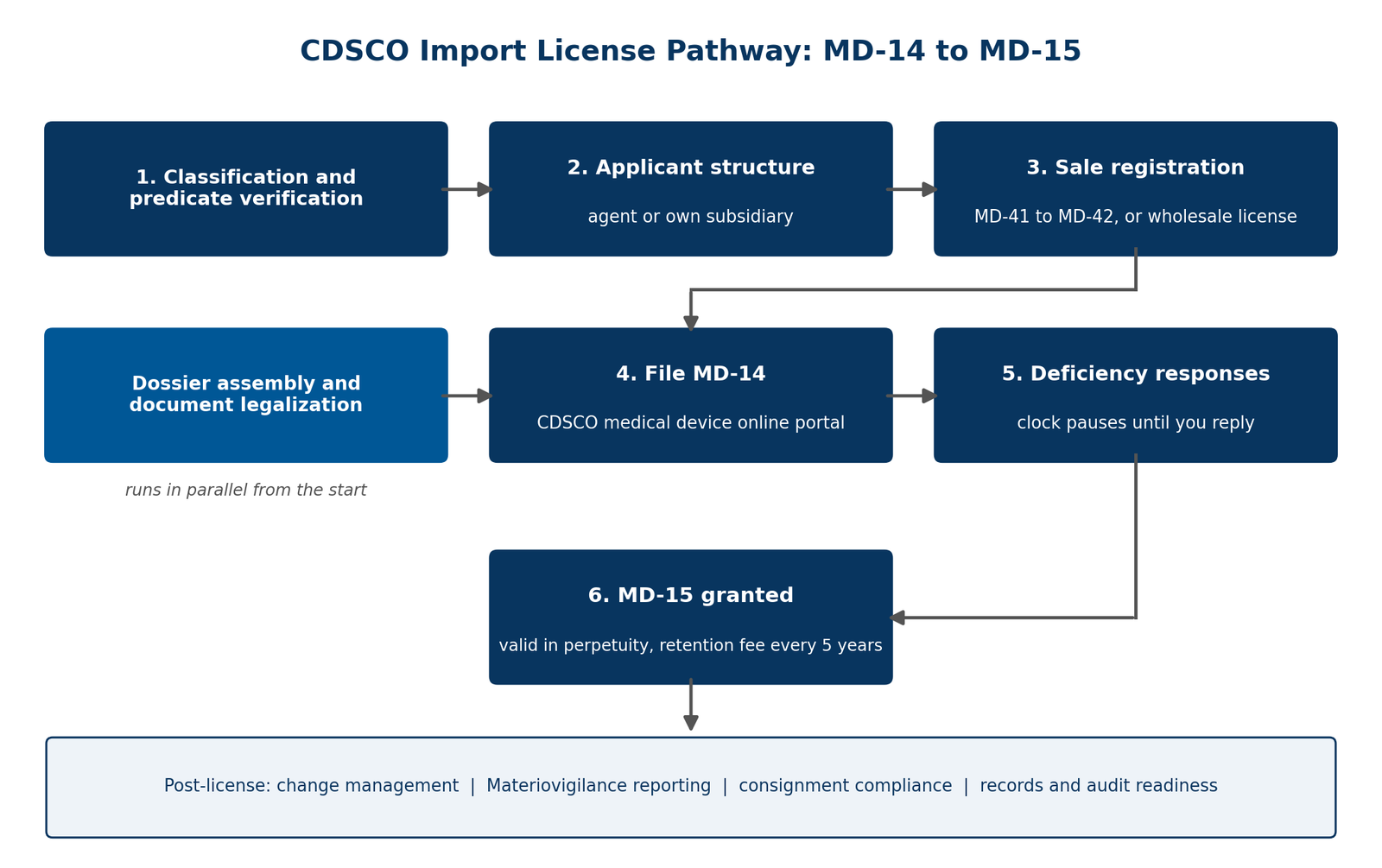
The correct sequence is: settle classification, establish or appoint the Indian applicant, secure the MD-42 or an existing qualifying license, assemble the MD-14 dossier in parallel, file MD-14, respond to queries, receive MD-15. Applicants who prepare a complete MD-14 dossier first and only then learn about the MD-42 prerequisite typically lose one to three months waiting on a state registration they could have applied for on day one.
MD-41 and MD-42: the sale and distribution registration
Form MD-41 is the application, and Form MD-42 is the registration certificate, for sale, stock, exhibit, or offer for sale, or distribution of medical devices, introduced under rule 87A by the Medical Devices (Fifth Amendment) Rules, 2022 [3]. It is granted by the State Licensing Authority of the state where the applicant operates, and it remains valid in perpetuity subject to its own retention fee before completion of each five-year period [3]. An applicant that already holds a wholesale license or a manufacturing license for sale or distribution under these rules can rely on that instead; the MD-41/MD-42 route serves applicants without one [5].
An authorized agent will usually hold one of these already; verify that it is current rather than assuming it. A newly incorporated subsidiary must obtain it, which means the subsidiary needs premises, the applicable competent technical staff requirement satisfied, and the state application processed, all before the central import application can move.
Practical points:
- The registration is state-specific to the applicant's place of business. Plan it around where your Indian entity or agent operates.
- Requirements and processing speed vary by state. Build a realistic state-level timeline into the project plan.
- Keep the MD-42 certificate details exactly consistent with the applicant details you will enter in the MD-14. Mismatched names, addresses, or entity details between the two are a common source of queries.
MD-14 application: documents required
With the MD-42 in hand, the import license application is filed in Form MD-14 through the CDSCO medical device online portal. The application is made per manufacturing site and covers the devices manufactured at that site that you intend to import.
The dossier centers on the following, matching CDSCO's published checklist for the MD-15 grant [5]:
Corporate and authority documents. Power of attorney from the foreign manufacturer to the Indian applicant, executed in the format prescribed in the Fourth Schedule and authenticated by a First Class Magistrate in India, the Indian Embassy in the country of origin, or apostille. Constitution documents of the applicant. The applicant's MD-42 registration certificate, wholesale license, or manufacturing license.
Quality system evidence. ISO 13485 certification for the manufacturing site, and the quality system documentation supporting it. CDSCO expects the quality management system to be demonstrably in place at the site whose devices are being imported.
Free Sale Certificate. From the national regulatory authority of the country of origin, duly notarized, showing the device is approved and marketed there. An EU certificate is acceptable for this purpose.
Device Master File and Plant Master File. The DMF describes the device: design, specifications, intended use, materials, manufacturing process, verification and validation, risk management, clinical evidence, labeling. The PMF describes the manufacturing site: facilities, equipment, quality systems, personnel. Both follow the structures prescribed under MDR 2017 and its guidance. These two documents carry most of the technical review, and their quality determines how many query cycles you face.
Regulatory approvals and clinical evidence. Approvals held in other jurisdictions, and the clinical evaluation supporting safety and performance. For a predicate-backed device this is your existing clinical evaluation evidence. For software-driven and AI-based devices, CDSCO finalized a dedicated guidance document on medical device software in July 2026 (Doc No. CDSCO/MD/GD/MDSW/01/2026) [6], and the dossier expectations for such devices now include software-specific documentation; we have covered this in our CDSCO medical device software guidance analysis.
Labels and IFU. Device labels compliant with Chapter VI of MDR 2017 and the Legal Metrology requirements, and instructions for use.
Two habits prevent most deficiency letters: internal consistency, meaning every name, address, model number, and specification matches across every document in the dossier, and completeness against the current published checklist.
Working through this document set? Download our one-page CDSCO Import License Document Checklist and tick items off as you compile the dossier.
Download the checklist (PDF)CDSCO import license fees
Fees are set in the Second Schedule of MDR 2017 [1] and are payable in US dollars (or equivalent) for import applications, structured as a fee per manufacturing site plus a fee per distinct medical device:
| Class | Per manufacturing site | Per distinct device |
|---|---|---|
| A (non-sterile, non-measuring) | Registration route, no license fee of this type | Not applicable |
| A | USD 1,000 | USD 50 |
| B | USD 2,000 | USD 1,000 |
| C | USD 3,000 | USD 1,500 |
| D | USD 3,000 | USD 1,500 |
As a worked example, importing two Class C devices manufactured at one European site involves a government fee of USD 3,000 for the site plus USD 1,500 for each device, USD 6,000 in total, in addition to professional fees and any testing costs. Fees for market permission applications (the no-predicate route) and clinical investigation applications are separate and additional.
Verify the current schedule at the time of filing. Fee schedules change by amendment, and an incorrect fee delays the application.
CDSCO import license timeline
Separate two numbers when planning.
The first is the statutory review window. Under MDR 2017, the Central Licensing Authority is to grant the MD-15 or reject the application, with reasons recorded, within nine months from the date of application [4]. In practice, grants for complete, predicate-backed files commonly come through in six to nine months, and deficiency cycles extend this: the clock effectively pauses on each query until you respond.
The second is the end-to-end project timeline, which includes everything before filing. For a manufacturer starting from zero Indian presence, nine to fifteen months from project start to MD-15 grant is a realistic planning figure for a predicate-backed device, with the subsidiary route at the longer end and a well-established agent route at the shorter end.
| Phase | Indicative duration |
|---|---|
| Classification confirmation and predicate verification | 2 to 4 weeks |
| Subsidiary incorporation, if that route is chosen | 4 to 8 weeks |
| MD-41 to MD-42 state registration | 4 to 12 weeks, varies by state |
| Dossier assembly and document legalization | 6 to 10 weeks, runs in parallel with the above |
| MD-14 review to MD-15 grant | Up to 9 months statutory; commonly 6 to 9 months for complete files |
These figures assume a predicate-backed device and complete documentation. If the device has no predicate, market permission and possibly a clinical investigation precede the import license, and the realistic planning horizon is measured in years. Read our no-predicate pathway tutorial before committing dates to your board.
Demonstration and evaluation units: the MD-16/MD-17 test license
Commercial import waits for the MD-15, but importers usually need units in India well before that, for distributor demonstrations, evaluation by prospective buyers, training, or testing. MDR 2017 provides a separate test license for this: the application is made in Form MD-16 and the license is granted in Form MD-17, covering import for the purposes of clinical investigations, test, evaluation, demonstration, or training [1]. It is valid for three years and does not permit commercial sale. Test license applications are currently routed through the NSWS portal, while all other medical device applications go through the CDSCO medical device online portal [6].
IVD import runs on the same forms
In vitro diagnostic medical devices also take the MD-14 to MD-15 route for import, with documentation drawn from the IVD-specific parts of the Fourth Schedule, including performance evaluation requirements. The strategic decisions in this article apply unchanged to IVDs; the dossier contents differ.
MD-15 license validity and post-license obligations
The MD-15 import license, once granted, remains valid in perpetuity, subject to payment of the license retention fee every five years and subject to the license not being suspended or cancelled [1]. Many websites state that the license is valid for five years and must be renewed. That is not the current position under MDR 2017. For the compliance calendar, this means diarizing a retention fee payment every five years, with no renewal application in the ordinary course. Missing the retention fee puts the license at risk.
Ongoing obligations attach to the license:
- Change management. Changes to the device, the manufacturing site, labeling, or the constitution of the applicant require notification to or prior approval from the licensing authority, depending on the nature of the change. Importing a changed device under an unchanged license is a compliance breach.
- Post-market surveillance and vigilance. Adverse events must be reported under the Materiovigilance Programme of India within the prescribed timelines, and, for newly approved devices, periodic safety update reports are required for the initial years as prescribed.
- Import conduct. Each consignment must correspond to the licensed devices and sites; customs clearance runs against the license.
- Record keeping and audit readiness. The applicant must maintain distribution records and be prepared for inspection.
Common mistakes that cost months
Across import projects, the same handful of errors account for most delay:
- Filing sequence ignored. Preparing MD-14 before securing MD-42, then waiting on a state registration that could have run in parallel from the start.
- Classification assumed without confirmation. A device treated as Class B that reviews as Class C changes the fee, the scrutiny, and sometimes the evidence expectations mid-application.
- CE mark overread. Assuming EU approval waives Indian clinical requirements. It supports the Free Sale Certificate; it is not on the rule 63 list as the rules currently stand.
- Predicate never verified. Discovering during review that no Indian predicate exists, which converts a months-long import project into a multi-year new-device project.
- Inconsistent dossiers. Different device names, model numbers, or site addresses across the DMF, PMF, FSC, and application form, each mismatch generating a query cycle.
- Legalization underestimated. Apostille and attestation of powers of attorney and certificates from the country of origin can take weeks; left to the end, they become the critical path.
- License holder chosen by default. Handing the license to the first distributor who offered, without any contractual mechanism for transfer.
- Post-grant obligations unowned. No one assigned to vigilance reporting, change notifications, or the retention fee, discovered only when a change or an inspection forces the question.
Frequently asked questions
Is an authorized Indian agent mandatory, or can our own Indian subsidiary apply?
An external agent is not the only route. An Indian subsidiary may act as the applicant, subject to holding a wholesale license, a manufacturing license, or the MD-42 registration certificate.
Can one MD-14 cover several devices?
The application is structured per manufacturing site, with the distinct devices of that site listed and fee paid per device. Devices from different manufacturing sites need separate applications.
Another importer already holds an MD-15 for this device. Can we import it too?
Yes, as a subsequent importer with your own license. The second importer files its own MD-14 and pays the manufacturing site and device fees again; the earlier importer's license does not cover you.
Our device is CE marked. Do we need Indian clinical data?
If a predicate exists in India, the pathway generally proceeds on your existing evidence. If there is no predicate, the new-device route applies, and a CE mark alone does not currently satisfy the rule 63 waiver conditions; approval and two years of marketing in the UK, US, Australia, Canada, or Japan is the operative test, with an amendment adding the EU proposed but not yet notified.
Which portal is used?
Import license applications are filed through the CDSCO medical device online portal. Test license applications in Form MD-16 are currently routed through the NSWS portal.
How long does CDSCO take to grant the import license?
The rules provide for grant or rejection, with reasons recorded, within nine months of the application. Complete, predicate-backed files commonly come through in six to nine months, extending with each deficiency cycle.
How long does the import license last?
In perpetuity, subject to the retention fee every five years and to the license not being suspended or cancelled.
What does the government fee come to for a Class C device?
USD 3,000 per manufacturing site plus USD 1,500 per distinct device, per the Second Schedule as it currently stands.
We plan to manufacture in India eventually. Should we still get an import license first?
Often yes. An import-first, localize-later strategy lets revenue start while the manufacturing project runs. Plan both phases from the start, including the licensing route for the future Indian site.
Can the import license be transferred from our agent to our own subsidiary later?
There is no transfer mechanism. The new applicant files a fresh MD-14 with the power of attorney, Free Sale Certificate, fees, its own registration or license, a copy of the earlier license, and a manufacturer undertaking that the DMF and PMF are unchanged. The move goes far smoother when the original agency agreement and document ownership anticipated it.
What happens if CDSCO raises queries?
The authority issues deficiency communications, and the clock effectively pauses until you respond adequately. The number of query cycles is largely a function of dossier quality and internal consistency.
Do spare parts and accessories need their own listing?
Accessories and components intended for use with a medical device fall within the regulatory net and need to be addressed in the application. Scope this at classification stage rather than at customs.
How we approach import projects at EvySaif
EvySaif Research and Medical Affairs Solutions works with foreign manufacturers and their Indian partners on the strategy first. On an India market entry engagement, our sequence is: classify the device and verify the predicate position, assess what your existing approvals support under the rules as they currently stand, and structure the applicant entity question with your commercial plan in view. We then build the MD-41/MD-42 and MD-14 applications with the dossier consistency that keeps query cycles short, and stay engaged through deficiency responses to grant and into post-license compliance.
If you are planning to bring a medical device into India, start with a pathway assessment before preparing any application. Talk to our regulatory strategy team, or read more about our regulatory strategy consulting and regulatory affairs services.
References
- Medical Devices Rules, 2017 (as amended), Ministry of Health and Family Welfare, Government of India.
- Ministry of Health and Family Welfare, Notification S.O. 648(E), 11 February 2020, specifying all medical devices as drugs with effect from 1 April 2020. Press Information Bureau summary.
- Medical Devices (Fifth Amendment) Rules, 2022, G.S.R. 754(E), 30 September 2022, inserting rule 87A and Forms MD-41 and MD-42.
- Central Drugs Standard Control Organisation, Frequently Asked Questions on Medical Devices Rules, 2017.
- Central Drugs Standard Control Organisation, Checklist for the grant of Import Licence in Form MD-15 for Medical Devices under Medical Devices Rules, 2017.
- Central Drugs Standard Control Organisation, Guidance Document on Medical Device Software, Doc No. CDSCO/MD/GD/MDSW/01/2026, 21 July 2026.
- Draft Medical Devices (Amendment) Rules, 2026, G.S.R. 270(E), 10 April 2026, proposing the insertion of European Union countries in the proviso to rule 63(1). Not notified as final at the time of publication.
This article reflects the regulatory position as of 23 August 2026, including the Medical Devices Rules, 2017 as amended, CDSCO's 2026 Medical Device Software guidance, and the status of the draft rule 63 amendment (G.S.R. 270(E)), which had not been notified as final at the time of writing. Regulatory requirements evolve; verify current requirements for your specific device before acting.