
The same herbal formulation can hold three different legal identities in India: an Ayurveda, Siddha, or Unani (ASU) medicine licensed by a State Licensing Authority, a phytopharmaceutical drug approved by CDSCO as a new drug, or a health supplement or nutraceutical regulated by FSSAI as a food. Which identity applies is determined by what is in the product, how it is made, and what the label claims. It decides the evidence you must generate, the authority you answer to, the cost, and the timeline.
This is why we do not start with a clinical trial. The first question is classification. A classical formulation with a textual indication can be licensed without any trial, while a purified fraction needs a full new drug program, and sponsors often budget for one when their product needs the other.
In this guide
The three regulatory routes
| ASU medicine | Phytopharmaceutical drug | FSSAI health supplement or nutraceutical | |
|---|---|---|---|
| Legal basis | Drugs and Cosmetics Act, 1940, section 3(a) or 3(h), with Part XVI of the Drugs and Cosmetics Rules, 1945 [1] | Rule 2(eb) of the Drugs and Cosmetics Rules, regulated as a new drug through CDSCO [2] | Food Safety and Standards Act and the FSSAI nutraceutical regulations [3] |
| What it is | A medicine made from ingredients described in the authoritative books of the ASU systems listed in the First Schedule | A purified and standardized fraction of a medicinal plant extract with a defined minimum of four bioactive or phytochemical compounds, assessed qualitatively and quantitatively [2] | A food format product using permitted nutrients, botanicals, extracts, or isolates within the FSSAI schedules |
| Claims allowed | Disease diagnosis, treatment, mitigation, or prevention, within the licensed indication | Disease claims, as an approved drug | No claims of cure, prevention, or mitigation of a specific disease; nutrition and wellness positioning only [3] |
| Licensing authority | State or UT Licensing Authority for manufacture | CDSCO (Central Licensing Authority) | FSSAI |
| Evidence burden | Citation in authoritative texts for classical products; proof of effectiveness under Rule 158B for patent or proprietary products [1] | New drug package per Appendix I-B of Schedule Y: quality, safety, pharmacology, and clinical trials [2] | Compliance with schedules of permitted ingredients and limits; no efficacy trials required |
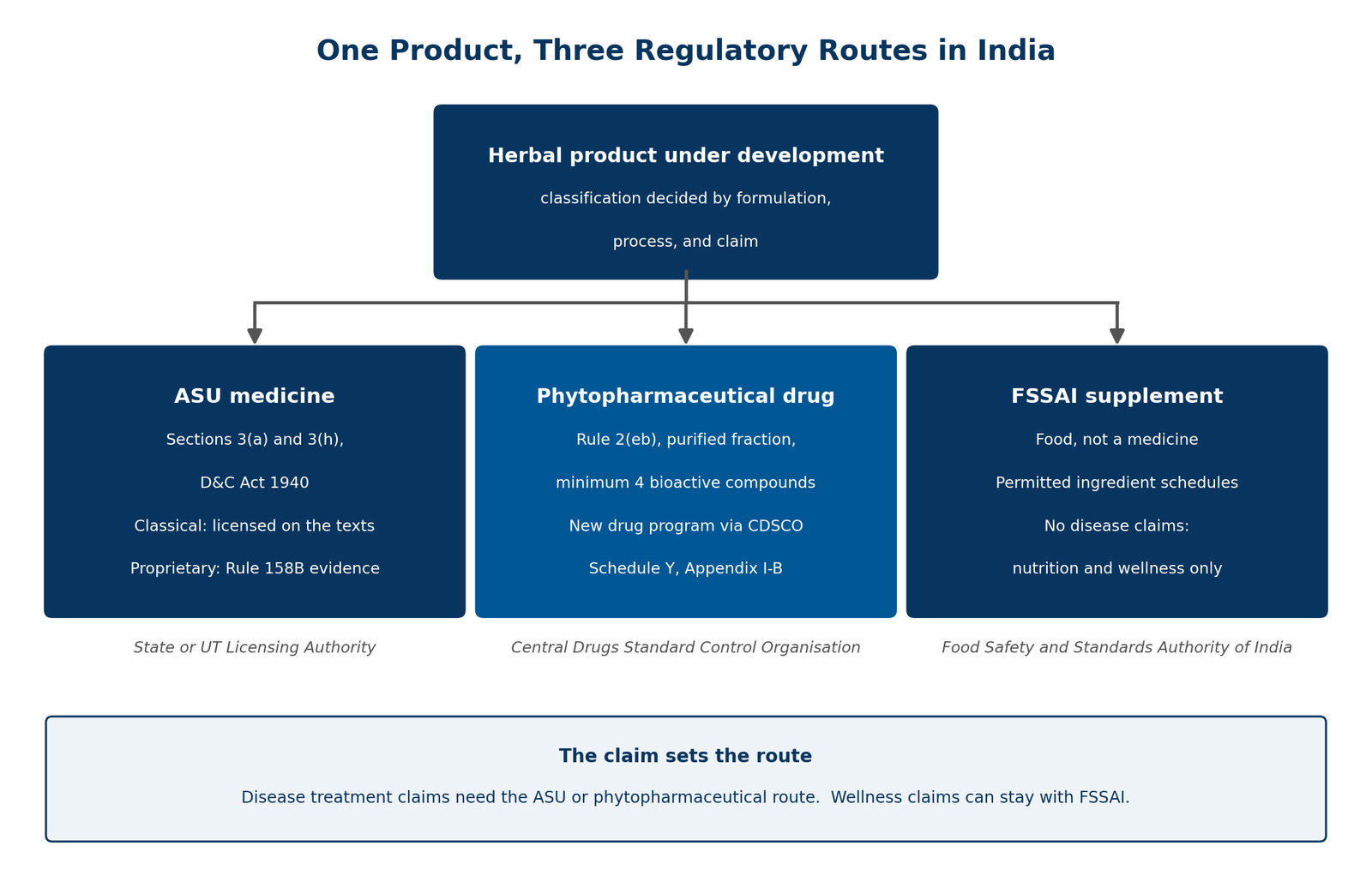
A product marketed as a supplement while claiming to treat a disease is outside what the FSSAI framework permits, which expressly excludes products claiming cure, prevention, or mitigation of a specific disease [3]. A concentrated extract that meets the purified-fraction definition may no longer qualify as an ASU medicine at all.
The five factors that decide classification
Classification is determined by what is in the product and how it is made, not by how it is described or marketed. We assess five factors, each answered from a document the sponsor already holds:
| What we check | Answered from |
|---|---|
| Is every ingredient, including any excipient carrying activity, named in the classical texts of the First Schedule? | Master formula record |
| Is the formulation itself a text formulation, or a new combination of text ingredients? | Master formula record, compared against the text |
| Is the preparation method one the texts describe, or a modern extraction process? | Batch manufacturing record |
| Has any constituent been concentrated beyond what the classical process yields? | Extract ratio and marker specification |
| How many bioactive compounds are defined and quantified in the specification? | Certificate of analysis and product specification |
A formulation manufactured exclusively in accordance with the authoritative texts is a classical ASU medicine under section 3(a). A formulation using only text ingredients but with innovation in combination, process, or dosage form is a patent or proprietary ASU medicine under section 3(h) [1]. The rules also recognize defined extract categories within the ASU framework, including aqueous and hydroalcoholic plant extracts from First Schedule plants [1]. Once the product is a purified and standardized fraction with four or more defined bioactive compounds, it meets the phytopharmaceutical definition and falls to CDSCO with a new drug evidence package [2]. The fifth factor exists because sponsors sometimes cross this line without intending to: a specification strengthened for commercial reasons can reclassify the product.
Final classification is confirmed by the licensing authority rather than by the sponsor. The assessment output is a defensible written position with the evidence behind it; where the answer is genuinely ambiguous, the right step is a written pre-submission query to the authority rather than a guess.
Running this check on your own product? Download the one-page AYUSH Classification Self-Check with the five factors and a result key.
Download the self-check (PDF)The ASU route: Rule 158B evidence requirements
For ASU medicines, the evidence requirement is graduated, and this is where sponsors most often over-plan or under-plan.
| Product situation | Safety study | Evidence of effectiveness |
|---|---|---|
| Classical formulation, textual indication | Not required | Citation in the authoritative texts suffices [1] |
| Classical formulation, new indication | Not required | Proof of effectiveness required [1] |
| Patent or proprietary medicine | Not required unless Schedule E(1) ingredients are used | Textual rationale and published literature; a pilot study only where these do not support the intended indication [1] |
| Any product containing Schedule E(1) ingredients | Required | Required [1] |
In practice, a classical product with a textual indication needs no trial for licensing. For a patent or proprietary product, the pilot study under Rule 158B is conditional: it is required when textual rationale and published literature do not support the indication [1]. Establishing what the texts and literature already cover therefore comes before any study design, because it decides whether a study is needed at all.
Manufacture of ASU medicines is licensed by the State or UT Licensing Authority, with application in Form 24-D and the license granted in Form 25-D (loan license variants exist), subject to Schedule T good manufacturing practices [1].
The phytopharmaceutical route: a new drug with a botanical origin
A phytopharmaceutical drug is defined in Rule 2(eb) as a purified and standardized fraction with a defined minimum of four bioactive or phytochemical compounds, qualitatively and quantitatively assessed, of an extract of a medicinal plant or its part, for internal or external use, excluding parenteral administration [2]. CDSCO's own guidance is explicit that the minimum-four-compounds condition is non-negotiable [2].
A phytopharmaceutical that has not been used in India to a significant extent is a new drug, and the development program is a new drug program: the data requirements in Appendix I-B of Schedule Y cover quality and manufacturing of the purified fraction, safety and pharmacological information, and human studies through confirmatory clinical trials [2]. The Indian Pharmacopoeia Commission has published development guidance for this class, including characterization expectations for the four marker compounds in both the fraction and the source extract [4].
The conventional drug route that a phytopharmaceutical enters at that point is described in our drug registration in India guide.
This route is worth its cost when the commercial plan needs what only drug status provides: disease claims with prescription positioning, defensible differentiation built on a proprietary standardized fraction, or acceptance in markets and channels closed to supplements. It is the most expensive of the three identities, and the choice should be made with the full evidence cost known.
The FSSAI route: claim limits
If the product's claims stay within nutrition and wellness support, the FSSAI health supplement and nutraceutical framework is the fastest and cheapest route to market. Its formulation boundaries are set by schedules of permitted ingredients, and its limit is the claim: the framework expressly excludes drugs and products claiming cure, prevention, or mitigation of a specific disease [3]. Sponsors who want disease language on the pack or in promotion are choosing between the ASU and phytopharmaceutical routes.
The development sequence
Once classification is settled, the program follows a fixed order.
1. Product assessment. Ingredients, formulation, process, extract ratios, specification, proposed claim wording, and the evidence already held. Output: the classification position and the regulatory strategy, with a written recommendation on whether and how to proceed.
2. Regulatory pathway confirmation. The route determines the document set: formulation and quality dossiers, GMP status, applicable safety data, and whether clinical evidence is required at all. Not every product requires every item, and the exact list is confirmed after classification.
3. Product and safety readiness. Before any product is given to participants: specifications, batch consistency, stability, GMP standing, and whatever safety package the pathway requires. A classical formulation with clean quality data may need almost nothing at this stage; a proprietary formulation containing Schedule E(1) ingredients needs a full safety program. This is settled before anything is commissioned.
4. Clinical study, where one is required. Protocol, ethics committee approval, CTRI registration completed before the first participant is enrolled, regulatory permission where the pathway requires it, GCP-compliant conduct under the ASU good clinical practice guidelines where applicable [5], safety monitoring, and a clinical study report. Our teams build these as regulatory documents from the start, because a study run to publication standards alone can support a paper and still fail the licensing dossier. See our work on clinical trial protocols and clinical study reports.
5. License or approval. The evidence goes into the applicable submission: the state licensing dossier on the ASU route, or the CDSCO dossier on the phytopharmaceutical route, with the same study also supporting publication and commercial positioning.
Four checks run in parallel across the whole program rather than as a stage: access and benefit-sharing obligations under the Biological Diversity Act for Indian bio-resources [6], intellectual property strategy, approvals connected to any foreign collaboration or foreign funding, and GMP standing. Each is raised at the point it becomes relevant, so none of them surfaces late enough to hold the program up.
Common mistakes that cost programs
- Starting with the trial. Commissioning a study before classification, then discovering the pathway did not require it, or required a different design.
- Classifying by marketing intent. The label "Ayurvedic" does not make a purified fraction an ASU medicine, and the label "supplement" does not survive a disease claim.
- Standardizing across the line. Enriching an extract and quantifying four markers to strengthen the specification, and thereby meeting the phytopharmaceutical definition without intending to.
- Ignoring the conditional pilot study. Budgeting a Rule 158B pilot without first establishing whether textual rationale and published literature already support the indication.
- Disease claims on a food. Promotion that drifts from wellness support into treatment language, which the FSSAI framework expressly excludes.
- Biodiversity compliance discovered late. Access and benefit-sharing addressed at submission time instead of sourcing time.
- Studies run to the wrong standard. Ethics approval or CTRI registration treated as optional, or a report written for a journal rather than a licensing authority.
Frequently asked questions
Does every AYUSH product need a clinical trial?
No. A classical formulation with a textual indication is licensed on citation in the authoritative texts. A patent or proprietary ASU medicine needs a pilot study only where textual rationale and published literature do not support the indication. Phytopharmaceuticals, by contrast, follow a full new drug clinical program.
Who licenses an ASU medicine?
The State or UT Licensing Authority of the manufacturing state, with application in Form 24-D and the license in Form 25-D, subject to Schedule T GMP.
What makes a product a phytopharmaceutical rather than an ASU extract?
The definition: a purified and standardized fraction with a minimum of four defined bioactive or phytochemical compounds, quantitatively assessed. Aqueous and hydroalcoholic extracts of First Schedule plants can remain within the ASU framework; purified fractions meeting the definition cannot.
Can we sell the product as a supplement first and upgrade later?
Often, yes, and it can be a sound two-phase strategy, provided the supplement phase stays strictly within FSSAI claim limits and the later program is planned from the start rather than improvised.
Is CTRI registration mandatory for AYUSH studies?
Yes, before the first participant is enrolled, alongside ethics committee approval. Whether central regulatory permission is also needed depends on the pathway, and establishing that is part of the classification work.
Do imported herbal products follow these routes?
The classification logic is the same, with import licensing mechanics layered on top. For the CDSCO side of import licensing generally, see our CDSCO India market page.
What is Schedule E(1) and why does it matter?
The list of poisonous substances under the ASU systems. Any of these in the formulation triggers safety study requirements that otherwise do not apply.
Does the Biological Diversity Act apply to us?
If the program uses Indian bio-resources, access and benefit-sharing obligations can apply, and they are far easier to settle at sourcing stage than at submission stage.
Questions to answer before commissioning any study
These determine the scope and cost of the entire program: What exactly is the product, a classical formulation, a proprietary formulation, an extract, or a purified fraction? What indication is targeted, in what exact claim wording? What quality, stability, and safety data already exist? And does the program involve patents, foreign collaboration, or foreign funding? With these four answered, it is possible to state whether a trial is required, which route applies, and what the program will cost.
How EvySaif runs AYUSH programs
EvySaif Research and Medical Affairs Solutions runs AYUSH development in this order: classification first, from the documents the sponsor already holds, then the pathway, then only the evidence the pathway requires. Where a study is needed, we design and document it to licensing standards, from protocol through clinical study report to the submission dossier, with the parallel checks handled at the point they become relevant. The output of the first stage is a written classification position and a program scoped to it, at which point some sponsors learn the required program is smaller than they expected.
If you are developing an AYUSH product and the classification question is open, settle it before commissioning anything. Talk to our regulatory strategy team, or read about our regulatory strategy consulting.
References
- Drugs and Cosmetics Act, 1940, sections 3(a) and 3(h), and the Drugs and Cosmetics Rules, 1945, Part XVI (rules 151 to 160, including Rule 158B, Forms 24-D and 25-D, Schedule E(1), and Schedule T).
- Rule 2(eb), Drugs and Cosmetics Rules, 1945, inserted by G.S.R. 918(E), 30 November 2015 (phytopharmaceutical drug definition), with Appendix I-B of Schedule Y; Central Drugs Standard Control Organisation, FAQ on Phytopharmaceutical Drugs.
- Food Safety and Standards Act, 2006, and the FSSAI regulations governing health supplements, nutraceuticals, and related categories, which exclude drugs and products claiming cure, prevention, or mitigation of a specific disease.
- Indian Pharmacopoeia Commission, Phytopharmaceutical Drugs: General Guidance for Development.
- Ministry of AYUSH, Good Clinical Practice Guidelines for Clinical Trials of ASU Medicines.
- Biological Diversity Act, 2002, as amended, and its rules on access and benefit sharing.
This article reflects the regulatory position as of 23 August 2026, including the Drugs and Cosmetics Rules, 1945 as amended and the FSSAI framework as it stands. Regulatory requirements evolve; verify current requirements for your specific product before acting.